



Use Wozber and land your dream job
Create CV
No registration required
Orchestrating events, but your CV feels out of sync? Check out this Program Coordinator CV example, built with Wozber free CV builder. Learn how to align your organizational skills with job specifications, ensuring your career always takes centre stage!
Program coordination work sits at the intersection of planning, follow-through, and communication. Hiring teams want to see whether you can keep moving parts aligned across timelines, stakeholders, budgets, and reporting without losing track of details. Your CV should make that operating style visible, not just mention that you are organised.
For Program Coordinator roles, early screening often comes down to whether your CV clearly connects coordination work to concrete program outcomes, from schedule execution to stakeholder updates and budget oversight. Wozber's free CV builder helps shape that experience into an ATS-friendly CV format that matches the language of the posting, so the hiring team can quickly recognize your ability to run programs smoothly and keep people informed.
This section is brief, but it still carries practical weight. For a Program Coordinator, clean contact details reinforce the same traits the role depends on every day: accuracy, professionalism, and clear communication.
Use your full name exactly as you present yourself professionally and make it easy to spot at the top of the page. Keep the styling simple and polished. Program Coordinator roles often involve document handling, reporting, and stakeholder-facing communication, so visual clutter here sends the wrong signal.
Place "Program Coordinator" directly beneath your name so your positioning is immediate. If your recent background is adjacent, such as Program Assistant or Project Coordinator, you can still use the target title when it honestly reflects the role you are pursuing and the experience you are emphasizing.
List a reliable phone number and a professional email address, ideally in a straightforward format such as firstname.lastname@email.com. Double-check for typos. If a hiring manager wants to schedule an interview after reviewing your experience with timelines, stakeholder updates, or budget tracking, you do not want a small contact mistake to slow that down.
Some Program Coordinator openings include a location filter early in the review process. Here, the employer asks for candidates located in San Francisco, CA, so showing "San Francisco, California" in your personal details immediately addresses that requirement. Use this approach whenever location is explicitly stated, rather than assuming every coordinator role needs it.
If you include LinkedIn or a personal website, make sure it supports the same story as your CV. For program coordination, that means visible consistency in titles, dates, and scope of work, especially around scheduling, cross-functional support, events, reporting, or operations. A profile link should deepen credibility, not introduce mismatched details.
A precise contact section shows the same care you would bring to calendars, documentation, and stakeholder communication. Keep it easy to read and aligned with the practical requirements of the role.




This is the section where Program Coordinator candidates separate themselves. Employers are looking for more than administrative support. They want to see how you kept initiatives on track, coordinated contributors, managed reporting, and handled the operational details that keep programs moving.
Start by marking the responsibilities that define success in the role. In this description, the recurring themes are program planning and execution, cross-functional coordination, budget oversight, stakeholder reporting, and communication around risks or changes. Those themes should shape which achievements you include and how you phrase them.
Use reverse chronological order and give the most space to roles where you managed timelines, supported deliverables, scheduled work, tracked resources, or coordinated teams. Even if an earlier title was "Program Assistant," keep the bullets focused on the coordination work you handled, such as documentation, meeting cadence, event logistics, or participant feedback loops.
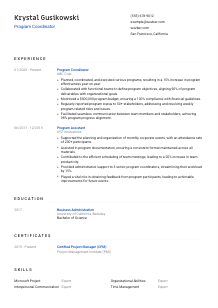
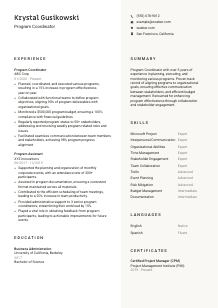
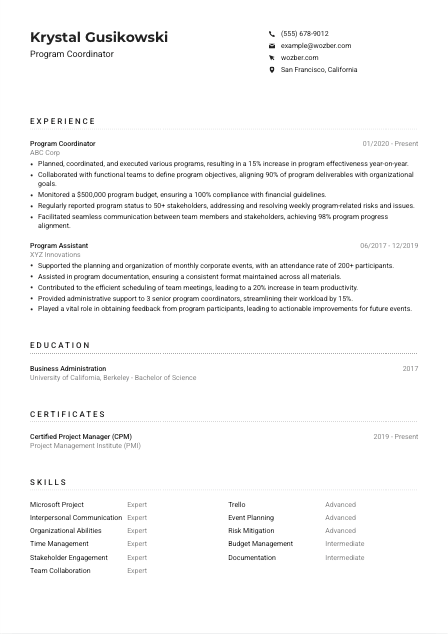
Generic statements like "responsible for coordinating programs" do not say enough. Write bullets that show what moved because of your work. The example CV does this well with lines such as increasing program effectiveness by 15% and aligning 90% of deliverables with organizational goals. That is the kind of wording that shows both ownership and result.
Program coordination is measured through progress, participation, compliance, budget control, and reporting quality. Add metrics that match those realities: budget size, number of stakeholders updated, program volume, attendance, turnaround time, issue resolution cadence, or percentage improvements. A bullet mentioning oversight of a $500,000 budget or weekly reporting to 50+ stakeholders immediately gives your scope context.
Trim anything that does not help prove you can coordinate programs effectively. If a bullet does not connect to planning, communication, documentation, scheduling, resource allocation, risk tracking, or stakeholder management, rewrite it or remove it. The section should read like evidence of day-to-day program execution, not a mixed list of unrelated accomplishments.
Your experience should show how you handled coordination in practice, from keeping timelines moving to reporting issues before they became problems. When that operational picture is clear, the hiring team can place you in the role much faster.
Education matters here because the posting asks for a bachelor's degree in a related field. Keep the section straightforward, then use details selectively when they strengthen your relevance to coordination, operations, or business support work.
When a posting asks for a bachelor's degree, include it clearly with the degree type, field, school, and graduation year. If your major relates to business, communications, public administration, operations, or another coordination-linked field, that connection is worth making visible right away.
List your education in a simple structure that is easy to scan. Degree, field of study, institution, and date are usually enough. Program Coordinator hiring rarely depends on elaborate academic descriptions unless you are early in your career and need coursework to support your experience.
If your degree lines up naturally with program work, let that relevance come through without overexplaining it. A Bachelor of Science in Business Administration, like the example CV shows, supports the operational and organizational side of coordination. Use the same logic if your background is in nonprofit management, communications, education, or a related discipline.
Relevant coursework can help if you are a newer candidate or shifting into program coordination from another path. Prioritise subjects that connect to scheduling, project management, budgeting, communication, operations, or event planning. Skip long course lists that do not add hiring value.
Academic honors, leadership roles, or notable projects belong here when they support the qualities this work depends on, such as organisation, initiative, communication, or managing group deliverables. Keep the focus on signals that translate into program execution rather than general academic praise.
For most Program Coordinator candidates, education confirms the required foundation and then steps back while experience does the heavier lifting. Present it clearly, and add detail only when it sharpens your relevance.
Certifications are rarely the main deciding factor for Program Coordinator roles, but the right one can strengthen your case, especially when it supports planning, scheduling, process control, or project delivery.
If the job description does not require a certification, include only the ones that genuinely reinforce your program coordination profile. A project or program management credential makes sense because it connects directly to timelines, deliverables, stakeholder communication, and execution discipline.
Choose certifications that support the actual work of the role, such as project management, scheduling, operations, agile workflows, event management, or nonprofit program administration. The example's Certified Project Manager credential works because it strengthens the candidate's case for handling structured program work and cross-team coordination.
Include the certification date, and if relevant, indicate that it is active or maintained. That matters most when the credential reflects current working knowledge in tools, project practices, or reporting standards that affect how programs are run.
As your responsibilities expand into larger budgets, broader stakeholder groups, or more formal project workflows, this section should evolve too. Add certifications that reflect where your coordination work is heading, not just what you completed years ago.
A well-chosen certification helps underline that you understand structured delivery, not just administrative support. Keep this section selective and tied to the real demands of program coordination.
A Program Coordinator skills section should read like the toolkit behind your daily execution. That means a mix of software, coordination skills, and communication strengths that directly support planning, reporting, stakeholder updates, and keeping work on schedule.
Start with the terms used in the posting, especially the ones tied to actual execution. Here that includes project management software, written and verbal communication, organisation, multitasking, and detail orientation. Named tools such as Microsoft Project or Trello should appear if you have used them in real program work.
List strengths that are both relevant and supported by your work history. If you claim Microsoft Project, budget management, stakeholder engagement, or risk mitigation, your experience bullets should show where and how you used them. The example CV works because skills like Trello, communication, and budget management are reinforced by achievements tied to deliverables, reporting, and financial oversight.
Do not overload this section with every transferable skill you have ever used. Pick the capabilities most central to program coordination, such as scheduling, documentation, cross-functional collaboration, meeting coordination, resource tracking, stakeholder communication, and project software. A shorter, targeted list is more useful for both ATS optimisation and human review.
Your skills list should support the picture already established in your experience section. When the tools and strengths line up with the work you describe, your CV reads as credible and well matched to the role.
Language ability matters more in Program Coordinator CVs when the role involves frequent updates, documentation, participant communication, or work across diverse teams. Even when only one language is required, list it clearly if it appears in the posting.
If the employer specifies English proficiency, place English first and state your level clearly. This posting asks for high proficiency in English, so that belongs near the top of the section and should align with the communication quality shown throughout the CV.
Extra languages can strengthen your profile when the work involves community-facing programs, multilingual participants, or coordination across broader teams. Spanish, for example, may be especially useful in some program environments, but it should be presented as an added asset rather than assumed to be required everywhere.
Choose standard labels such as Native, Fluent, Advanced, Intermediate, or Basic. Avoid vague wording. Hiring teams need a practical sense of how confidently you can write updates, speak with stakeholders, or support participants in each language.
Additional languages are most persuasive when they support the actual communication demands of the role. If you have used another language in event support, participant outreach, team coordination, or written materials, that makes the skill more meaningful than a bare label alone.
If you are actively studying a language and it relates to the environments you work in, you can include that thoughtfully. Keep it brief. For Program Coordinator roles, practical communication ability matters more than broad statements about personal growth.
For a coordination role, languages matter when they improve communication with teams, stakeholders, or program participants. List them honestly and in a way that reflects how you would use them on the job.
The summary should give a hiring manager a fast, concrete read on your level, your coordination scope, and the kinds of results you have helped deliver. For Program Coordinator roles, that usually means a blend of execution, communication, and operational control.
Before writing the summary, identify the few themes that define the job. Here, those are coordinating programs, aligning work with organizational goals, communicating with stakeholders, and handling budgets or resources responsibly. Build your opening around that combination instead of writing a generic professional profile.
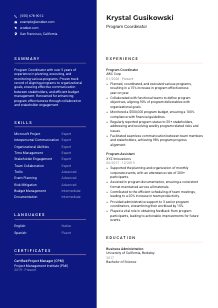
Lead with a direct line that states who you are and how long you have worked in related roles. A summary like "Program Coordinator with over 5 years of experience in planning, executing, and monitoring programs" works because it immediately establishes function and seniority.
Use the next lines to connect your capabilities to the work itself. Mention strengths such as cross-functional coordination, stakeholder communication, budget monitoring, reporting, or improving program effectiveness. The example summary is strongest where it links collaboration and budget management to better program outcomes, rather than listing personality traits.
Aim for a short paragraph of 3 to 5 lines. That is enough space to cover your role, years of experience, and a few high-value contributions without repeating bullets from the experience section. Every phrase should earn its place by clarifying the scale or quality of your coordination work.
A sharp summary helps the reader understand your coordination range before they reach the detailed bullets. When it is tailored to program delivery, communication, and operational follow-through, the rest of the CV lands more clearly.
A Program Coordinator CV works when each section supports the same story: you can organise moving parts, communicate clearly with stakeholders, and keep programs aligned with goals, budgets, and timelines. That consistency matters in both ATS screening and human review.
Wozber's free CV builder gives you a practical way to structure that story with an ATS-compliant CV, role-matched phrasing, and tools like the ATS CV scanner to tighten alignment with the job description. Use it to present your real coordination experience with the clarity hiring teams need to judge your readiness.