



Use Wozber and land your dream job
Create CV
No registration required
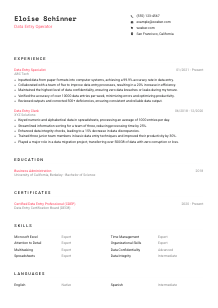
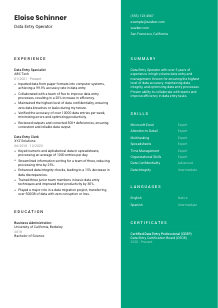
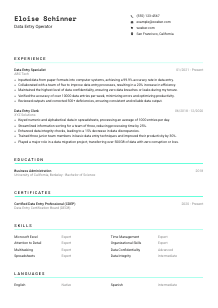
Keying in data, but your CV feels like a CTRL+C, CTRL+V job? Check out this Data Entry Operator CV example, created with Wozber free CV builder. It shows how you can seamlessly present your data-driven skills to match job specifics, typing your way to career success!
Data entry work gets judged quickly on one thing that affects everything else: whether your record of work suggests dependable accuracy at volume. Hiring teams want to see that you can move information from paper, spreadsheets, scanners, or source files into the right system without introducing errors, exposing sensitive data, or slowing down downstream reporting.
When the CV is tailored well, that distinction becomes obvious early. Wozber's free CV builder helps you shape an ATS-compliant CV around the language employers use for data input, verification, confidentiality, and spreadsheet work, so the screening process points faster to the candidates who can be trusted with clean records and consistent output.
For data entry roles, the header should be clean, correct, and easy to scan. Small mistakes in contact details can undercut your case before a hiring manager even reaches your experience, so this section needs the same accuracy you would bring to a live data set.
Place your full name at the top in a clear, readable format. Keep the styling simple. For a role built around precision and orderly records, an uncluttered header already supports the impression that you work carefully.
Add "Data Entry Operator" directly under your name if that is the role you are applying for. Matching the title used in the posting helps ATS filters and also makes your focus clear right away, especially when your recent titles vary between Data Entry Clerk, Data Entry Specialist, or similar roles.
Include a reliable phone number and a professional email address, then check every character. Data entry hiring puts unusual weight on basic accuracy, so a typo in your own contact information sends the wrong message. If you include a website or LinkedIn profile, make sure it is current and consistent with your CV.
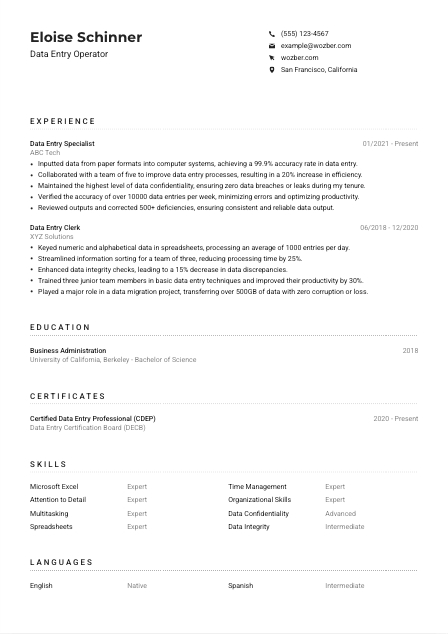
If the employer asks for a specific location or relocation readiness, reflect that here. In this example, listing San Francisco, California immediately answers a stated requirement. If you are relocating, say so plainly instead of leaving the employer to guess.
A LinkedIn profile can reinforce your work history, software familiarity, and dates of employment. Keep the details aligned with your CV, especially job titles, timelines, and skills such as Excel, data integrity, or records handling.
Your header should tell the employer exactly who you are, how to reach you, and whether you meet any location requirement. For data entry work, even this first section should reflect order, correctness, and attention to detail.




This section carries the most weight for a Data Entry Operator. Employers want a track record of entering, checking, correcting, and protecting data across real workloads, whether that means daily spreadsheet entry, paper-to-system transfer, scanning workflows, or quality control on large record volumes.
Read the job description for the actual work patterns you need to mirror. Here, the core themes are entering data from paper formats, verifying accuracy, correcting deficiencies, protecting sensitive information, and improving team efficiency. Those points should shape which bullets you keep and how you phrase them.
Start with your most recent position and work backward. Include company name, job title, and dates. For data entry jobs, adjacent titles such as Data Entry Specialist, Records Clerk, Administrative Assistant, or Data Processing Clerk can all be relevant if the bullets show keyboarding volume, document handling, database updates, or error correction.
Avoid generic lines like "responsible for data entry." Show what you handled and how well you handled it. A bullet such as "Inputted data from paper formats into computer systems, achieving a 99.9% accuracy rate" works because it ties the task to a measurable standard the employer immediately understands.
Metrics matter here because they show pace, consistency, and quality control. Useful examples include records processed per day or week, accuracy rate, discrepancy reduction, output reviewed, correction counts, or efficiency gains from process changes. The sample CV does this well with figures like 10,000 entries verified per week and a 20% efficiency increase.
Choose bullets that support the hiring decision for this kind of role. Teamwork matters, but it should be tied to the work itself, such as improving entry procedures, training colleagues on validation steps, or supporting a data migration with zero loss or corruption. Give the most space to accuracy, confidentiality, multitasking, and system reliability.
Your experience section should leave no doubt that you can process information accurately, catch inconsistencies, and maintain data integrity under real workload. If your bullets show volume, precision, and secure handling of records, this section is doing its job.
Education usually plays a supporting role in data entry hiring, but it still helps frame your background. A degree or coursework can show comfort with business processes, office software, written communication, or information handling, especially when the role involves spreadsheets, reporting support, or structured documentation.
Some Data Entry Operator jobs ask for a diploma or degree, while others focus almost entirely on experience and keyboard accuracy. If no strict education requirement appears, list your strongest credential clearly and let your work history carry the heavier proof. In the example, a Business Administration degree adds useful professional context even though the role is experience-led.
List degree, field of study, school, and graduation year in a clean sequence. Keep this section easy to scan. The same discipline that keeps records organised in a database should show up in how you present academic information.
If your studies supported the work, make that connection briefly through the field itself or selected details. Business, information systems, office administration, or similar programs can support data entry applications because they often involve documentation, spreadsheet use, and process accuracy.
Early-career applicants can include a few relevant courses such as computer applications, database fundamentals, business communication, or information management. If you already have several years of data entry experience, coursework matters less unless it supports a specific requirement from the posting.
Academic honors, student work, or extracurriculars belong here only if they reinforce skills used in data entry, such as administrative support, records coordination, document control, or software proficiency. Avoid filling space with unrelated activities when your experience section already carries stronger evidence.
Education should support the story your experience already tells. Keep it concise, accurate, and relevant to office systems, information handling, or the structured work environment behind data entry operations.
Certifications are not mandatory in every data entry search, but they can strengthen your CV when they point to software proficiency, data handling standards, or role-specific training. They are most useful when they reinforce the exact kind of accuracy and process discipline the employer wants.
Start with credentials that relate directly to data entry, office software, records management, or administrative systems. A certification such as "Certified Data Entry Professional (CDEP)" is relevant because it supports your specialization instead of adding generic training that does not affect the hiring decision.
A short, focused certificate section is stronger than a crowded one. Prioritise credentials that connect to spreadsheet work, data quality, confidentiality, or document processing rather than listing every course you have ever completed.
Dates help employers see whether a certification is current, recently earned, or still active. That matters more when the credential has renewal requirements or reflects up-to-date software knowledge.
If you have recent training in Excel, database tools, document scanning systems, or information security, include it when it supports the job. Data entry may look straightforward from the outside, but strong applicants often stand out through better validation habits, cleaner spreadsheet work, and stronger confidentiality practices.
Certificates help when they sharpen your profile around the actual work: accurate input, system familiarity, and responsible data handling. Keep the section focused on credentials that strengthen that picture.
The skills section should reflect the tools and habits that keep data clean and usable. For a Data Entry Operator, that usually means a mix of spreadsheet ability, fast and accurate keyboarding, document review, organisation, multitasking, and careful handling of confidential information.
Use the employer's wording as a guide for what belongs here. In this description, spreadsheet and word processing software, numerical and alphabetical keying accuracy, attention to detail, multitasking, confidentiality, and professional English all deserve consideration. That language improves both relevance and ATS optimisation when it matches your actual background.
List skills that also appear in your work history so the CV reads consistently. For example, "Microsoft Excel," "Attention to Detail," and "Data Confidentiality" become more credible when your experience bullets also show high-volume verification, discrepancy correction, and secure handling of records.
Do not overload this section with broad traits. Choose skills that matter in day-to-day data entry work, such as spreadsheets, data integrity, time management, document review, database entry, and organizational skills. A targeted list gives hiring teams a faster read on whether you can handle the workflow they are hiring for.
Your skills section should read like the operating toolkit for accurate, efficient data entry. If the listed skills match the posting and are supported by your work history, the section will hold up under closer review.
Language ability matters in data entry when instructions, source documents, customer records, or internal communication need to be interpreted correctly. Even when the role is heavily process-driven, mistakes often begin with misunderstood text, labels, or formatting conventions.
If the posting asks for professional English, list English clearly with an honest proficiency level. That matters in data entry because written instructions, field names, reports, and exception notes all depend on accurate reading and interpretation.
Lead with the language required for the job, then add any others that could support the workplace. Additional language ability may help in multilingual record environments, customer databases, or teams that process documents from different markets.
Choose consistent terms such as Native, Fluent, Intermediate, or Basic. Hiring teams do not need inflated claims here. They need a realistic sense of whether you can handle written communication, follow documentation, and work accurately with text-heavy fields.
A second language is worth listing if it supports the employer's environment or gives you broader document-handling range. In the example, Spanish adds context without distracting from the required English proficiency.
For most Data Entry Operator jobs, languages are secondary to accuracy, speed, and software skill. Include them cleanly, then let your experience and skills sections carry the main case for your application.
Language details should confirm that you can read instructions, handle text accurately, and communicate clearly in the work environment. Keep the section honest, concise, and tied to the role's actual needs.
Your summary should quickly establish the kind of data entry professional you are. This is where you give the employer a short, specific overview of your experience level, core strengths, and the type of results you have delivered in high-accuracy, high-volume work.
Before writing, identify the few themes that define the opening. Here, accuracy, high-volume input, verification, confidentiality, and process efficiency matter more than broad office language. Use those priorities to shape the first impression.
Start with a direct professional label and years of experience. A line like "Data Entry Operator with over 5 years of experience" immediately positions you for the role and works well when your background includes closely related titles in the same workflow.
Follow with strengths that hiring teams in data entry actually look for, such as maintaining high accuracy, protecting sensitive information, improving throughput, or supporting clean database records. The sample summary succeeds because it stays close to these practical themes instead of drifting into generic self-description.
Aim for a compact paragraph with no wasted lines. A hiring manager should be able to read it quickly and understand your level, your main value, and the kind of data work you do well. Save fine-grained metrics for the experience section, where they have more room to carry weight.
Your summary should frame you as someone who can be trusted with accurate entry, reliable review, and secure handling of information. If it sets up the rest of the CV around those strengths, it is doing exactly what it should.
A Data Entry Operator CV works when every section points to the same conclusion: you can enter information accurately, maintain confidentiality, and keep data usable at scale. That is the standard hiring teams are trying to confirm.
Use Wozber's free CV builder, ATS-friendly CV templates, and ATS CV scanner to align your wording with the posting, tighten section focus, and present your background in an ATS-friendly CV format. The finished CV should make it easy to see your accuracy, consistency, and readiness for the workflow.




