



Use Wozber and land your dream job
Create CV
No registration required
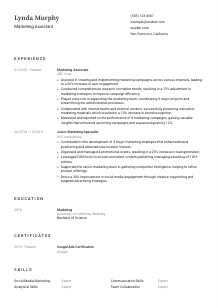
Crafting campaigns, but your CV doesn't sell? Check out this Marketing Assistant CV example, created with Wozber free CV builder. Learn how to spotlight your marketing flair and promotional prowess to match job requirements, making your career journey as impactful as your ad campaigns!
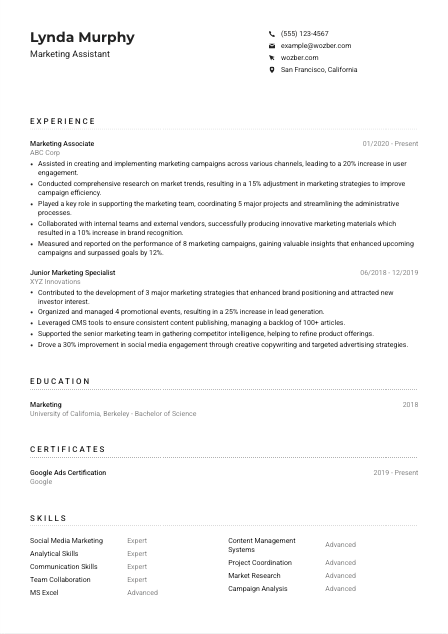
Marketing Assistant work sits close to execution. You are expected to help campaigns move from idea to launch, keep projects organised across teams, and track whether the work actually performed. A CV for this role needs to show that you can support campaign delivery, handle research and coordination, and contribute to measurable marketing outcomes.
When that story is tailored to the posting, hiring teams can quickly separate general admin experience from real marketing support experience. Wozber's free CV builder helps you shape an ATS-compliant CV around the language of the role, so campaign reporting, CMS or CRM exposure, and channel-specific work are easy to spot from the first scan.
This section is brief, but it still carries practical value. For a Marketing Assistant CV, the header should immediately show who you are, how to reach you, and whether you meet any location or communication requirements named in the posting.
Use your full name in a slightly larger font than the rest of the header. Keep it simple and professional. In marketing roles, presentation matters, and a clean header sets the tone for a CV that feels organised rather than cluttered.
Place "Marketing Assistant" directly below your name when that is the role you are applying for. This removes any ambiguity if your recent title was Marketing Associate, Junior Marketing Specialist, or something similar, and it keeps your application closely aligned with the posting.
Include a current phone number and a professional email address. If you also share a portfolio, LinkedIn profile, or personal site with campaign samples, content work, or brand projects, make sure it is active and consistent with the experience on your CV.
Some employers want local candidates for coordination-heavy roles. Here, the job asks for someone based in San Francisco, CA, so listing "San Francisco, California" helps remove that question immediately. Only include location to the level that is relevant. Full street addresses are rarely necessary.
For marketing roles, an online profile can strengthen credibility if it shows the right kind of work. A polished LinkedIn page, a portfolio with campaign assets, or examples of content and social media execution can support your CV, especially if the role involves digital channels, vendor coordination, or content publishing.
This section should answer the basics in seconds. Clear identity, accurate contact details, and any required location cue help the reader move straight to your campaign work and marketing results.




This is the section most likely to decide whether you move forward. Marketing Assistant hiring usually turns on whether your past work shows real involvement in campaigns, reporting, content coordination, research, and day-to-day team support rather than generic office duties.
Before you edit your bullets, mark the responsibilities and requirements that matter most in the job ad. For this role, that includes campaign implementation, market and competitor research, project coordination, vendor collaboration, performance reporting, and familiarity with CMS and CRM tools. Your experience bullets should echo that work where it genuinely reflects what you have done.
Start with your most recent position and list your title, employer, and dates clearly. For marketing candidates, progression matters. A path from Junior Marketing Specialist to Marketing Associate, for example, suggests growing ownership across campaign execution, content workflows, and reporting responsibilities.
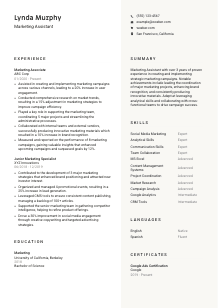
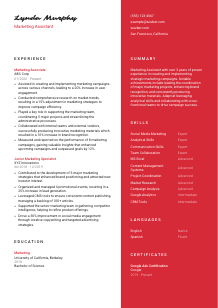
Each bullet should show what you handled and what changed because of your work. Good Marketing Assistant bullets often include campaign support, audience research, content scheduling, event promotion, stakeholder coordination, or reporting. The sample CV does this well by pairing tasks with outcomes such as increased engagement, stronger brand recognition, and improved campaign efficiency.
Numbers make your contribution easier to understand. Use engagement growth, lead volume, campaign count, conversion lift, content output, event attendance, reporting cadence, or process improvements where you have them. The example's 20% increase in user engagement and reporting on 8 campaigns are useful because they show both scale and business effect.
If a bullet does not help prove campaign support, analysis, channel execution, content operations, or collaboration with internal teams and vendors, revise or remove it. Even strong achievements from unrelated work can weaken the read if they crowd out the experience that matters for a Marketing Assistant opening.
A hiring manager should be able to see your role in planning support, execution, and reporting without guessing. The best experience sections make it clear how you helped campaigns run better and what results followed.
For many Marketing Assistant openings, education is a qualification check before the reader moves back to experience. Keep it concise, accurate, and easy to verify, especially when the posting names a bachelor's degree in Marketing, Business, or a related field.
List your highest relevant degree first. If you hold a Bachelor's in Marketing, Business, Communications, or a related discipline, that should be easy to find. In the example, a Bachelor of Science in Marketing directly supports the requirement and does not need extra explanation.
Include degree, school, field of study, and graduation year or date range. Marketing hiring rarely depends on elaborate education formatting. Clear presentation is enough, and it keeps attention on the experience and skills sections where campaign work is evaluated more closely.
If your field of study aligns directly with the role, keep that wording intact. "Marketing" should not be shortened away or buried. The same goes for closely related areas such as Business Administration with a marketing concentration if that is how your program was structured.
Early-career candidates can include relevant coursework, capstone projects, or student campaign work when professional experience is limited. Focus on items tied to audience research, digital marketing, content strategy, analytics, or brand planning. Skip general class lists that do not add useful context.
Academic honors, scholarships, or marketing competition results can be worth noting if they show initiative or subject strength. Keep them brief. They should support your positioning, not overtake the section.
For this role, education is usually a supporting qualification rather than the main selling point. Present it clearly, match the degree requirement when you can, and let your campaign experience do the heavier lifting.
Certifications are not mandatory in every Marketing Assistant search, but they can strengthen your CV when they point to tools, channels, or reporting skills the team already uses. The key is relevance, not volume.
Review the posting for clues about channels and platforms. If the role mentions campaign support, analytics, social platforms, CMS, or CRM tools, certifications in digital advertising, analytics, email marketing, automation, or content marketing can reinforce your experience. The Google Ads Certification in the example works because it relates to real campaign execution.
Choose credentials that connect to the work a Marketing Assistant is likely to do. Useful examples include Google Ads, Google Analytics, HubSpot, Meta Blueprint, email marketing, SEO, or CRM-related learning. A shorter list of relevant certificates carries more weight than a long list of generic courses.
Marketing tools and platform practices change quickly, so dates matter. If a certification is active, renewed, or recently completed, include that. A current credential suggests you are keeping pace with channel updates, platform changes, and reporting standards.
As your career grows, update this section with training that matches the direction of your work. If you are moving deeper into campaign analytics, content operations, paid media, or CRM workflows, choose certifications that sharpen those areas and align with the kinds of roles you want next.
A certification section works best when it supports your actual marketing track record. Pick credentials that strengthen your case for campaign execution, platform fluency, and current knowledge of the channels named in the posting.
For a Marketing Assistant CV, the skills section should mirror how the work gets done. Hiring teams look for a practical mix of campaign support skills, channel knowledge, analysis, and tool familiarity, especially when the posting mentions software platforms, CMS, CRM tools, and communication strength.
Start with the language the employer already used. Here, that includes marketing software, social media platforms, analytical skills, communication skills, CMS familiarity, and CRM tools. These terms belong in your skills section if they accurately reflect your background, and they should also appear naturally in your experience bullets where possible.
Order matters. Lead with the abilities most tied to the role's daily work, such as social media marketing, market research, campaign analysis, project coordination, content management systems, and CRM tools. In the sample CV, that mix makes sense because it supports both campaign execution and reporting.
Avoid filling the section with broad traits that every candidate could claim. Instead of generic wording alone, include marketing-specific capabilities and platforms you have used. Skills such as Google Analytics, Excel for reporting, content publishing tools, audience research, and vendor coordination tell a much clearer story than vague terms on their own.
This section should reinforce the marketing work already shown in your experience. A focused list helps the reader connect your tools and strengths to campaign delivery, research, and performance tracking.
Marketing teams rely on clear messaging, coordination, and audience awareness, so language ability can matter more than it does in many support roles. If a posting explicitly requires English proficiency, make that visible right away.
When the job specifies English, list English at the top with an accurate proficiency level such as "Native" or "Fluent." This is a direct match to the requirement and reassures the employer that you can handle copy review, team communication, reporting, and vendor coordination in the expected language.
Additional languages can be useful in marketing, especially for community outreach, multicultural campaigns, customer-facing content, or market expansion work. They are not always required, but they can broaden your value when they are relevant to the brand or audience.
Stick with standard descriptions such as "Native," "Fluent," "Conversational," or "Intermediate." Clear labels set the right expectation if the role involves writing, presenting, or collaborating across teams and external partners.
Not every Marketing Assistant role needs more than one language, but some do. If the company serves multilingual audiences or has cross-border campaigns, additional language skills may support content adaptation, social engagement, or market research.
List languages when they can contribute to communication, audience understanding, or campaign reach. In the example, Spanish adds useful breadth beyond the required English because it could support audience engagement in a diverse market.
For marketing roles, language skills matter when they support communication and audience connection. Lead with the required language, then add others that genuinely strengthen your value.
The summary needs to establish your level, your marketing focus, and the kind of contribution you make in a few lines. For a Marketing Assistant, that usually means campaign support, research, coordination, content or channel work, and measurable results.
Read the posting closely before writing your summary. If the role leans toward campaign coordination, reporting, social media execution, research, or content operations, your opening lines should reflect that mix. Avoid summaries that are so broad they could belong to any office or communications role.
Lead with your professional identity and years of relevant experience. A line like "Marketing Assistant with 3+ years of experience supporting multi-channel campaigns" gives the reader immediate context and keeps the focus on relevant work rather than vague ambition.
Use the next lines to highlight the parts of your background that map most closely to the job. That might include campaign implementation, market research, content publishing, vendor coordination, or performance reporting. The example summary works because it ties experience to major project coordination, brand recognition, and campaign success rather than making generic claims.
Aim for a short paragraph that can be read in seconds. Three to five lines is usually enough. Focus on channel work, analysis, coordination, and results, and avoid filler language that does not add information.
Your summary should tell the reader, quickly and specifically, what kind of marketing support you have delivered and where you can contribute next. If it is aligned well, the rest of the CV feels easier to trust.
A Marketing Assistant CV works when it shows more than interest in marketing. It should make your campaign support, research, coordination, platform familiarity, and reporting contributions easy to understand section by section.
Use Wozber to turn that experience into an ATS-friendly CV format with language aligned to the posting, then refine it until the connection between your background and the team's day-to-day marketing work is obvious. That is what helps a hiring manager see you as ready to step in and contribute.