




Use Wozber and land your dream job
Create CV
No registration required
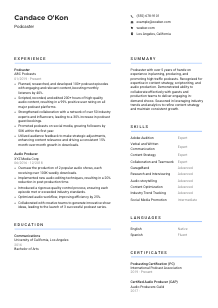
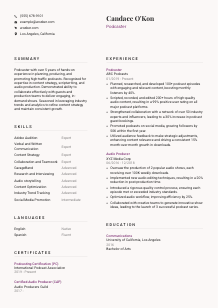
Sharing stories, but feeling like your CV is on mute? Unmute it with this Podcaster CV example, created with Wozber free CV builder. It shows how to share your audio adventures in a way that matches job requirements, so your career narrative never fades into the background noise!
Podcast hiring moves quickly when a CV makes the work visible. Editors and content leads want to see whether you can turn research into a sharp episode concept, run a clean recording and edit process, and grow an audience through programming choices that actually land with listeners. Your CV should show how you shape stories, manage production, and improve performance across downloads, retention, ratings, or subscriber growth.
A tailored CV also helps separate podcast hosts from candidates who can own the full production cycle. When the language in your CV matches the posting's terms for scripting, interviewing, audio editing, analytics, and promotion, Wozber's free CV builder helps you organise that experience into an ATS-compliant CV that reads clearly for both software filters and hiring teams reviewing whether you can produce engaging episodes consistently.
For a podcaster, the header should do one job well: make it easy to contact you and confirm the basics that matter for the opening. Keep it clean and professional, and include details that support your candidacy without crowding the page.
Use your full name in the largest text on the page so it is easy to spot. Avoid nicknames unless that name is part of your professional brand across podcast platforms, credits, or your website.
Place "Podcaster" directly under your name if that is the role you are pursuing. If your background leans more toward production, a close variant such as "Podcaster and Audio Producer" can work when it reflects your actual experience and still aligns with the posting.
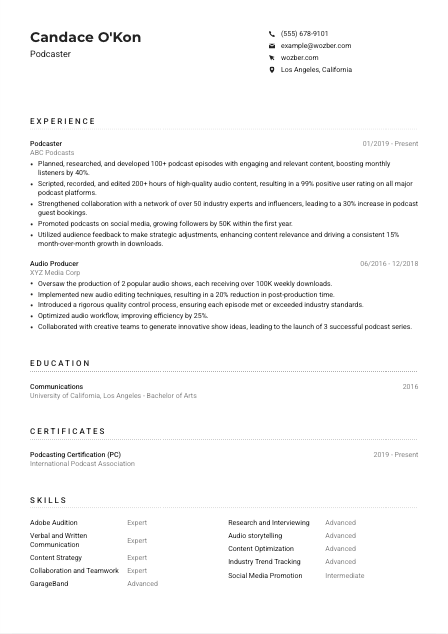
If a posting specifies a city or requires local availability, include it clearly. In the example here, listing "Los Angeles, California" immediately addresses the employer's stated location requirement without adding extra explanation.
A website, portfolio, or LinkedIn profile can strengthen this section if it shows published episodes, guest interviews, show descriptions, or production credits. For podcasters, a link is most useful when it lets a hiring team quickly hear your work or review your content style.
Keep the header straightforward and role-aware. It should confirm who you are, how to reach you, and any practical detail, such as location or portfolio access, that helps move your application forward.




This section carries the most weight for podcast roles. Hiring teams want to see whether you have planned episodes, handled scripting and recording, edited audio to a publishable standard, worked well with guests or producers, and improved audience performance over time.
Start by identifying the recurring work in the job description. For a podcaster, that usually includes topic research, episode development, interviewing, scripting, recording, editing, collaboration, analytics, and promotion. Those responsibilities should shape which bullets you keep and how you phrase them.
List each position with your title, company, and dates first, then follow with accomplishment bullets. Keep the structure easy to scan so a hiring manager can quickly trace your progression from production support or audio roles into ownership of a show or channel.
Use each bullet to show what you produced and what changed because of your work. The example CV does this well with details like planning 100+ episodes, editing 200+ hours of audio, and increasing monthly listeners by 40%. That tells a much fuller story than "responsible for podcast production."
Choose numbers that reflect how podcast work is actually measured. Listener growth, downloads, subscriber gains, positive ratings, post-production turnaround time, guest booking volume, and social audience growth all help hiring teams understand your range. A line such as growing followers by 50K or reducing post-production time by 20% gives clear production and audience context.
If a bullet does not support storytelling, production quality, research depth, audience growth, or collaboration, trim it. Save space for the work that proves you can develop strong episodes and keep a show performing. Tailoring here matters more than trying to document every duty from every media job you have held.
Your experience section should show that you can take an episode from idea to published result. The strongest entries connect editorial judgment, production skill, and audience growth in language that is easy to scan and easy to trust.
Education usually sits behind experience for podcast hiring, but it still matters when the posting names a degree requirement or when your academic background connects directly to media, journalism, communications, or audio production. Keep it clean and relevant.
Check whether the employer asks for a specific academic background. Here, a bachelor's degree in Communications, Journalism, or a related field is listed, so your CV should make that qualification immediately visible if you have it.
Include your degree, field of study, school, and graduation year or date format consistent with the rest of your CV. The example uses "Bachelor of Arts" in "Communications" from UCLA, which aligns directly with the posting and needs no extra explanation.
If your degree title closely matches the posting, use the formal wording on your transcript or diploma. That helps both ATS matching and human review. If your major is adjacent, such as Media Studies or Broadcast Journalism, keep the official title and let your experience section show the podcast connection.
Early-career candidates can strengthen this section with capstone projects, student radio, interview-based reporting, audio documentaries, or campus media work. Mid-career podcasters usually do not need this unless the project directly supports the role they are targeting.
Honors, media clubs, student publications, or production awards can help when they reinforce your storytelling or communication background. If they do not add useful context for podcast production or editorial work, leave them out and keep the section tight.
This section should confirm that you meet any stated degree requirement and, where useful, show a foundation in communication, reporting, or media production. Let it support the story your experience already tells.
Certifications are not always required in podcast hiring, but they can add value when they reinforce practical production skills, current industry knowledge, or commitment to craft. Focus on credentials that connect directly to audio, storytelling, or digital media work.
If no certification is required, treat this section as support rather than a centerpiece. For podcaster roles, it works best when it adds proof of audio production training, platform knowledge, or structured development in interviewing and storytelling.
Lead with credentials related to podcasting, audio production, editing workflows, content development, or digital media. In the example, "Podcasting Certification" and "Certified Audio Producer" both reinforce the mix of editorial and technical work the role requires.
Dates matter when they help show that your training is recent or ongoing. That is especially useful in audio and content roles where tools, distribution practices, and audience strategy keep changing.
If you are adding new credentials, choose ones that improve real parts of the job, such as sound design, Adobe Audition workflow, interview technique, narrative structure, or platform analytics. Those areas are easier for employers to connect to day-to-day podcast production than general online course completions.
List certificates that deepen your case as a capable podcast professional. When they reinforce your editing skills, editorial judgment, or production process, they add useful weight without taking attention away from experience.
A podcaster's skills section should reflect how the show gets made and how it performs after release. That means combining production tools with editorial abilities and audience-facing strengths instead of filling the section with broad, generic traits.
Start with the capabilities the employer actually named. In this posting, that includes audio editing software, strong communication, research, interviewing, and content development. If you genuinely use Adobe Audition, GarageBand, analytics platforms, scripting, or social promotion tools, list them in the language employers will recognize.
Podcast roles sit between content and production, so your skills section should reflect both. Software proficiency, recording and editing, sound cleanup, and content optimisation belong alongside interviewing, scriptwriting, collaboration, and story development. The example CV handles this balance well with tools like Adobe Audition and abilities such as content strategy and research.
Do not overload this section with every media skill you have picked up. Prioritise the ones that help produce better episodes, stronger guest conversations, smoother workflows, or wider audience reach. A shorter list with clear relevance will do more for you than a long list of loosely connected abilities.
Choose skills that map to episode planning, recording, editing, collaboration, and growth. When the list mirrors the production realities of the job, the rest of the CV becomes easier to trust.
Language matters in podcasting because voice, clarity, and audience connection sit at the centre of the job. This section should stay simple and accurate, while highlighting any language ability that expands your reach or supports your interviewing range.
If the posting specifies English fluency, make that visible. Here, the employer asks for strong reading and writing in English, so listing English clearly with an honest proficiency level is essential.
Additional languages can be useful when a show serves multilingual audiences, books international guests, or produces cross-market content. They are especially valuable if you have used them in interviews, audience engagement, or promotional work.
Stick to standard terms such as native, fluent, advanced, intermediate, or basic. Hiring teams need a realistic sense of how comfortably you can research, write, interview, or speak in each language.
Lead with the languages most likely to matter for the role or audience. In the example, English is listed as native and Spanish as fluent, which could support broader guest sourcing and listener reach, though that will depend on the show's format.
Only include languages you can use with confidence. In podcast work, overclaiming can become obvious quickly if the role involves live interviews, script review, or audience-facing communication.
Use this section to confirm required fluency and highlight any additional language ability that genuinely supports interviews, audience growth, or broader content distribution.
The summary is your quick read on what kind of podcaster you are. It should establish your level, your production strengths, and the kind of results you have driven, using language grounded in podcast work rather than vague personal branding.
Before writing, note the few themes repeated in the posting. For this role, that includes professional podcasting experience, strong communication, research and interviewing, audio editing, and content strategy shaped by analytics and feedback. Your summary should address those priorities in a compact form.
Start with a direct line that names your profession and years of relevant experience. A phrase like "Podcaster with 5+ years of experience producing interview and narrative audio content" tells the reader what lens to use for the rest of the CV.
Choose strengths that connect to the role's daily demands, such as episode development, scriptwriting, guest interviewing, audio editing, or audience growth strategy. The example summary works because it ties hands-on production to content strategy and collaboration, rather than leaning on empty adjectives.
Close with the result you tend to deliver. That could be growth in downloads, consistently polished audio, strong guest experiences, or data-informed programming decisions. Keep it short, specific, and connected to how podcasts are actually measured and improved.
A strong summary gives hiring teams an immediate sense of your production level, content strengths, and audience impact. If they finish those first lines understanding the kind of showmaker you are, the section has done its job.
A podcaster CV should make one thing easy to judge: can you research, produce, edit, and grow audio content that people keep listening to. Every section should support that answer, from the tools you use to the audience results you can point to.
Use Wozber's free CV builder to tighten structure, refine role-specific wording, and build an ATS-friendly CV template that matches podcast job language cleanly. With the right tailoring, your CV will show both your production craft and your ability to build a show people want to hear.




