



Use Wozber and land your dream job
Create CV
No registration required
Driving artistic vision, but your CV feels like an unfinished masterpiece? Check out this Creative Manager CV example, created with Wozber free CV builder. It shows how to blend your design leadership with job expectations, painting a career narrative that's as dynamic as your next big project!
Creative Manager hiring usually turns on one question quickly: can you lead strong creative work through real constraints. Teams need someone who can direct designers, protect brand standards, work across Marketing, Product, and UX, and still keep deadlines, revisions, and production quality under control. Your CV needs to show that kind of operating range, not just taste or software fluency.
When that story is tailored well, the hiring team can see where your experience sits, whether you have enough leadership depth, and how you handle the mix of concept development and delivery management the role requires. Wozber's free CV builder helps shape that story into an ATS-compliant CV by aligning your wording with the job description and keeping the structure easy to scan. That matters when the first pass needs to confirm creative leadership, cross-functional collaboration, and execution at pace.
For a Creative Manager, the header should confirm professional credibility fast and remove friction. Keep it clean, easy to scan, and aligned with the level of responsibility you are targeting.
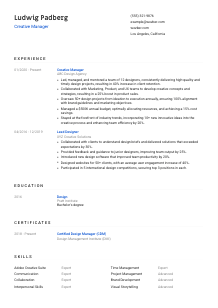
Place "Creative Manager" directly under your name when that is the role you are applying for. This helps frame the rest of the CV around creative direction, team oversight, and project ownership instead of leaving the reader to infer whether you are still positioned as an individual contributor.
List one reliable phone number and a professional email address you check regularly. Hiring for creative leadership often moves through several conversations with recruiters, department heads, and cross-functional stakeholders, so your contact details should look polished and be easy to use.
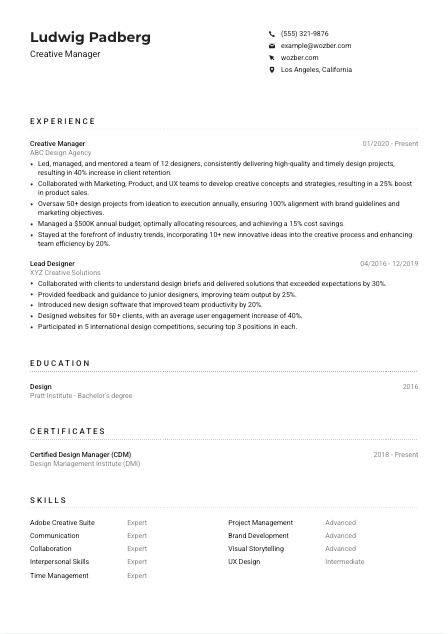
If a role calls for a specific location, make that visible in your header. In the example here, "Los Angeles, California" immediately addresses a stated requirement and prevents your application from being screened out for geography before anyone reviews your portfolio or leadership record.
A Creative Manager CV benefits from a website, portfolio, or strong LinkedIn profile when it reflects the same level of brand thinking and execution described in your work history. Link only to material that supports the job target, such as campaign work, brand systems, digital launches, or team-led creative programs.
Skip details like age, marital status, or a full street address unless there is a clear legal or logistical reason to include them. For this role, the focus belongs on leadership scope, creative output, and how you work with teams and stakeholders.
Your personal details should answer the practical questions right away: who you are, what role you are pursuing, how to reach you, and whether any location requirement is covered. Then the reader can move straight to your creative leadership record.




This section carries the most weight for a Creative Manager. Hiring teams want to see how you have led designers, managed workflow, influenced business results, and kept creative work aligned with brand and campaign goals.
Before rewriting your bullets, pull out the responsibilities that define how the team works. For a Creative Manager, that usually includes leading designers, collaborating with functions like Marketing and UX, overseeing projects from concept through execution, and allocating resources well enough to hit deadlines without sacrificing quality.
Use reverse chronological order and make every entry easy to parse: job title, company, and dates first. In leadership hiring, a clean timeline helps the reader quickly spot progression from hands-on design work into team lead or management responsibility, which is especially important when the job asks for both creative experience and managerial experience.
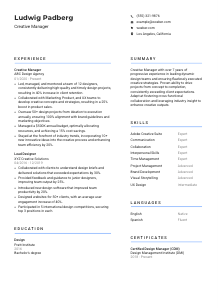
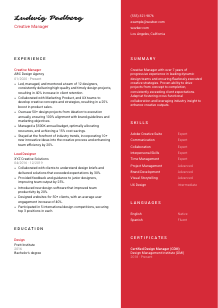
Each bullet should show what you led, what you improved, and what changed because of your work. The example does this well by pairing responsibilities with outcomes, such as mentoring a team of 12 designers, overseeing 50+ projects annually, boosting product sales through cross-functional creative strategy, and delivering cost savings through budget management.
Creative leadership becomes more credible when the scale is measurable. Good metrics here include team size, campaign volume, project count, client retention, launch cadence, budget ownership, engagement lift, sales impact, turnaround time, or efficiency gains. Numbers like a 40% increase in client retention or a $500K annual budget tell the reader far more than "managed multiple projects."
If you have older experience that better proves brand oversight, resource management, or team leadership, emphasize that over less relevant recent work. For this profession, the strongest evidence usually comes from roles where you influenced both creative quality and delivery, not from isolated design assignments without ownership.
By the end of this section, the hiring team should understand the scale of work you have directed, the kinds of teams you have led, and the business outcomes your creative decisions helped produce. That is the core proof a Creative Manager CV needs to provide.
Education will not outweigh your leadership record, but it still matters when the posting names a degree requirement. Keep this section straightforward so the reader can confirm the academic background without hunting for it.
If the role asks for a Bachelor's degree in Design, Fine Arts, Marketing, or a related field, present that information clearly. In the example, a Bachelor's degree in Design from Pratt Institute lines up cleanly with the stated requirement and supports the candidate's creative foundation.
List degree, field of study, school, and graduation year in a consistent order. That is usually enough for an experienced Creative Manager and keeps the section easy to scan alongside experience, portfolio links, and leadership achievements.
Name the discipline precisely when it strengthens alignment. "Bachelor's degree, Design" gives a clearer hiring read than a vague or abbreviated entry, especially when the employer is screening for a creative or visual background.
Seasoned candidates usually do not need course lists, but earlier-career applicants moving into leadership can include standout projects or coursework tied to branding, visual communication, marketing, UX, or creative strategy. Include it only if it supports the direction of your current CV.
Honors, awards, or leadership roles in student design organizations can stay if they reinforce your creative development or leadership path. For a manager-level CV, keep these details brief unless they are especially relevant or well recognized in the field.
This section should confirm that you meet the stated academic baseline and support the broader story of your creative training. Once that is clear, the emphasis can stay where it belongs, on leadership, execution, and results.
Certifications are not mandatory in every Creative Manager search, but the right one can reinforce management range, design leadership, or commitment to professional growth. Use them to add relevance, not volume.
List certifications that strengthen the kind of work the role involves, such as creative leadership, design operations, brand management, or project delivery. A credential like Certified Design Manager supports the move from strong designer to leader of creative teams and processes.
A short list of certifications tied to the job target works better than a crowded section of loosely related courses. For Creative Manager roles, quality matters more than quantity, especially when space is needed for campaign outcomes, team scope, and cross-functional leadership.
Show when the certification was earned and whether it is current. That helps the reader understand how recent your training is, which matters in fields shaped by shifting design systems, digital channels, and evolving team workflows.
Creative managers are expected to stay current on tools, brand practices, and collaboration methods. Ongoing learning through certifications, workshops, or formal training supports that expectation and can complement experience with Adobe workflows or project management platforms.
If this section appears, it should strengthen your positioning as someone who leads creative work with structure, judgment, and current practice. Keep every credential connected to the kind of responsibility the job actually carries.
A Creative Manager skills section should show more than design software. It needs to reflect how you direct teams, shape concepts, collaborate across departments, and keep creative output aligned with business and brand goals.
Start with the language used in the job description. For this role, that includes Adobe Creative Suite, communication, collaboration, interpersonal skills, and project management. Then add adjacent strengths that are common in creative leadership, such as brand development, visual storytelling, creative direction, resource planning, or review and feedback processes.
Lead with the skills most central to the job. If the posting stresses advanced Adobe proficiency and team leadership, those should appear before broader or less critical capabilities. In the example, placing Adobe Creative Suite among top skills immediately supports a core requirement.
Do not turn the section into a full inventory of everything you have ever used. A tighter list helps both ATS parsing and human review. Group skills around what matters for the role, such as design tools, leadership and collaboration, brand work, and project execution.
The skills section should make it easy to see that you can lead creative production as well as contribute to it. When the list is targeted, it supports the claims in your experience instead of repeating generic strengths.
Language skills matter differently across Creative Manager roles. In some teams, English proficiency is the baseline for presentations, feedback, and stakeholder communication. In others, additional languages can support regional campaigns, client relationships, or multicultural collaboration.
Check the posting for explicit communication requirements. Here, effective oral and written English is required, so English should appear clearly in this section or be strongly implied elsewhere through your CV and portfolio.
Put English at the top and label your level honestly, such as Native or Fluent. That makes it easy for the reader to confirm you can handle presentations, written briefs, reviews, and cross-functional communication without hesitation.
Additional languages can be useful in agencies, global brands, or teams serving multilingual audiences. In the example, Spanish adds range that could help with client communication or culturally informed campaign work, even though it is not a stated requirement.
Choose simple levels like Native, Fluent, Intermediate, or Basic. Creative leadership often involves live feedback, client conversations, and nuanced written direction, so accuracy matters more than sounding impressive.
If you work in international branding, regional marketing, or global product teams, language skills deserve more visibility. If not, keep this section concise and let your leadership, portfolio, and execution record carry more weight.
For most Creative Manager CVs, this section is brief. Its job is to confirm required communication ability and, when relevant, show extra range that supports client work, collaboration, or market context.
The summary is where you establish seniority and direction in a few lines. For a Creative Manager, it should quickly connect leadership experience, creative execution, and business-facing collaboration.
Before you write, identify the patterns in the posting. If the role centers on team leadership, brand-aligned execution, cross-functional collaboration, and timely delivery, those ideas should shape the language of your summary instead of generic statements about being passionate or innovative.
Start with a direct line that places you in the right career tier. The example uses "Creative Manager with over 7 years of progressive experience," which immediately establishes seniority and makes sense for a role asking for 5+ years in creative work and 2 years in management or team leadership.
Choose highlights that map to how Creative Managers are hired. Strong options include leading design teams, translating strategy into campaigns or assets, improving client retention, driving engagement or sales, managing budgets, or keeping multi-stakeholder projects on brand and on schedule.
Aim for 3 to 5 lines with concrete language. You are giving the reader a fast read on your leadership scope and creative value, not repeating every bullet from the experience section. Specific phrasing beats broad claims every time.
A well-built summary tells the hiring team what kind of Creative Manager you are before they reach the first job entry. It should make your level, leadership range, and creative-business impact clear from the start.
A strong Creative Manager CV makes three things easy to spot: the quality of work you have led, the teams and stakeholders you can manage, and the business outcomes your creative decisions influenced. When those points are clear across your headline, experience, skills, and summary, the CV starts reading like a leadership document instead of a designer profile with a new title.
Use Wozber's free CV builder to shape that story in an ATS-friendly CV format, and use its ATS CV scanner to tighten language around the exact priorities in the job description. The final version should show that you can guide creative teams, partner across functions, and deliver brand-right work at the pace the role demands.




