




Use Wozber and land your dream job
Create CV
No registration required
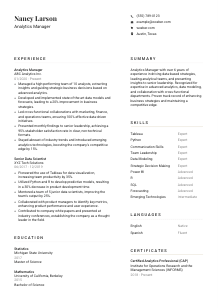
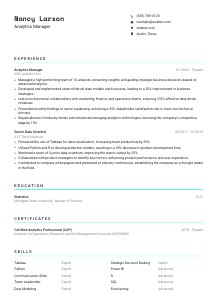
Working with data, but your CV lacks insights? Peruse this Analytics Manager CV example, created with Wozber free CV builder. Learn how to blend your analytical acumen with job requirements, shaping a career narrative that's as compelling as the insights you uncover!
Analytics managers sit at the point where technical analysis turns into business decisions. Hiring teams want to see more than strong modeling or dashboard work. They want proof that you can lead analysts, shape decision-ready insights, and explain complex findings to executives without losing the commercial point.
When that story is tailored well, the CV quickly separates a hands-on analyst from someone who can run an analytics function. Wozber's free CV builder helps you align your language with the job description and create an ATS-compliant CV that surfaces the right mix of leadership, statistical depth, and communication. That makes it easier for reviewers to see whether you can turn data work into action.
For an Analytics Manager, the top of the CV should read cleanly and professionally. This section does not need flair. It needs to show that you are easy to contact, correctly positioned for the role, and aligned with any practical requirements in the posting.
Put your name at the top in a format that is easy to scan. The visual treatment should be simple and polished, the same way you would present a dashboard headline or executive summary: direct, readable, and free of clutter.
Place "Analytics Manager" directly under your name if that is the role you are applying for. Matching the posted title helps frame your background immediately, especially when your recent experience includes adjacent titles such as Senior Data Scientist, BI Lead, or Data Analytics Lead.
List a reliable phone number and a professional email address. Check both carefully. If a hiring manager wants to discuss team leadership experience, forecasting work, or your Tableau and Python background, they should not hit a dead end because of a typo.
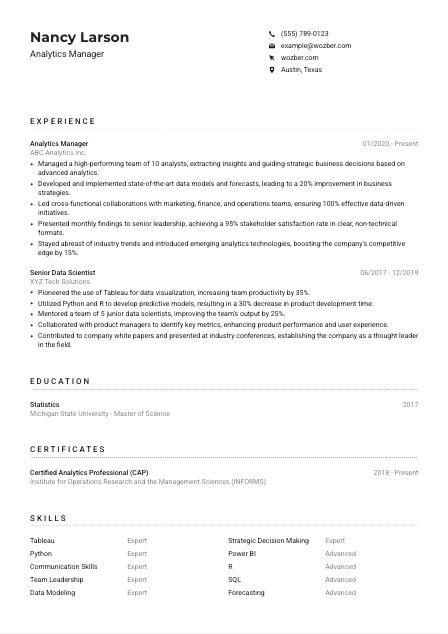
If the employer specifies a location requirement, show it plainly. In the example, listing Austin, Texas directly supports a stated hiring condition. For other Analytics Manager roles, add city and state when location, relocation, or hybrid availability matters to the employer.
A LinkedIn profile, portfolio, or personal site can support your CV if it adds useful depth. For analytics professionals, that might include leadership context, published talks, project summaries, or selected dashboard and modeling work presented in a business-friendly way.
Your personal details should remove basic questions before the reader reaches your experience. Clear title, clean contact information, and any required location details keep the focus where it belongs: on your analytical leadership.




This section carries the most weight for Analytics Manager hiring. Reviewers are looking for a blend of technical depth, team leadership, and business influence. Your bullets should show how you managed analysts, built or guided analytical work, and moved decisions with data.
Start by identifying the work the employer cares about most. For Analytics Manager roles, that usually includes leading analysts, building models or forecasts, partnering across functions, and presenting recommendations to senior stakeholders. Use those priorities to decide which achievements move to the top of each role.
List jobs in reverse chronological order and make the progression visible. Hiring teams want to see whether you moved from individual contribution into leadership, whether you owned larger business questions over time, and whether you managed people, projects, or analytical programs at increasing scale.
Replace generic task descriptions with results tied to business performance. The example does this well with points such as improving business strategies by 20% through data models and forecasts, or reaching 95% stakeholder satisfaction through clear monthly presentations. Those bullets show both technical execution and executive communication.
Metrics give hiring teams a clearer read on your level. Include team size, model impact, reporting cadence, productivity gains, revenue or efficiency outcomes, or cycle-time reductions where they are credible. A line like managing 10 analysts or reducing product development time by 30% says much more than "supported strategic decisions."
Cut or compress accomplishments that do not support the target role. Prioritise leadership, advanced analytics, forecasting, stakeholder communication, cross-functional delivery, and tool-driven impact. If you include earlier data science work, frame it to show how it prepared you for managing analysts and guiding business decisions now.
Your experience section should make three things easy to judge: the scale of your analytics work, the strength of your leadership, and the business value of your decisions. When those are clear, your CV reads like management material rather than a senior analyst profile.
Analytics Manager roles often ask for formal quantitative training, especially when the work involves forecasting, statistical analysis, and model-driven decisions. Your education section should make that foundation easy to spot without taking space away from your professional impact.
If the posting asks for a bachelor's degree in Mathematics, Statistics, Economics, or another quantitative field, make sure that qualification is immediately visible. In the example, a Bachelor of Science in Mathematics and a Master of Science in Statistics align cleanly with that requirement.
List degree, field, school, and graduation year in a consistent structure. Hiring teams scanning for minimum qualifications should be able to confirm your academic background in seconds, especially when the role combines technical analytics with leadership responsibility.
Quantitative disciplines carry weight here because they support work in modeling, experimentation, forecasting, and statistical interpretation. If your degree is in a related field, keep the wording accurate and make the analytical relevance clear through your experience or projects.
Early-career candidates can use selected coursework, thesis work, or capstone projects to show depth in regression, forecasting, machine learning, econometrics, or experimental design. For experienced managers, this is usually optional unless the project directly matches the employer's analytical environment.
Honors, research appointments, or leadership in statistics, economics, or data-focused organizations can help if they reinforce your analytical foundation. Keep these additions brief and relevant so the section stays focused on qualifications that matter for the role.
Education should confirm that you have the quantitative grounding to lead advanced analysis, not distract from your experience. Keep it concise, accurate, and clearly aligned with the level of analytical work the role requires.
Certifications are not mandatory for every Analytics Manager role, but the right ones can strengthen your profile, especially when they connect analytical rigor with current industry practice. Use this section to show ongoing development, not to list every course you have ever taken.
Start with certifications that reinforce analytics, data science, visualization, or management capability. A credential such as Certified Analytics Professional fits well because it signals recognized knowledge in applied analytics without pulling attention away from your work history.
Only include certifications that support the kind of work described in the posting. For an Analytics Manager, that usually means advanced analytics, statistical methods, business intelligence tools, data leadership, or related technical platforms. Relevance matters more than volume.
Include certification dates, and note renewals or active status when applicable. This is especially useful for credentials that require continuing education, because it shows your knowledge is current rather than historical.
Analytics work changes quickly as tooling, modeling approaches, and reporting expectations evolve. A focused certification section can support the point that you stay current with methods and technologies, which matters for managers expected to keep teams and practices up to date.
A well-chosen certification section adds credibility when it strengthens your technical and professional profile. Keep it relevant, current, and connected to the kind of analytics leadership the employer is hiring for.
Analytics Manager CVs need a balanced skills section. The employer is not only hiring for Python, SQL, or Tableau. They are also hiring for judgment, team leadership, stakeholder communication, and the ability to translate analysis into decisions.
Start with the technical and managerial skills named in the posting, then add closely related strengths you genuinely use. Here, that includes data visualization tools such as Tableau or Power BI, programming in Python or R, SQL familiarity, team leadership, and communication with non-technical stakeholders.
Lead with the capabilities that define success in the job. For this kind of role, advanced analytics, data modeling, forecasting, Python, SQL, Tableau or Power BI, and people leadership usually belong near the top. In the example, the mix of Tableau, Python, data modeling, communication, and team leadership supports both the technical and managerial sides of the role.
Avoid turning the skills section into a software inventory. Choose skills you can back up in your experience bullets, projects, or summary. A shorter list with real depth is stronger than a long list that mixes core analytics tools with unrelated or outdated items.
Your skills list should read like the operating toolkit of an Analytics Manager: tools for analysis, methods for decision support, and leadership strengths that help teams turn findings into business action.
Language ability matters more in analytics leadership than many candidates realize. Managers present findings, influence cross-functional teams, and explain technical conclusions in clear business language. This section should support that communication profile without overstating it.
If the posting specifies English fluency, list English prominently with an accurate proficiency level. That matters for presentations to senior leadership, written recommendations, and day-to-day communication with analysts and business partners.
Additional languages can strengthen your profile when the company works across regions, customer groups, or international teams. They are not a substitute for analytics experience, but they can be a useful secondary advantage.
Choose clear ratings such as Native, Fluent, Professional, Conversational, or Basic. Accuracy matters. If you are likely to present findings or collaborate in that language, your stated proficiency should hold up in practice.
For Analytics Managers, extra languages can help in regional reporting, stakeholder workshops, or cross-market analysis. That relevance is stronger when your work involves multinational teams, diverse customer data, or executive audiences in more than one language.
Languages should support your candidacy, not compete with your core analytics qualifications. A simple entry such as English: Native and Spanish: Fluent, as shown in the example, is enough when the rest of the CV already proves the analytical and leadership side of your profile.
Used well, language details reinforce that you can communicate clearly across teams and audiences. For Analytics Manager roles, that supports a practical hiring question: can this person explain complex analysis in a way people will act on?
The summary is your opening argument for why your background fits this level of analytics leadership. It should quickly cover your seniority, your analytical strengths, and the kind of business impact you have led, without repeating bullet points word for word.
Before writing, identify the few qualities the employer needs to see first. For an Analytics Manager, that usually means experience level, advanced analytics capability, team leadership, and executive-facing communication. Build the summary around those points rather than broad claims about being results-driven.
Start with a direct line that places you at the right level, such as an Analytics Manager with 6+ years in advanced analytics or data science. The example summary does this effectively and immediately frames the candidate as someone operating beyond entry-level analysis.
Use the next sentence to mention the areas that distinguish you for this role, such as data modeling, forecasting, dashboarding, cross-functional partnership, or leading analytical teams. Keep the language tied to work you can prove elsewhere on the CV.
Aim for a short paragraph that sounds like the kind of introduction you would give in a leadership meeting. Crisp wording works best. Focus on what you help the business do through analytics, whether that is improving strategy, accelerating decisions, or strengthening performance tracking.
A strong summary should position you as someone who can lead analysts, guide decision-makers, and deliver analytical work that matters commercially. If that is clear in four or five lines, the rest of the CV has a strong opening to build on.
An Analytics Manager CV should show a clear through-line from technical skill to team leadership to business impact. When each section supports that progression, hiring teams can quickly see whether you are ready to manage analysts, guide strategy, and communicate insights at senior level.
Use Wozber to tighten the tailoring, strengthen ATS optimisation, and present your work in an ATS-friendly CV format that reflects the language of the role. The finished CV should make one thing easy to judge: you can lead analytics work that changes decisions.




