



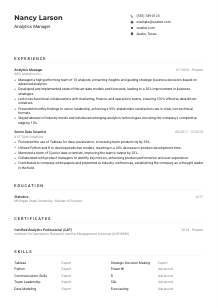
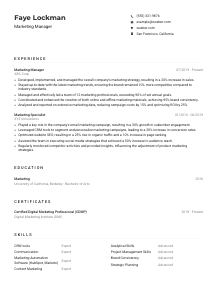
Use Wozber and land your dream job
Create CV
No registration required
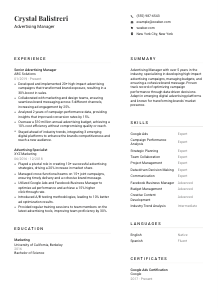
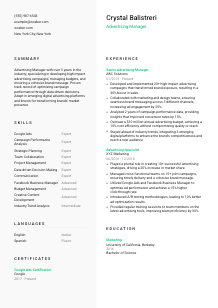
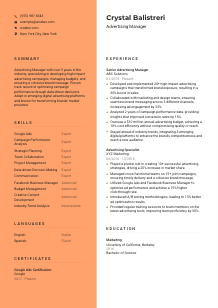
Designing campaigns but your CV isn't getting a click? Swipe right on this Advertising Manager CV example, created with Wozber free CV builder. Learn how to showcase your strategic marketing skills to match job requirements, positioning your career at the top of the creative ad space!
Advertising managers are hired on their ability to turn strategy into campaigns that move numbers. A CV in this field has to show more than general marketing experience. It needs to make your channel judgment, budget control, performance analysis, and cross-functional coordination visible from the first page.
When those details are tailored to the posting, hiring teams can quickly separate broad marketing backgrounds from candidates who have actually managed paid campaigns, optimisation cycles, and reporting. Wozber's free CV builder helps you shape that story into an ATS-compliant CV, so your Google Ads work, budget ownership, and campaign results are easy to read in both screening tools and human review.
This section is simple, but it still affects how smoothly your application moves. For an Advertising Manager role, your header should immediately confirm who you are, how to reach you, and whether you meet practical requirements such as location and professional title alignment.
Use your full name as the clearest text in the header so it reads like a professional byline, not a design element. Keep the formatting clean and modern. In advertising, presentation matters, and even this first line should suggest good judgment and polish rather than visual clutter.
Place "Advertising Manager" under your name when that matches the role you are pursuing. This instantly frames your background around campaign leadership, media planning, and performance accountability. If your current title is slightly different, such as Senior Advertising Manager, you can still align it carefully when your experience supports the same level of responsibility.
List a reliable phone number and a professional email address in a format that looks current and business-ready. If you include a website or portfolio, make sure it supports your candidacy with campaign work, brand examples, or measurable results, not unrelated content. A hiring manager should be able to reach you and review your work without friction.
Some advertising roles are tied to a market, office, or client base. Here, New York City is a stated requirement, so showing "New York City, New York" in the header removes an immediate question. Treat this as targeted tailoring to the posting, not a rule for every Advertising Manager CV.
If you have a LinkedIn profile or personal site, include it only if it strengthens your credibility. For this profession, that might mean showcasing campaign scope, platform expertise, certifications, or leadership over channel strategy. Keep the content aligned with the CV so the story stays consistent across every touchpoint.
Your personal details should confirm the basics fast: title alignment, contact access, and any logistical requirement the employer has already named. For an Advertising Manager, that clarity keeps the focus where it belongs, on campaign leadership and business results.




This is the section most likely to decide whether you move forward. Advertising hiring teams want to see the kind of campaigns you led, the platforms you used, the budget or channel scope you managed, and what changed because of your decisions. Generic marketing bullets get skipped quickly in this field.
Before rewriting anything, mark the responsibilities that define the role. In this posting, that includes strategic campaign development, brand consistency across platforms, performance analysis, budget management, and staying current with new advertising channels. Those themes should guide which achievements you surface first and which language you mirror.
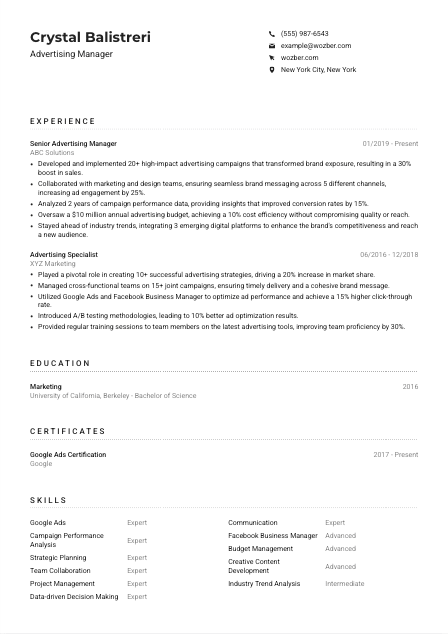
For each position, show the parts of your work that map to advertising management rather than broad marketing support. Start with campaign planning and execution, then move into optimisation, collaboration, and budget oversight. The sample CV does this well by opening with 20+ advertising campaigns and then moving into engagement, conversion, and budget outcomes.
Strong bullets in this field usually include results such as sales lift, click-through rate, conversion rate, cost efficiency, reach, engagement, or market share. Numbers help hiring teams understand scale and decision quality. "Improved conversion rates by 15%" or "managed a $10 million annual budget with 10% cost efficiency" tells a far fuller story than "responsible for campaign optimisation."
If the role calls for Google Ads and Facebook Business Manager, mention them where they were part of real delivery. Also include relevant workflow details such as A/B testing, channel optimisation, audience targeting, or reporting analysis when they reflect your experience. These specifics help distinguish someone who managed live performance campaigns from someone who worked around them.
Every bullet should earn space by showing strategic contribution, execution scope, or measurable performance. Remove older details that do not connect to ad operations, campaign outcomes, client or stakeholder coordination, or platform use. A tighter experience section helps hiring teams see your management depth faster, especially when they are scanning for supervisory experience and paid media ownership.
An Advertising Manager CV works best when each role shows campaign ownership, channel fluency, and business impact in concrete terms. By the end of this section, the reader should already understand the scale of work you can lead and the results you know how to improve.
Education usually will not outweigh your campaign record at this level, but it still matters when the posting names a degree requirement. For advertising management, the section should confirm your academic base in marketing, advertising, communications, or a related field without distracting from stronger experience-led proof elsewhere on the page.
If the employer asks for a Bachelor's degree in Marketing, Advertising, or a related field, present that information directly. A degree such as "Bachelor of Science in Marketing" checks the requirement cleanly and supports your background in positioning, audience strategy, and promotional planning.
List the degree, school, field of study, and graduation year in a straightforward format. This section is usually reviewed quickly, so avoid extra wording or decorative formatting. Clarity matters more than detail unless you are early in your career.
When your field of study aligns with the role, that connection should be obvious. In the example, a marketing degree reinforces the transition into campaign strategy and advertising platform work. If your degree is in a related discipline, use the standard title and let your experience section do the heavier role-specific proof.
Most experienced Advertising Managers do not need to list classes. Still, if you are earlier in your career or shifting into paid media leadership, coursework in digital advertising, consumer behaviour, analytics, or media planning can help explain the foundation behind your current skills. Include it only when it strengthens the role match.
Honors, relevant student projects, or marketing competition work can be useful if they connect to campaign strategy, analytics, brand development, or leadership. For a manager-level candidate, keep these brief. The section should support your professional story, not compete with it.
For this role, education should do one job well: confirm that you meet the stated academic requirement and have a relevant foundation in marketing or advertising. Keep it clear, accurate, and secondary to your campaign results.
Certifications matter most when they reinforce the tools and channels the employer already cares about. In advertising, they can help validate current platform knowledge, especially for paid media environments where bidding systems, policy changes, and reporting features evolve quickly.
Start with credentials that support the actual platform requirements in the job description. Here, Google Ads Certification is directly relevant because the role asks for strong proficiency with Google Ads. That kind of alignment makes the certification section immediately useful rather than decorative.
Order certifications by hiring value, not by personal preference. Platform credentials, digital marketing certifications, and analytics-related certifications usually matter more than broad or outdated training. In the example, Google Ads Certification deserves top placement because it speaks directly to campaign execution.
Advertising platforms change fast, so dates matter. If a certification is active, renewed, or ongoing, show that clearly. A current certification suggests you are staying familiar with platform updates, bidding options, audience settings, and measurement tools rather than relying on old knowledge.
Use certifications to reflect how your work is evolving. Beyond core paid search and social credentials, additional learning in analytics, attribution, retail media, or emerging platforms can strengthen your profile when it matches your target jobs. The key is relevance to the campaigns you want to manage next.
A well-chosen certification section reassures employers that your platform knowledge is current and job-relevant. For Advertising Manager roles, it works best when it backs up the experience section with recognizable tools and active credentials.
Advertising managers are usually screened for a mix of platform fluency, performance analysis, planning judgment, and team coordination. A skills section should reflect that working reality. It should not read like a generic marketing list, and it should not duplicate every phrase from the job description without proof elsewhere on the CV.
Look beyond broad labels and identify the actual capabilities required. For this role, that includes Google Ads proficiency, Facebook Business Manager, campaign performance analysis, strategic planning, budget management, communication, and cross-functional collaboration. These are the skills that support campaign delivery and optimisation in day-to-day work.
Include the skills you can back up with results in your experience section. If you list campaign analysis, budget management, or creative content development, there should be bullets elsewhere showing conversion improvements, spend oversight, or channel execution. The sample CV handles this well by pairing platform skills with measurable gains in click-through rate, sales, and efficiency.
A shorter, sharper list is usually stronger than a long inventory. Prioritise the skills most likely to matter in advertising management: paid media platforms, reporting and optimisation, strategic campaign planning, budget control, and stakeholder communication. That makes it easier for both ATS screening and hiring teams to spot the capabilities tied to live campaign ownership.
Your skills section should reinforce the way you work: the platforms you know, the decisions you make, and the collaboration required to deliver campaigns on time and on budget. Keep it aligned with the evidence already shown in your experience.
Advertising work depends on clear messaging, stakeholder communication, and platform execution, so language ability can matter more here than in some back-office roles. That does not mean every CV needs a long language section. It means you should present language capability in a way that supports the communication demands of the job.
This posting specifies an English-speaking environment, so English should be listed clearly and accurately. If English is your native or professional working language, state that plainly. It removes uncertainty about meetings, reporting, copy review, and collaboration across teams.
Additional languages can be useful when they support audience reach, client communication, or collaboration in diverse markets. For example, Spanish may strengthen your profile in roles involving multicultural campaigns or broader customer segments. Include extra languages when they add business value, not just because you know them.
Terms like Native, Fluent, Advanced, or Conversational make your level easy to understand. Avoid vague wording. Hiring teams want a realistic sense of whether you can present ideas, review messaging, or handle day-to-day communication in that language.
Some Advertising Manager positions are highly local, while others involve international audiences, regional teams, or multilingual creative review. Adjust the section based on what the role actually touches. In this case, English is the clear requirement, while other languages are a secondary advantage rather than a core qualification.
For Advertising Manager applications, language information should support communication credibility, not fill space. Make the required language obvious, then add others only when they strengthen the business context of your candidacy.
The summary is where you establish your level fast. In advertising, that means leading with years of experience, campaign scope, platform fluency, and the kind of outcomes you influence. A vague opener about being passionate or creative does little here. Hiring teams want to know what kind of advertising manager you are and what results tend to follow your work.
Start with a direct line that defines your professional profile. "Advertising Manager with over 5 years of experience" works because it immediately addresses the seniority requirement. If your background leans toward paid media, brand campaigns, performance marketing, or multi-channel strategy, include that focus early.
Use one or two short points that reflect the employer's priorities, such as building strategic campaigns, managing budgets, improving conversions, or coordinating messaging across channels. The example summary does this by combining campaign development, budget management, and data-driven optimisation into a compact profile.
Aim for a short paragraph that reads like experienced professional positioning, not ad copy. Choose concrete terms like campaign performance, brand exposure, conversion improvement, paid platforms, and cross-functional execution. That keeps the summary credible and gives the reader a focused lens for the rest of the CV.
A strong summary gives the reader an immediate sense of your advertising scope, strategic level, and performance mindset. If it is doing its job, the hiring team already expects to see campaign results, platform knowledge, and leadership depth in the sections that follow.
An effective Advertising Manager CV makes three things easy to spot: the campaigns you have led, the platforms and budgets you have managed, and the business results you improved. When each section supports those points, the document feels credible, focused, and ready for serious review.
Use Wozber to tighten that alignment from top to bottom. Its ATS-friendly CV templates, ATS CV scanner, and AI-powered tailoring features help you match role language, surface missing requirements, and present your experience in an ATS-friendly CV format that keeps campaign leadership and measurable performance front and centre.