



Use Wozber and land your dream job
Create CV
No registration required
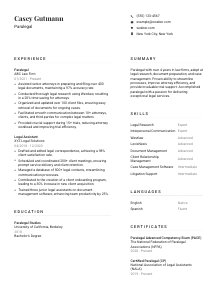
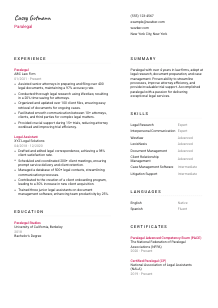
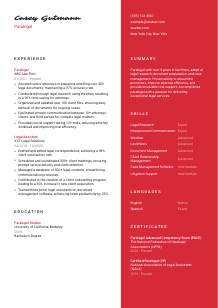
Pounding away on legal drafts, but your CV seems non-defensible? Check out this Paralegal CV example, put together using Wozber free CV builder. It shows how to align your case-winning skills with job criteria, convincing employers that you're the legal eagle they need by their side!
Paralegal work runs on accuracy, timing, and document control. Attorneys depend on you to keep filings on track, research grounded, and client records organised enough that the next motion, hearing, or trial prep step does not stall. Your CV should make that operational value visible fast, especially through examples of legal drafting support, research depth, and case-file management.
A tailored CV changes how quickly a legal employer can place you in their workflow. When your wording reflects the posting's priorities, such as legal research platforms, filing support, and coordination across attorneys and clients, Wozber's free CV builder helps turn that experience into an ATS-compliant CV that is easier to parse and stronger in front of hiring teams. The result should be a clear picture of how you support legal work under real deadlines.
Law firms and legal departments do not need a long personal profile. They need clean, professional contact details and any location information that directly affects eligibility for the role.
Place your full name at the top, then use the job title you are pursuing, such as "Paralegal." Matching the title to the posting helps frame the rest of the CV around legal support work rather than broader administrative experience, which is especially useful if you have held titles like Legal Assistant or Case Coordinator.
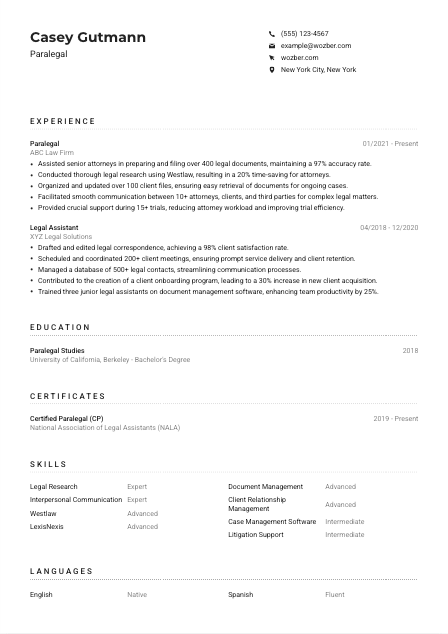
List a working phone number and a professional email address with no typos. If the posting includes a location requirement, include your city and state in this section. In the example, "New York City, New York" directly supports a stated employer requirement, but location should only be emphasized when the job actually asks for it.
A LinkedIn profile can help if it reinforces your legal experience, certifications, software knowledge, or litigation support background. Keep the dates, titles, and firm names consistent with the CV so attorneys, recruiters, or legal operations staff do not run into conflicting information.
This section should stay focused on information that helps the employer contact you and confirm basic eligibility. For a paralegal opening, that usually means your name, title, phone, email, location when relevant, and optionally a professional profile link. You do not need extra personal data to strengthen your application.
Skip details such as marital status, age, photo, or unrelated personal identifiers. Legal employers are scanning for whether you can support filings, research, document organisation, and attorney coordination. Give them a clean header that keeps attention on your qualifications.
Keep your personal details brief, accurate, and professionally presented. For paralegal roles, this section should confirm who you are, how to reach you, and, when relevant, whether you meet a location requirement without pulling focus from your legal experience.




This is where hiring teams look for proof that you can handle the pace and precision of legal practice. Your bullets should show the kinds of documents you supported, how you used research tools, how you kept files organised, and what changed because of your work.
Start by marking the core duties in the job description, then match them to your own history. For a paralegal role, that usually includes preparing and filing briefs, pleadings, or motions, conducting legal research, maintaining client files, coordinating communication, and supporting attorneys during proceedings. If your background covers the same work under a different title, make that overlap clear in your bullets.
List your most recent role first, then work backward. Include your title, employer, and dates. This straightforward structure helps legal employers quickly see whether you meet experience expectations such as 2+ years in a law firm or legal department, and it gives ATS systems a clean path through your employment history.
Each bullet should connect your task to a legal outcome. Instead of saying you "helped attorneys," specify what you prepared, researched, filed, organised, or coordinated. The example does this well with details like preparing and filing more than 400 legal documents and supporting trial work, which immediately tells a hiring manager where the candidate fits in a legal team.
Numbers carry weight in paralegal CVs because they show volume and reliability. Good metrics include document counts, filing accuracy, time saved through research, number of attorneys supported, case volume, trial support frequency, or client communication load. A line such as a 97% accuracy rate or 20% attorney time savings is much stronger than a general claim about being efficient.
Keep the section centered on work that matters to the target role. If you are applying for a litigation-focused or general paralegal position, prioritise legal research, drafting support, case organisation, records management, and coordination across counsel, clients, and third parties. Administrative accomplishments can stay if they clearly improved legal workflow, but unrelated wins should not take space from stronger evidence.
Your experience section should show that you can step into legal workflow quickly and handle the details attorneys rely on. Focus on document work, research tools, file management, coordination, and measurable contributions that reflect real law firm or legal department demands.
For paralegal openings, education is often a threshold item before it becomes a differentiator. Present it clearly so the employer can confirm that you meet the academic requirement and then move on to your legal experience and certifications.
If the job asks for a bachelor's degree in Paralegal Studies or a related field, make that easy to spot. Put the degree, field of study, school, and graduation year in a standard format. In the example, a bachelor's degree in Paralegal Studies directly matches the requirement and should never be buried.
Legal employers do not need a complicated education layout. A clean entry with degree, field, institution, and date is enough for most experienced candidates. This also supports ATS readability and helps recruiters confirm qualifications in seconds.
If your studies were specifically in Paralegal Studies, legal studies, criminal justice, or another clearly related discipline, show that connection plainly. When your degree is in a broader field, you can still present it effectively, but make sure your experience and certifications do more of the work in establishing legal specialization.
Recent graduates can strengthen this section with relevant coursework such as legal research, civil procedure, litigation support, or legal writing. Honors, moot court, legal clinic work, or strong academic distinctions can also help if you do not yet have much law firm experience.
If you participated in a legal clinic, internship, research project, or document-intensive academic program, include it when it supports the role you want. These details are especially useful when they show hands-on exposure to research, drafting, client intake, or case preparation.
Use the education section to confirm that you meet the degree requirement without slowing down the CV. For most paralegal candidates, its job is to establish the academic baseline and support the legal story told in your experience and certifications.
Certifications carry real weight in paralegal hiring because they show formal commitment to the profession and, in some postings, satisfy a stated requirement. If a role asks for a CP or PACE credential, this section should make that answer immediate.
When the posting names a certification, list it prominently and use the exact credential name. For this role, that means Certified Paralegal "CP" or Paralegal Advanced Competency Exam "PACE." The example includes both, which makes qualification easy to confirm, though many roles will only require one of them rather than both.
Use this section for credentials that strengthen your standing as a paralegal, not for every course you have taken. Legal employers will care far more about recognized paralegal certifications, compliance-related training, or specialised legal credentials than generic professional development items.
List when the certification was earned and who issued it. That context helps the employer understand whether the credential is current and from a recognized body. In legal hiring, named issuers such as NALA or NFPA add useful credibility because they are familiar to many firms and departments.
If your certifications are active, renewed, or supported by continuing education, make that visible when the format allows. Legal procedures, filing expectations, and practice-area demands change over time, so current credentials reinforce that you are keeping pace with the profession rather than relying on outdated knowledge.
Your certifications section should answer an important hiring question quickly. Are you formally qualified for the level of paralegal work this employer needs? Put the most relevant legal credentials first and make them easy to verify.
The best paralegal skills sections read like a practical legal toolkit. They should reinforce the work you have already shown in your experience, with a mix of research tools, document handling, communication, and case support capabilities tied to the posting.
Start with skills the employer explicitly asks for. In this case, legal research platforms such as Westlaw or LexisNexis belong near the top if you have real experience with them. Mirroring that language helps with ATS optimisation and shows that you can work in the systems the legal team already uses.
Paralegals are hired for both technical execution and dependable coordination. Pair hard skills like legal research, document management, case management software, and litigation support with role-critical soft skills such as interpersonal communication, client communication, and teamwork. The posting's emphasis on working independently and collaboratively makes that balance especially important here.
Do not turn this section into a long inventory. Choose the skills most relevant to the target job and use terms that are standard in legal settings. The example's mix of Legal Research, Westlaw, LexisNexis, Document Management, Client Relationship Management, and Litigation Support is useful because each item ties back to real paralegal tasks rather than vague strengths.
Every skill you include should support a legal function the employer cares about. Prioritise research platforms, filing and document workflows, communication, and case support skills that match the job description and reinforce your experience bullets.
Language ability matters in legal settings when it affects drafting, client communication, intake, or coordination across parties. Present it clearly and honestly, especially when the posting names a required language.
If English proficiency is listed as a requirement, include English with an accurate proficiency level. That may seem obvious, but in legal work it matters because written communication, document review, and client-facing coordination all depend on precise language use.
Extra language ability can strengthen your profile when it is relevant to the client population or practice area. For example, Spanish may be useful in many legal environments for intake conversations, basic coordination, or client communication, but it should be presented as an added capability rather than a substitute for core paralegal qualifications.
Be precise about whether you are native, fluent, advanced, or conversational. Legal employers may rely on listed language skills in client interactions or document handling, so overstating proficiency can quickly become a problem on the job.
Order languages by relevance to the position. If the posting only requires English, place that first. If an additional language is likely to support the firm's client base or matter mix, include it, but keep the emphasis where the job description puts it.
Language skills are most valuable on a paralegal CV when they connect to real work such as explaining next steps to clients, coordinating with outside parties, or navigating multilingual case communication. Framing them this way keeps the section professional and useful.
List languages with the same accuracy you would bring to a filing or research memo. For paralegal roles, clear language information helps employers understand whether you meet required communication standards and whether you offer additional client-service value.
Your summary should read like a concise case for why you belong in the role. In a few lines, show your level of experience, the kind of legal support you provide, and the tools or outcomes that match the employer's priorities.
Start with a direct introduction such as "Paralegal with 4+ years in law firm settings" or a similarly accurate version of your background. This immediately answers a common screening question and helps distinguish you from candidates whose experience is more administrative than legal.
Use the summary to name two or three role-defining capabilities, such as legal research, preparation of briefs and motions, case file management, trial support, or proficiency with Westlaw and LexisNexis. The example works because it quickly establishes research, document preparation, and case management rather than relying on generic claims about being hardworking.
Aim for a short paragraph that highlights the value you bring to attorneys and legal operations. Phrases about improving attorney efficiency, maintaining accurate files, supporting litigation, or handling high document volume are much stronger than broad statements about passion or dedication unless they are backed by specifics elsewhere.
The summary should shift based on the role. If one employer emphasizes litigation support and hearings, lead with trial and filing experience. If another leans toward research-heavy work, foreground legal research platforms and memorandum support. Tailoring this section is one of the fastest ways to align your CV with the posting.
A paralegal summary should tell the reader, in a few lines, what kind of legal support you provide and at what level. When it reflects the posting's priorities, it helps the employer place you in their practice quickly and keep reading for the details.
Your CV should now present you as someone who can support attorneys with organised files, dependable research, accurate document handling, and steady communication across matters. That is the core story legal employers need to see.
Use Wozber's AI CV builder to tailor your language to the posting, strengthen ATS optimisation, and organise your experience in an ATS-friendly CV format that legal employers can review quickly. The finished document should make one thing easy to judge: whether you can step into a paralegal workflow and contribute from day one.