



Use Wozber and land your dream job
Create CV
No registration required
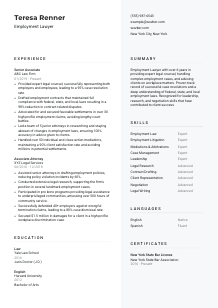
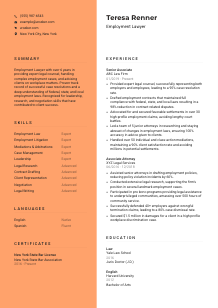
Fighting workplace battles, but your CV hits a snag? Check out this Employment Lawyer CV example, created with Wozber free CV builder. Learn how to match your legal acumen to job prerequisites, positioning your career trajectory as solidly as airtight contracts!

Employment law work is judged in practice by how well you handle conflict before it escalates and how effectively you defend a position when it does. A CV for this field needs to make that visible quickly through the kinds of matters you advise on, the disputes you have handled, the documents you draft, and the outcomes you have delivered for employers, employees, or both.
When those details are tailored to the posting, reviewers can separate broad legal experience from true employment-law depth much faster. Wozber's free CV builder helps you align that language in an ATS-friendly CV format, so your case resolutions, compliance work, and litigation scope are easier to identify from the first scan.
Law firms and in-house teams expect clean, exact information at the top of the page. For an Employment Lawyer, this section should confirm professional identity, make contact easy, and address practical filters such as jurisdiction or location when the posting calls for them.
Use your full name in a clear, professional format that is easy to spot at a glance. Keep styling restrained. Legal hiring rarely rewards decorative formatting, and a straightforward heading sets the right tone for a profession built on precision.
Place "Employment Lawyer" directly under your name if that is the role you are pursuing. Matching the title used in the posting helps frame the rest of the CV around employment counseling, workplace investigations, contract drafting, and dispute resolution rather than broader litigation or general counsel work.
List a phone number and a professional email address you check regularly. If you include a website or LinkedIn profile, make sure it reflects the same practice area focus, bar status, publications, or representative matters shown on your CV.
Geography can matter in legal hiring, especially where court access, client meetings, or local labour law knowledge are relevant. Here, the employer asks for someone based in New York City, New York, so stating that location directly removes a likely screening question early.
A LinkedIn page, attorney bio, or personal site can help when it includes useful legal content such as speaking engagements, articles on employment compliance, or practice summaries. Keep it current and consistent with your CV. If it adds no relevant legal context, leave it off.
This section should read like a reliable legal header: accurate, current, and easy to verify. Once the contact details and location are settled, the hiring team can focus on your employment law record.




This is where employers look for actual practice scope. Titles alone do not show whether you have advised on workplace policy, defended wrongful termination claims, managed mediations, or drafted compliant employment agreements. Your bullets need to show the matters you handled and what changed because of your work.
Read the job description closely and mark the recurring work: counseling clients on workplace issues, drafting contracts and policies, handling discrimination or harassment claims, and representing parties in mediation, arbitration, or civil litigation. Those responsibilities should shape the language of your bullets so the match is obvious without forcing keywords.
List your most recent role first and include your title, employer, and dates for each position. In legal CVs, this helps reviewers quickly map your progression from associate-level work to independent case handling, client counseling, team leadership, or more complex dispute portfolios.
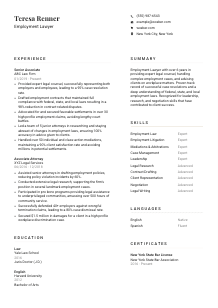
Choose bullets that show employment-law substance over generic legal support. Strong examples include defending wrongful termination claims, drafting workplace policies, leading investigations, negotiating settlements, or advising on multi-jurisdiction compliance. The sample CV does this well by showing representation of both employers and employees, contract drafting, and hands-on dispute work rather than broad legal duties.
Metrics make your practice scope tangible when they reflect real legal outcomes. Case resolution rate, number of mediations handled, dismissal rate, settlement value, reduction in policy violations, or dispute reduction after contract revisions are all credible indicators. For example, a bullet noting a 95% case resolution rate or 50+ mediations immediately tells the reader about volume and effectiveness.
If you have broader litigation or advisory experience, keep the parts that support your employment-law candidacy and trim the rest. Prioritise labour and employment disputes, compliance work, client representation, legal research tied to workplace law, and negotiation results. Even strong achievements should earn space by reinforcing your fit for the target practice area.
Your experience section should show what kinds of employment matters you handled, how much responsibility you carried, and what results followed. When that is clear, the CV reads less like a job history and more like a proven practice record.
For lawyers, education is a credentialed requirement, not a decorative section. Hiring teams need to see the law degree quickly, and they should be able to confirm the academic path that supports your practice without digging through extra detail.
Lead with your Juris Doctor because it is the essential degree for the role. Include the law school name clearly. The posting specifically requires a J.D. from an accredited law school, so this credential should be impossible to miss.
List degree, school, field of study if useful, and graduation year. Legal hiring values clarity here. A simple structure also supports ATS parsing and keeps the focus on the credential itself rather than formatting choices.
When the employer names a required degree, mirror that language accurately. If you also hold another degree that supports your profile, include it after the J.D. In the example, a Bachelor of Arts in English adds context for strong writing and communication, but the J.D. remains the credential that anchors the section.
Coursework, journals, moot court, clinics, or research assistant work can be useful if you are earlier in your career or if they relate directly to employment law, civil procedure, negotiation, or workplace rights. For a lawyer with several years of practice, keep these details selective.
Honors such as cum laude, law review, or major advocacy awards can strengthen this section, especially if your post-qualification experience is still developing. Once you have a deeper case record, academic achievements should support your profile rather than dominate it.
The education section should confirm that you meet the profession's baseline without slowing the reader down. Put the J.D. in plain view, keep the rest concise, and let your practice experience carry the heavier weight.
In legal hiring, active licensing is often more important than optional certifications. For an Employment Lawyer, this section should reassure the reader that you are authorized to practice and current enough to advise on changing workplace law requirements.
If you are licensed to practice, place that first. For a New York-based employment role, a New York State Bar license is highly relevant because it supports court practice, client counseling, and local law compliance work tied to the jurisdiction.
Use this section for bar admissions, employment-law-adjacent certifications, or substantial compliance training that strengthens your candidacy. Remove items that do not help explain your authority to practice or your relevance to workplace law matters.
Dates matter for legal credentials. If a license is active, note the start year and current status so there is no ambiguity. The example's "2016 - Present" format works well because it communicates ongoing validity immediately.
Employment law changes with new regulations, agency guidance, and court decisions. If you complete continuing legal education or gain certifications tied to investigations, mediation, or HR compliance, add the most relevant ones to show that your knowledge stays current.
This section should quickly answer a practical legal question: are you licensed, current, and prepared to practice in the jurisdiction that matters for the job. Keep it tight and directly relevant.
A legal skills section works best when it reflects actual practice, not generic professional traits. For Employment Lawyers, that usually means a mix of subject-matter expertise, dispute-handling capability, research strength, and drafting or negotiation skills tied to workplace matters.
Pull out the capabilities the employer names directly, then match them with your real experience. Here that includes employment law knowledge, client representation in disputes, legal research, negotiation, and communication. Terms such as "employment litigation" or "mediations and arbitrations" are especially useful when they reflect work you have actually done.
Choose skills that show how you practice. Employment contract drafting, workplace investigations, policy review, discrimination claim handling, legal writing, mediation, arbitration, and multi-jurisdiction compliance are stronger than broad labels like "problem-solving" on their own. Soft skills belong here only when they support legal delivery, such as negotiation or client counseling.
Do not overload this section with every skill you have used in practice. A focused list is easier for both human reviewers and ATS systems to process. The example balances substantive areas such as Employment Law and Legal Research with practical delivery skills like Contract Drafting and Negotiation, which is a useful model.
Every skill listed should connect to real employment-law tasks you can discuss in an interview or support with examples from your casework. Relevance matters more than volume.
Employment law often involves interviews, negotiations, policy advice, and sensitive fact patterns where precise language matters. If you speak more than one language, that can widen your client reach and improve communication in investigations or disputes, but only if the proficiency level is stated honestly.
The posting asks for strong command of English, so list English prominently and describe your level accurately. In legal work, this goes beyond conversation. It implies clear drafting, precise advocacy, and dependable interpretation of statutes, contracts, and witness statements.
Extra languages can be a real asset in employment law, especially in diverse labour markets and employee-facing matters. Spanish, for example, may help with client communication, intake interviews, or workplace investigations, but it should be listed only if you can use it confidently in a professional setting.
Terms like Native, Fluent, Advanced, Intermediate, and Basic are usually enough. Avoid exaggeration. If you cannot negotiate, advise, or review documents comfortably in that language, choose a lower level.
Not every employment-law position requires multilingual ability. Include extra languages when they add practical value to the type of clients, workforce, or disputes you are likely to handle. If they do, they can become a differentiator rather than a sidebar.
If you regularly conduct interviews, explain legal options, or handle sensitive workplace matters across languages, maintaining that fluency is part of your professional effectiveness. Ongoing language development can strengthen both client trust and case handling.
For this profession, language skills matter when they improve communication, drafting, or client access. State them clearly, rate them honestly, and keep the emphasis on practical legal use.
The summary should give a hiring partner or recruiter a fast read on your practice area, level of experience, and the kinds of results you are known for. For an Employment Lawyer, that usually means years in practice, employment-law scope, dispute experience, and a short line on advisory or compliance strength.
Read the posting for the main themes before you write. Here, the employer wants an attorney with at least 5 years of experience, strong knowledge of employment laws, dispute representation experience, and strong communication and research skills. Those priorities should shape the summary first.
Start with a direct line that establishes your level and specialty, such as "Employment Lawyer with 6+ years of experience." That gives immediate context and helps the reader place the rest of your background quickly.
Use the next lines to show the kind of employment work you actually handle. That may include advising employers and employees, litigating workplace disputes, drafting contracts and policies, conducting investigations, or negotiating settlements. The sample summary works because it combines experience level, legal domain knowledge, and successful outcomes in a compact form.
Aim for a short paragraph of 3 to 5 lines. Include one or two concrete indicators of performance when possible, such as strong resolution results, deep compliance knowledge, or leadership in complex matters. Avoid broad claims that are not supported elsewhere in the CV.
A well-written summary gives the reader a clear headline on your employment-law background before they reach the case details below. Keep it specific enough to distinguish your practice and concise enough to hold attention.
Your CV should now show the parts of employment law practice that matter most in hiring: the disputes you have handled, the advice you have given, the documents you have drafted, and the jurisdictions or regulations you know well.
Use Wozber's free CV builder and ATS CV scanner to align that experience with the posting, strengthen wording around employment-law work, and present it in an ATS-compliant CV that is easy to review.
When the draft is finished, a hiring team should be able to tell quickly whether you can counsel, negotiate, investigate, and represent clients effectively in workplace matters.