




Use Wozber and land your dream job
Create CV
No registration required
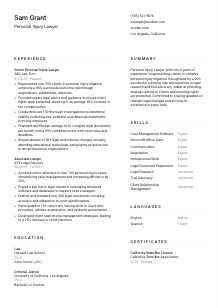
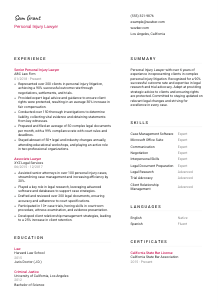
Fighting for justice, but your CV feels bruised? Check out this Personal Injury Lawyer CV example, created with Wozber free CV builder. It shows how to present your litigation prowess in line with job requirements, keeping your legal career in top form, minus any objectionable details!
Personal injury law is built on proof. Hiring teams want to see whether you can turn medical records, witness statements, liability analysis, and procedural deadlines into recoveries for clients. Your CV should make that work visible quickly, especially the parts that show case ownership, negotiation strength, and results in litigation or settlement.
When the CV is tailored to the posting, the first read becomes much clearer: are you a general practice attorney, or someone who has handled plaintiff-side injury matters from investigation through resolution. Wozber's free CV builder helps shape that distinction into an ATS-compliant CV by aligning your wording with the job description, so your background reads as relevant personal injury experience instead of broad legal experience.
For a Personal Injury Lawyer, the top of the CV should confirm professional identity and availability without distractions. This section is brief, but it still carries practical information a firm may screen for early, especially title alignment, contact accuracy, and, in some cases, location.
Use your full name in a clean, readable format that stands out from the rest of the page. Law firms move quickly between CVs, writing samples, and case lists, so your name should be easy to find at a glance and consistent across your application materials.
Place "Personal Injury Lawyer" directly under your name when that accurately reflects your background and the role you want. It immediately frames your candidacy around plaintiff representation, case valuation, negotiation, and trial work rather than leaving the reader to infer your practice area from later sections.
List a reliable phone number and a professional email address. In legal hiring, small errors can create real doubt about attention to detail, especially in a role that depends on accurate filings, client communication, and deadline control.
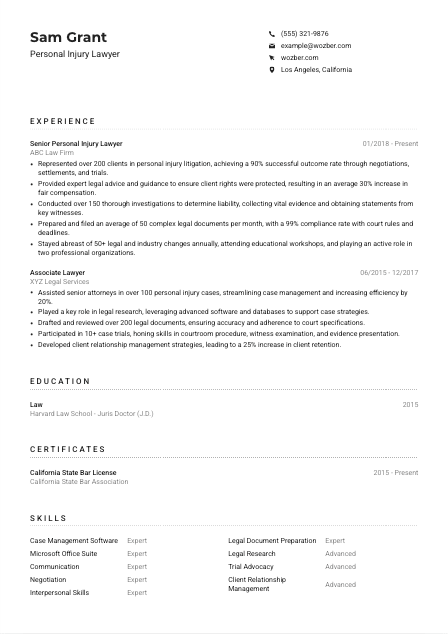
If the employer wants someone based in a specific market, include your city and state. In the example, listing "Los Angeles, California" supports a posting that asks for local presence or willingness to relocate. That is a tailoring move tied to this opening, not a rule for every personal injury position.
Include a LinkedIn profile or professional website only if it strengthens your application with bar information, representative matters, publications, or speaking engagements. Keep the content aligned with your CV so your litigation record, practice focus, and credentials tell the same story everywhere.
This section should confirm who you are, what kind of attorney you are, and how to reach you without forcing the reader to search. Once that is clear, the rest of the CV can focus on your case results and legal judgment.




Experience carries the most weight on a Personal Injury Lawyer CV because firms want to understand the scope of matters you have handled and the outcomes you have helped produce. Show the kind of files you managed, the litigation work you performed, and the results you delivered for clients.
Start by identifying the work the employer actually needs covered. Here, that includes client representation in personal injury litigation, settlement negotiations, investigations, evidence gathering, legal drafting, and staying current on legal developments. Those responsibilities should guide which bullets you keep, expand, or cut.
For every position, list your title, employer, and dates in a straightforward format. A legal employer should be able to track your progression from associate work to heavier case responsibility, trial exposure, or independent client management without piecing the timeline together.
Each bullet should pair a concrete legal activity with a result. Useful details include number of clients represented, settlement or trial outcomes, compensation improvements, investigation volume, motion practice, or filing accuracy. The example does this well by tying litigation work to a 90% successful outcome rate and a 30% increase in fair compensation.
Numbers help a firm gauge your caseload, pace, and effectiveness. Metrics such as 200+ clients represented, 150 investigations completed, 50 legal documents filed per month, or 99% compliance with court rules make your experience more credible than broad claims about being results-driven.
Prioritise work that supports a personal injury narrative. If you have broader litigation experience, keep the bullets that transfer directly, such as witness interviews, discovery, settlement strategy, courtroom advocacy, or client counseling. Space on the page should go first to the work most connected to injury claims and compensation matters.
A hiring partner should be able to see your practice area, your level of responsibility, and your results within a few bullets. If the section reads like active casework rather than a list of generic legal tasks, you are on the right track.
Education matters in legal hiring because it confirms the credential baseline quickly. For a Personal Injury Lawyer, this section usually needs to establish the J.D. clearly and then step aside for the experience section to carry most of the argument.
If the posting requires a Juris Doctor, list it exactly and make it easy to spot. That direct match matters more than decorative wording. In this case, "Juris Doctor (J.D.)" should appear plainly because it answers a stated requirement from the employer.
Include degree, field, school, and graduation year in a consistent structure. Law firms do not need a dense academic narrative here. They need to confirm the credential efficiently and move on to your litigation background.
Place your law degree before undergraduate education, and avoid burying it under extra detail. The example does this correctly by leading with Harvard Law School and the J.D., which keeps the most relevant qualification at the top of the section.
For early-career attorneys, coursework, clinics, moot court, law review, or a concentration related to torts, civil litigation, or trial advocacy can strengthen the section. For lawyers with more than 5 years of experience, that detail is usually secondary unless it directly supports the target role.
Academic honors, scholarships, or distinctions are worth listing if they are notable and still add value to your profile. As your practice record grows, these should complement your professional experience rather than compete with it for space.
This section should confirm that you meet the legal education requirement without slowing down the CV. Once the J.D. is clear, the reader should naturally return to your case history and results.
For attorneys, this section is less about collecting certificates and more about proving you are authorized to practice and current in your jurisdiction. Licensure and bar standing are essential screening points, especially when the posting names them directly.
When a posting requires admission to the state bar and good standing, lead with that information. A California State Bar license belongs at the top of this section for a Los Angeles opening because it answers a threshold requirement immediately.
After bar admission, include certifications or professional training that reinforce your effectiveness in personal injury practice, such as mediation, trial advocacy, deposition strategy, negotiation, or legal technology training. Skip items that do not strengthen your case-handling profile.
Show the issuance date or active date range where relevant. For legal licensure, dates help confirm continuity and current eligibility. The example's "2015 - Present" format works because it signals an active license rather than a one-time course completion.
If you regularly complete CLEs, attend litigation workshops, or participate in bar sections or plaintiff trial associations, include the most relevant items. Personal injury practice changes with case law, evidentiary issues, and procedural updates, so recent development can strengthen your profile.
Bar status should never be difficult to find on an attorney CV. Keep the section current, relevant, and focused on credentials that support active personal injury practice.
The skills section should read like the toolkit behind your files, not a list of soft phrases. For a Personal Injury Lawyer, that usually means combining litigation skills, client-facing abilities, and the systems you use to manage matters efficiently.
Start with the employer's language, then keep only the skills you can support elsewhere on the CV. In this posting, legal research, case management software, Microsoft Office, communication, negotiation, and interpersonal skills all belong because they connect directly to daily work in personal injury matters.
Show a mix of skills that reflects the full job. Personal injury work depends on more than courtroom ability. It also involves client counseling, settlement negotiation, witness communication, document drafting, and organised use of case management systems. The example's combination of legal research, trial advocacy, and client relationship management is a solid model.
Group the most relevant capabilities first and avoid padding the section with every tool or trait you have ever used. A shorter list of skills tied to litigation, compensation outcomes, and file management will carry more weight than a long inventory with little connection to injury practice.
If a skill supports stronger case handling, client service, or litigation execution, keep it. If it does not connect to the work described in the posting, cut it and use the space for something more relevant.
Language ability can matter significantly in personal injury practice because client trust, intake accuracy, witness communication, and settlement discussions often depend on clear communication. List languages in a way that reflects real working proficiency.
If the posting states that English is essential, include it clearly with an honest proficiency level. For attorneys, this is about more than conversation. It also covers legal writing, client advice, negotiation, and courtroom communication.
Lead with your primary language, especially if it is the language used for pleadings, client correspondence, and hearings. Listing English as "Native" or "Fluent" makes the baseline communication requirement easy to confirm.
Include additional languages that could strengthen client service in your market. In the example, Spanish is a meaningful addition because it may help with intake, client counseling, and witness interviews in a large and diverse metro area. That will be more valuable in some regions and practice settings than in others.
Use clear labels such as Native, Fluent, Conversational, or Basic. Overstating language ability can create problems quickly in legal work, where small misunderstandings can affect client expectations, documents, or testimony preparation.
Feature languages that make sense for the communities you serve or want to serve. If your target firms handle high-volume plaintiff work in multilingual markets, additional language ability can be a practical advantage rather than a side note.
Language ability matters most when it improves client communication and case handling. Present it that way, and the section becomes more than a nice extra.
The summary needs to establish your practice focus quickly. For a Personal Injury Lawyer, that means leading with years of experience, the kind of matters you handle, and the outcomes or strengths that make a firm want to keep reading.
Use the posting to decide what belongs in the opening lines. If the firm wants someone with 5+ years in personal injury, strong communication, litigation experience, and successful outcomes, those are the points your summary should surface first rather than generic statements about being dedicated or passionate.
Start with a direct professional snapshot, such as your title and years of experience handling personal injury matters. That gives immediate context and helps separate you from attorneys with broader but less relevant litigation backgrounds.
Choose measurable or concrete strengths that support the role. The example summary works because it mentions 6+ years of experience, a 90% successful outcome rate, legal research strength, and trial advocacy. Those details tell a firm far more than vague claims about excellence.
Aim for a short paragraph that captures your value without repeating bullets from the experience section. The summary should introduce your profile, not retell your whole caseload. Clear role alignment and one or two well-chosen results are enough.
A well-written summary should make a firm expect to see personal injury litigation, client advocacy, and measurable outcomes in the section that follows. Use Wozber's AI CV builder and ATS CV scanner to align your wording with the posting, strengthen ATS optimisation, and present your background as a credible match for the matters this employer needs handled.
Your CV should now show the essentials a personal injury employer looks for first: licensed practice, relevant case experience, litigation or settlement work, and results tied to client compensation or case outcomes.
Before you apply, review the language against the posting one more time. Wozber's free CV builder, ATS-friendly CV templates, and ATS CV scanner can help you tighten phrasing, surface missing requirements, and deliver an ATS-friendly CV format that makes your personal injury background easy to recognize.
That clarity matters. A hiring team should be able to tell, within seconds, that you can step into active files and represent injured clients effectively.




