



Use Wozber and land your dream job
Create CV
No registration required
Patrolling the highways, but your CV stuck in traffic? Rev up with this State Trooper CV example, created with Wozber free CV builder. Learn how to present your law enforcement expertise in a way that meets agency standards, putting your career in the fast lane and ready to serve and protect!
State Trooper hiring turns quickly on whether your background shows dependable field performance under pressure. Patrol work, crash response, arrests, report writing, and courtroom follow-through all carry public consequences, so your CV needs to show calm judgment, lawful procedure, and day-to-day operational discipline rather than broad statements about service.
The first pass often separates general law enforcement experience from highway-focused enforcement and incident response. Using Wozber's free CV builder helps you shape an ATS-compliant CV around the posting's language, so traffic enforcement, investigations, training, and documentation are easy to find and easy to connect to trooper-level responsibilities.
For a State Trooper CV, the personal details section should remove practical questions immediately. Hiring teams need to see who you are, how to reach you, and whether basic logistics such as location and licensing align with the posting before they get into patrol history or investigative work.
Place your full name prominently, then use the exact target title "State Trooper" beneath it. That simple alignment matters in law enforcement hiring because it keeps your application tied to the patrol and enforcement track you are pursuing, rather than reading like a general public safety CV.
List a reliable phone number and a professional email address that would not look out of place in a formal hiring file. State Trooper roles involve court communication, scheduling, and background processing, so even small presentation details should reflect professionalism and accuracy.
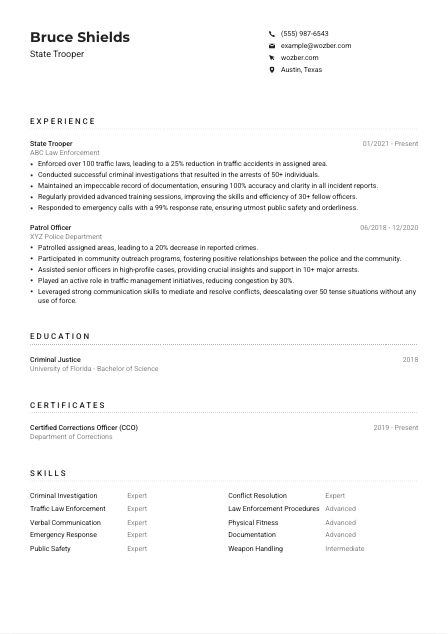
If the posting asks candidates to be in a certain area or willing to relocate, state that clearly in this section. In the example, listing Austin, Texas directly helps address the employer's location requirement without making the reader search for it elsewhere on the page.
Include a LinkedIn profile or professional site only if it supports your law enforcement background with consistent dates, training, and experience. An outdated profile with missing positions or mismatched credentials creates doubt, especially in a field where documentation standards matter.
The posting requires a valid state driver's license without restrictions, but you usually do not need to place license numbers or extra personal identifiers on the CV itself. If needed, signal eligibility in your summary or experience and be ready to provide documentation during later hiring stages.
This section should quickly confirm identity, contactability, and any immediate logistical requirement tied to the assignment. Keep it clean and exact, the same way official records need to be handled on the job.




Experience carries the most weight on a State Trooper CV because it shows how you operate in the field. Hiring teams are looking for patrol scope, enforcement activity, emergency response, investigations, report quality, training work, and outcomes that suggest you can handle independent decision-making on the road and in incident scenes.
Before editing bullets, mark the responsibilities that define the job. Here, that means traffic law enforcement, accident investigation, emergency response, patrol presence, arrests, court testimony, officer training, and accurate records. Your experience section should mirror those functions in plain language when they reflect your actual work.
List your most recent position first and include title, agency, and dates clearly. For this profession, progression matters. A move from Patrol Officer to State Trooper, as shown in the example, tells a useful story about increased enforcement authority, investigative responsibility, and field experience.
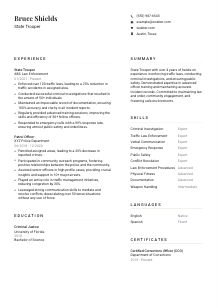
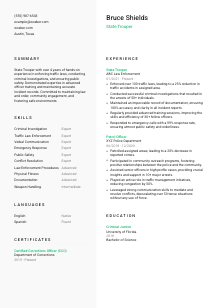
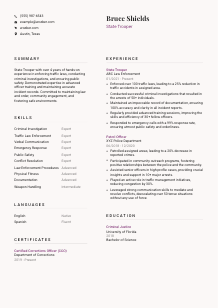
Do not stop at "patrolled highways" or "responded to calls." Show the work and the result. The example bullet about enforcing over 100 traffic laws and contributing to a 25% reduction in accidents is effective because it connects enforcement activity to a public safety outcome, which is exactly how trooper work is judged in practice.
Quantify what you can without forcing it. Useful measures include response rates, accident reduction, arrests made, reports completed accurately, training sessions delivered, or de-escalation counts. The sample CV uses metrics well, including 50+ arrests and a 99% emergency response rate, because those numbers reflect operational volume and reliability rather than generic performance claims.
State Trooper work is more than visible enforcement. Include bullets that show investigative follow-through, courtroom participation, report writing, and peer training if you have them. The example's training bullet strengthens the CV because it shows trust from the agency and command of procedures, not just time spent on patrol.
Your experience section should make it easy to picture you handling patrol shifts, roadside incidents, investigations, and documentation with confidence. Use Wozber's free CV builder to organise those results in an ATS-friendly CV format that keeps the most relevant field work visible.
Education matters on a State Trooper CV when it confirms the training base behind your fieldwork. Recruiters and command staff are usually checking for academy completion first, then for degrees or coursework that strengthen judgment, legal understanding, investigation, and public safety knowledge.
If academy graduation is required, make sure it is easy to find. Many applicants have related criminal justice education, but academy completion is often the qualification that moves the application forward for sworn law enforcement roles.
List school, degree or training program, field of study, and completion date in a consistent format. Clear structure matters here for the same reason clear incident documentation matters on the job. It shows control over facts and makes credentials easy to confirm.
Degrees in Criminal Justice, Criminology, Public Safety, or related areas add context to your field experience. In the example, a Bachelor of Science in Criminal Justice supports the candidate's patrol and investigation background, though it should complement rather than replace required academy training.
If you are early in your career or changing from a related law enforcement path, selective coursework can help. Subjects such as criminal law, investigative methods, report writing, constitutional policing, or emergency management are more useful than long course lists.
Honors, leadership roles, or capstone projects are worth listing only if they reinforce the job. A research project on traffic safety trends or criminal procedure has more value on this CV than unrelated student activities, especially once you already have patrol experience.
This part should confirm that your field performance rests on recognized training and relevant study. With Wozber, you can present academy credentials and degree details in an ATS-friendly CV template that keeps required qualifications easy to spot.
Certifications help when they reinforce the kind of work State Troopers actually do. They can support specialised readiness in corrections, investigations, firearms, emergency response, field training, or defensive tactics, provided they are current and clearly relevant to patrol and enforcement work.
Prioritise credentials that align with enforcement, investigation, safety, or officer development. Even when a posting does not name a specific certification, relevant credentials can show added capability beyond baseline academy preparation.
A short list of job-connected certifications is stronger than a long list of marginal ones. The example includes Certified Corrections Officer, which is not a universal requirement for State Trooper roles, but it does show formal law enforcement training that may support credibility depending on your path.
Include the date earned and, if applicable, whether the certification is active. In a profession built on current procedure, legal standards, and training compliance, stale or unclear credentials can weaken the section more than they help it.
As your career develops, certifications in crash investigation, instructor training, crisis intervention, tactical response, or emergency vehicle operations can sharpen your CV for more specialised assignments. Add them when they reflect real, usable capability rather than casual course attendance.
This section should reinforce your operational range, not pad the page. Wozber's ATS CV scanner can help you place the certifications that best support patrol, investigation, and training responsibilities in a format that stays easy to read.
The skills section should read like the core capabilities behind your daily performance in uniform. For State Trooper roles, that usually means a blend of enforcement knowledge, incident response, investigation, communication, fitness, report writing, and the judgment needed to manage tense situations lawfully.
Start with the language used in the posting, then match it to skills you can support with experience. Here, obvious priorities include traffic law enforcement, criminal investigation, emergency response, written communication, verbal communication, physical fitness, and documentation.
Order the section so patrol-relevant and enforcement-heavy skills appear before broader traits. A hiring team reviewing trooper candidates will care more about accident investigation, public safety, report writing, and conflict de-escalation than a scattered list of generic strengths.
Every skill listed should connect back to work you have done, training you have completed, or results you can discuss. The sample CV works because skills such as Criminal Investigation, Traffic Law Enforcement, Emergency Response, and Documentation are all supported by bullets in the experience section.
A well-built skills section should sound consistent with the patrol record and incident work in the rest of your CV. With Wozber, you can keep those terms aligned for ATS optimisation while still sounding like an experienced law enforcement professional.
Language ability matters in law enforcement because instructions, statements, de-escalation, and report accuracy all depend on it. For a State Trooper role, strong English communication is a stated requirement, and any additional language can become a real field advantage when interacting with motorists, witnesses, or communities with diverse language needs.
Since the posting specifically requires strong English speaking and writing, list English at the top with an honest proficiency level such as Native or Fluent. This matters for report writing, courtroom testimony, radio communication, and field interviews.
If you speak another language well enough to use it in real interactions, include it. In some patrol areas, Spanish can be especially useful for traffic stops, witness communication, and community-facing work, which is why it adds practical value in the example.
Use clear labels such as Fluent, Intermediate, or Basic rather than vague wording. In public safety roles, overstating language ability can create operational problems when communication needs to be exact.
Additional languages are most persuasive when they connect to actual service demands. If your target region has multilingual communities, language skill can support safer interactions, clearer instructions, and smoother conflict resolution.
If you are currently studying a language, mention it only when the proficiency is usable or the application specifically values it. This section works best when it reflects communication ability you could bring into patrol, reporting, or public interaction right away.
Language skills can strengthen your CV when they point to better communication in the field, not just broader personal background. Tailor the section with Wozber's ATS optimisation tools so required English proficiency and any additional language strengths are easy to read.
Your summary should give a concise read on the kind of officer you are before the hiring team moves into the details. For a State Trooper application, that means leading with years of law enforcement experience, then pulling forward the parts of your background that match patrol enforcement, investigations, emergency response, report quality, and public safety outcomes.
Read the job description first and identify the few themes that define the role. In this case, those include highway enforcement, emergency calls, investigations, accurate documentation, and communication. Build your opening around that mix rather than around broad statements about dedication or service.
Start with your current professional identity and years of relevant experience. The example's "State Trooper with over 4 years of hands-on experience" works because it gives level and field immediately, then leaves room to specify what that experience includes.
Choose abilities that matter most for the target posting, such as traffic enforcement, criminal investigations, emergency response, officer training, or report accuracy. Keep them concrete. A summary should sound like a compressed version of your strongest patrol and investigation record, not a list of soft traits.
Aim for 3 to 5 lines with enough detail to distinguish you from a general law enforcement applicant. If you mention impact, use grounded examples such as safer roadways, reliable incident documentation, or field training support. Short, specific phrasing carries more weight than grand language in this section.
A hiring team should finish your summary knowing your level, your core law enforcement strengths, and how closely your background matches trooper work. Use Wozber's AI CV builder to tighten the wording, align key terminology with the posting, and keep the CV ATS-friendly from the first lines onward.
A State Trooper CV works when each section supports the same hiring picture: reliable patrol experience, sound judgment in emergencies, accurate reporting, and the ability to enforce the law professionally in the field and in court.
Use Wozber to tailor every section with stronger role language, cleaner structure, and practical ATS optimisation. The final CV should make it easy to judge your readiness for highway enforcement, investigations, training responsibilities, and day-to-day public safety work.




