



Use Wozber and land your dream job
Create CV
No registration required
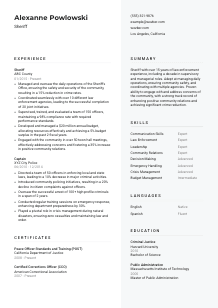
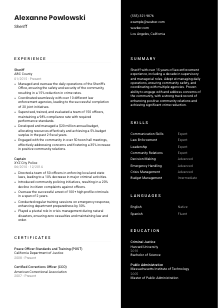
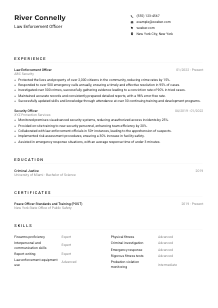
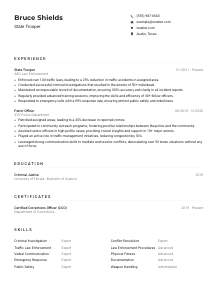
Upholding the law, but your CV feels like an outlaw? Wrangle it into shape with this Sheriff CV example, created with Wozber free CV builder. Learn how to tailor your law enforcement experience to match job expectations, and ride straight into your career's sunset, badge shining bright!
Sheriff hiring centers on command judgment. The role carries public safety consequences, political visibility, and day-to-day responsibility for people, budgets, and field operations, so a CV needs to show more than time served in law enforcement. It should make your leadership scope visible through staff oversight, emergency decisions, interagency coordination, and measurable results in crime reduction, compliance, or community relations.
Screening gets faster when those responsibilities are stated in the same language used in the posting. Wozber's free CV builder helps shape that alignment into an ATS-compliant CV, so terms such as supervisory experience, POST certification, budget management, and community-oriented policing are easy to read in context. That gives the hiring team a clearer view of whether your background matches the operational demands of the office.
For a Sheriff, the header should read like a clean professional identifier, not a decorative introduction. Hiring teams need immediate access to your name, title, contact details, and, when the posting requires it, your location.
Use your full name in a clear, prominent format. At this level, your name sits next to years of service, supervisory credibility, and public-facing leadership, so keep it easy to read and professional rather than stylized.
Place "Sheriff" directly under your name when that is the role you are pursuing. This keeps your positioning clear for both reviewers and ATS parsing, especially when your recent titles may include adjacent ranks such as Captain, Chief Deputy, or Division Commander.
List a reliable phone number and a professional email address. Sheriff's hiring processes often involve multiple interview rounds, background steps, and scheduling coordination, so accuracy matters. One typo in your email or phone number can slow an already detailed process.
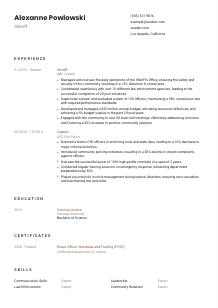
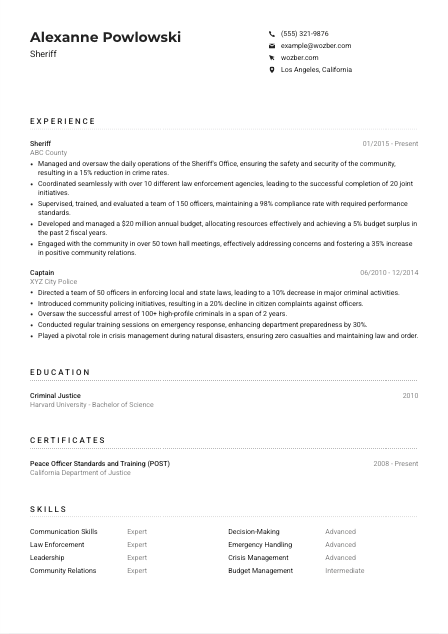
If the employer specifies a local requirement, include your city and state in the header. Here, listing "Los Angeles, California" directly supports the stated requirement and removes uncertainty about local availability. Keep this practical. It is about eligibility and logistics, not filler.
A LinkedIn profile or professional website can help if it reinforces your law enforcement leadership history, public service work, speaking engagements, or board involvement. Make sure any online profile matches the dates, ranks, and credentials on your CV exactly.
This section does not need personality statements. It needs accuracy, a clear target title, and the basic facts that let a hiring committee move straight to your command background.




Sheriff CVs are won or lost in the experience section. Committee members look for command responsibility, operational scale, staff oversight, emergency leadership, and a record of working with the public and partner agencies under pressure.
Start by identifying the responsibilities that define the job, then mirror them with your own work. For a Sheriff opening, that usually means office operations, supervision, training, interagency coordination, budgeting, and community engagement. If those duties appear in your background, state them directly instead of describing them in broad leadership language.
List positions in reverse chronological order and make the path to executive responsibility easy to follow. Hiring teams want to see how you moved from line or mid-level leadership into broader command, personnel management, or agency-wide decision-making. The sample CV does this well by moving from Captain to Sheriff, which immediately frames growth in scope and authority.
Each bullet should connect your action to a real result. In law enforcement leadership, useful measures include crime reduction, complaint reduction, training compliance, emergency preparedness, staffing scope, budget size, and number of partner agencies or community meetings. A bullet such as reducing crime by 15%, supervising 150 officers, or managing a $20 million budget tells reviewers far more than "responsible for daily operations."
Bring in the employer's wording where it reflects your real work. Phrases such as "daily operations," "community-oriented policing," "supervise, train, and evaluate staff," and "develop and manage the annual budget" help ATS optimisation when they appear in context, not as a pasted keyword list. Wozber's AI CV builder is especially useful here for tightening phrasing around the posting while keeping the content readable.
You may have a long service record, but not every assignment needs equal space. Prioritise roles that show leadership under pressure, policy implementation, public accountability, and multi-unit coordination. Tactical achievements matter, but for a Sheriff role they should support the larger picture of agency management and public trust.
By the end of this section, a reviewer should be able to see the size of the teams you led, the operations you ran, the outcomes you improved, and the level of authority you already carry.
Education carries different weight in Sheriff hiring than it does in early-career law enforcement roles, but it still matters. Degrees in criminal justice, public administration, or related fields reinforce your grounding in policy, governance, and organizational leadership.
If you have a bachelor's degree in Criminal Justice, Public Administration, or a related discipline, make that easy to find. This posting lists that background as preferred, so matching it directly strengthens your case. In the example, a Criminal Justice bachelor's aligns cleanly with the stated preference.
List degree, field of study, school, and graduation year in a consistent structure. Hiring panels reviewing senior law enforcement candidates often scan quickly for baseline qualifications before returning to experience and certifications, so clean formatting helps.
Advanced education can strengthen a Sheriff CV when it connects to agency leadership, public administration, budgeting, or justice systems. A master's in Public Administration, for example, adds credibility for overseeing staff, resources, and public-facing operations.
Formal degrees go in education. POST, academy credentials, and specialised professional certifications usually belong in the certifications section unless the CV format combines them. This keeps your academic background clear and avoids cluttering the section with mixed credential types.
For senior candidates, academic extras matter only when they reinforce the role. Student leadership, criminal justice research, or public administration distinctions can be worth including if space allows and the detail still supports your command profile. Skip older or minor items that do not strengthen the case.
Keep this section concise and relevant. It should confirm the academic grounding behind your law enforcement and administrative decisions.
Certifications carry real weight in Sheriff hiring because they speak to legal eligibility, current standing, and professional maintenance. This is where you make required credentials unmistakable.
If the posting calls for POST certification or the ability to obtain it, lead with that credential. For this role, it is one of the first items a reviewer will look for because it affects eligibility, not just preference. Place it above secondary certifications so it is never missed.
Choose credentials tied to law enforcement authority, corrections, emergency response, investigations, leadership development, or command-level responsibilities. A shorter, targeted list reads better than a long catalogue of outdated or unrelated coursework.
List issue dates and, when relevant, renewal periods or "Present" status. This helps demonstrate that your qualifications are active and maintained. The sample's "2008 - Present" format works well for an ongoing certification that remains in force.
Senior law enforcement leaders are expected to stay current on legal standards, use-of-force policy, emergency management, and supervisory practice. If you have recent command, crisis, or compliance-related credentials, include them to show you continue to train at the leadership level.
A hiring committee should not have to hunt for POST status or other key credentials. Put the essential items first and keep the section focused on qualifications that matter for running the office.
A Sheriff skills section should support the record already shown in your experience, not repeat generic traits. The most useful skills are the ones tied to command decisions, legal enforcement, staff management, and community-facing leadership.
Start with the capabilities named in the job description, then keep only the ones you can support elsewhere in the CV. For this opening, that includes leadership, decision-making, communication, emergency handling, knowledge of laws and regulations, and community-oriented policing. Skills are stronger when your experience section already proves them through staffing scope, crisis response, or measurable public outcomes.
Include both leadership capabilities and profession-specific expertise. A Sheriff CV benefits from a mix such as law enforcement operations, crisis management, staff evaluation, budget management, community relations, and interagency coordination. That blend reflects how the job is actually performed.
Use clean wording and avoid padding the section with broad claims that are impossible to test. Short, specific entries are easier for ATS systems to parse and easier for reviewers to connect back to your accomplishments. If you use proficiency labels, keep them believable and consistent with your career level.
Every item here should connect to a responsibility you have handled, from emergency decisions to budget oversight to public communication. That is what makes the list credible.
In law enforcement leadership, language ability is operational, not ornamental. It affects public communication, de-escalation, community meetings, media response, and coordination across a diverse jurisdiction.
When the posting names English fluency as a significant criterion, list English at the top with an accurate proficiency level. That removes any doubt about your ability to handle reports, public statements, courtroom communication, and command-level briefings.
Additional languages can be valuable when they reflect the population you serve or improve field communication. In the example, Spanish is a practical addition because it supports outreach and trust-building in a large, diverse community. Treat that as an illustration of tailoring, not a requirement for every Sheriff role.
Describe each language with plain terms such as "Native," "Fluent," "Intermediate," or "Basic." Hiring teams need a realistic sense of whether you can lead meetings, conduct interviews, or communicate in crisis conditions without overstatement.
If you speak more than one language, the benefit is not simply cultural awareness. It can improve witness communication, reduce misunderstandings, support public forums, and help build cooperation with residents who may already feel distant from law enforcement.
Only list languages you can actually use at the level you claim. For a Sheriff, credibility matters. Overstating fluency can become obvious quickly in community meetings, media settings, or interagency conversations.
Used well, this section shows that you can lead clearly across the communities your office serves and communicate effectively when pressure is high.
The summary should give a hiring panel a fast, accurate picture of your law enforcement tenure, command scope, and leadership style. For a Sheriff role, this short section works best when it combines years of experience with two or three role-defining strengths.
Start with a direct line that establishes your law enforcement background and supervisory depth. A phrase such as "Sheriff with over 15 years of law enforcement experience, including a decade in supervisory and managerial roles" works because it answers two major screening questions immediately.
After the opening line, add the parts of your background that match the posting most closely. For this role, that may include overseeing daily operations, managing staff, coordinating with agencies, maintaining public safety, or leading community engagement. The example summary succeeds because it stays close to those priorities instead of drifting into generic leadership claims.
Aim for three to five lines with concrete content. This section should not repeat your whole career history. It should give enough detail to frame the rest of the CV and encourage a closer read of your command accomplishments, budget oversight, and public service record.
Close with results or strengths that separate you from other senior law enforcement candidates. Crime reduction, improved community relations, successful multi-agency coordination, or a strong compliance record all work well if they are supported elsewhere in the CV.
When this section is written well, the reader already understands your tenure, leadership level, and the kind of Sheriff's office you are prepared to run before reaching the first job entry.
A Sheriff CV needs to show lawful authority, command experience, administrative control, and public-facing leadership in clear terms. When those elements are organised well, the hiring committee can quickly see whether you have led people, managed resources, and handled the pressures that come with running a Sheriff's Office.
Use Wozber's free CV builder to turn that record into an ATS-friendly CV format, refine your wording with ATS optimisation, and check alignment with an ATS CV scanner. The final draft should make your supervisory history, certifications, community engagement, and operational results easy to judge.