



Use Wozber and land your dream job
Create CV
No registration required
Strolling the beat, but your CV feels off-duty? Check out this Patrol Officer CV example, created with Wozber free CV builder. Learn how to spotlight your law enforcement journey so it matches job expectations, setting your career on a path as clear as your patrol route!
Patrol work leaves very little room for vague claims. Hiring teams want to see how you handled calls for service, documented incidents, exercised judgment under pressure, and maintained a steady presence with the public. Your CV should make that operational record visible, not bury it under broad statements about dedication or teamwork.
A tailored Patrol Officer CV also helps separate general security or public safety backgrounds from sworn law enforcement experience. Using Wozber's free CV builder to align your wording with the posting and keep an ATS-compliant CV structure makes it easier to surface the right training, patrol duties, reporting work, and community-facing experience early.
This section does basic identification work, but in law enforcement hiring it also clears early practical checks. A Patrol Officer CV should present contact details, role title, and location cleanly so nothing delays review or raises avoidable questions.
Place your full name at the top in a clear, readable format. Keep the presentation straightforward and professional. In public safety hiring, polish matters less than accuracy and easy identification.
Add "Patrol Officer" directly beneath your name when that is the role you are pursuing. Matching the posted title helps frame the rest of the CV around patrol response, enforcement, incident documentation, and community presence from the first line.
Your phone number and email should be current, professional, and easy to scan. If a department wants to move quickly on interviews, background steps, or follow-up documentation, this information needs to work without friction.
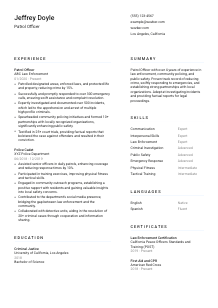
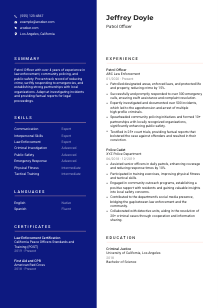
If the employer specifies a city or region, include it plainly. In the example, listing Los Angeles, California immediately addresses the stated location requirement and removes uncertainty about local availability.
Include a LinkedIn profile or professional site only if it supports your law enforcement background with consistent information. Any online profile should reflect the same job titles, dates, training, and public-facing professionalism shown on the CV.
Keep personal details clean, accurate, and aligned with the posting. For Patrol Officer roles, this section should quickly confirm who you are, how to reach you, and whether you meet practical requirements such as location.




Patrol hiring decisions are driven by what you have already handled in the field. This section should show your scope of patrol work, the kinds of incidents you responded to, how you documented events, and what outcomes followed from your actions.
Start by identifying the operational language in the job description. For Patrol Officer roles, that usually includes patrolling assigned areas, responding to emergencies, investigating incidents, making arrests, writing reports, testifying in court, and working with the community. Those duties should guide which bullets you keep and how you phrase them.
List positions in reverse chronological order with your title, department or agency, and dates. Under each role, focus on duties and accomplishments that show patrol responsibility, fast decision-making, public contact, and lawful enforcement activity. If you are earlier in your career, related roles such as police cadet or public safety support can still show useful field exposure.
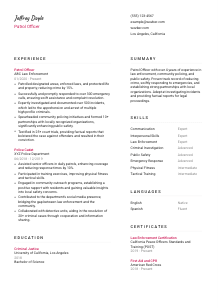
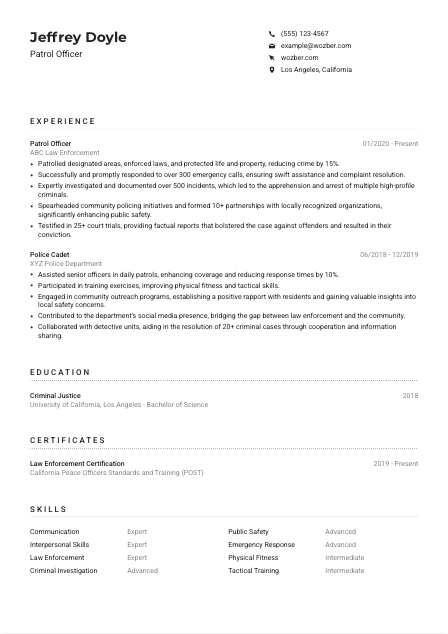
Use numbers where they reflect real policing results. The sample CV does this well by showing 300+ emergency calls handled, 500+ incidents investigated, 25+ court appearances, and a 15% crime reduction. Metrics like response volume, case support, community partnerships, or accident investigations give hiring teams a clearer view of your actual workload and impact.
Choose bullets that connect directly to patrol operations. Strong examples include responding under stress, de-escalating public encounters, preparing factual reports, supporting arrests, protecting life and property, and maintaining visibility in assigned zones. Community policing experience also matters when it shows you built trust and solved recurring safety concerns with residents or local groups.
Do not overload this section with every task you have ever performed. Keep the focus on field work, enforcement activity, report writing, training that affected performance, and results that matter in patrol. A concise set of relevant bullets reads far better than a long list of generic responsibilities.
Your experience section should read like a credible patrol record. When the bullets show response volume, sound judgment, documentation quality, enforcement activity, and community presence, the CV gives a department something concrete to evaluate.
Education usually supports a Patrol Officer application rather than carrying it, but it still adds important context. It can show formal preparation in criminal justice, public safety, law, or related fields, especially when paired with field experience and academy training.
List your highest or most relevant education first. A degree in Criminal Justice, Criminology, Public Administration, or a related field can reinforce your understanding of legal procedure, public safety systems, and law enforcement operations. In the example, a Bachelor of Science in Criminal Justice supports the patrol background without overstating its role.
Present the institution, degree, field of study, and graduation year in a clean format. This is one of the simplest places to protect ATS readability and keep the CV easy for a reviewer to scan quickly.
If you are newer to law enforcement or your degree strongly connects to the job, relevant coursework can help. Topics such as criminal law, constitutional procedure, investigations, traffic enforcement, or community policing can add useful detail, but only when they support your candidacy rather than pad the page.
Honors, leadership roles, academy-related projects, or public safety research are most useful when your field experience is still developing. For an experienced officer, these details usually matter less than patrol accomplishments and certifications.
If you have completed additional training in report writing, crisis intervention, de-escalation, defensive tactics, or similar areas, mention it when it adds current professional value. Ongoing education shows you stay current with policy, procedure, and field demands.
Keep this section straightforward and relevant. For Patrol Officer roles, education works best when it reinforces your law enforcement foundation and supports the operational experience shown elsewhere on the page.
Certifications carry real weight in patrol hiring because they speak directly to legal qualification, training status, and operational readiness. This section should make required credentials easy to find and easy to confirm.
Start with certifications named in the posting, especially academy completion or a state-certified law enforcement training credential. If the role requires basic police academy certification, that belongs at the top of this section, not buried below general training.
After required credentials, include certifications tied to patrol work. First Aid, CPR, crisis response, firearms qualification, defensive tactics, or similar training can strengthen your profile because they connect directly to emergency response and public safety. In the example, POST certification and First Aid and CPR are both relevant and easy to recognize.
Many public safety credentials depend on active standing or renewal cycles. Listing dates helps show that your training is current and that you remain in compliance with expected standards.
Law enforcement practices evolve through policy updates, court decisions, and training requirements. Adding current certifications or refreshed credentials shows that you continue to maintain the standards expected in active patrol work.
A Patrol Officer CV should make certification status immediately clear. When the required training is visible and current, hiring teams can move on to evaluating how you apply that training in the field.
The skills section should reflect the demands of patrol, not generic workplace strengths. Focus on the abilities that affect performance on calls, in reports, during public interactions, and under pressure.
Read the posting closely and mirror the skills it emphasizes when you genuinely have them. For this type of role, that often includes sound judgment, calm decision-making in stressful situations, communication, interpersonal ability, emergency response, incident investigation, and law enforcement procedures.
A Patrol Officer needs both field capability and public-facing control. Include hard skills such as criminal investigation, report writing, traffic accident documentation, or tactical training alongside communication, conflict management, and community engagement. The sample skills list works because it combines enforcement-related strengths with public interaction skills.
Resist the urge to turn this section into a master inventory. Choose the skills most relevant to patrol duties and support them through your experience bullets. A shorter list of believable strengths is more convincing than a long list of broad claims.
Every skill listed here should connect to real patrol performance. If a reviewer can see the same abilities echoed in your calls handled, reports written, arrests supported, or community work, the section does its job.
Language skills can matter in patrol because communication often shapes compliance, de-escalation, witness cooperation, and community trust. Include this section when it adds practical value to the environments you serve.
If the job specifies English proficiency, list it clearly. Law enforcement work depends on accurate verbal communication, report writing, testimony, and procedural clarity, so this requirement should be addressed directly.
If you speak additional languages, list the ones most useful in your target community or agency setting. In a city such as Los Angeles, Spanish can be especially valuable because it can improve public contact, witness interviews, and day-to-day service interactions.
Use honest levels such as Native, Fluent, Conversational, or Basic. Overstating language ability can create real problems in field communication, while an accurate rating gives hiring teams a realistic sense of where you can operate confidently.
When relevant, think beyond translation. Additional language ability can help during crisis response, neighborhood engagement, victim assistance, and informal rapport-building in communities that may be wary of law enforcement.
If you are actively improving a second language, that can still be worth noting in interviews or supporting materials. Patrol work often rewards officers who can communicate clearly across different community settings and reduce friction in public encounters.
For Patrol Officer roles, language ability is most persuasive when it clearly supports public contact and service delivery. List what you can truly use in the field and let it strengthen your community-facing profile.
Your summary should quickly establish what kind of Patrol Officer you are, how much relevant experience you bring, and which parts of your background matter most for the opening. Keep it grounded in field work, not slogans.
Begin with a direct line that names your role and years of relevant experience. A statement such as "Patrol Officer with 4+ years of law enforcement experience" gives immediate context and sets up the rest of the summary with useful specificity.
Add two or three strengths that reflect the actual responsibilities of the job. For this role, that could include emergency response, community policing, incident investigation, report writing, traffic accident documentation, or court testimony. The sample summary works because it stays tied to patrol outcomes rather than generic law enforcement language.
Aim for a short paragraph that can be read in seconds. Three to five lines is usually enough to cover experience level, patrol focus, and a few results or strengths without repeating the experience section.
Write with professional confidence and let the facts do the work. Mention proven results, areas of responsibility, or notable scope, but avoid inflated claims. A Patrol Officer summary should sound dependable, steady, and credible.
This section should give a department an immediate sense of your patrol background and operating strengths. When the summary clearly points to field experience, judgment, response work, and community presence, the rest of the CV has a strong opening.
You now have a clear framework for tailoring each section of a Patrol Officer CV around real law enforcement work, from patrol coverage and emergency response to report writing, certification status, and community policing.
Use Wozber's free CV builder to structure that experience in an ATS-friendly CV format, then refine the language with targeted ATS optimisation so the right duties, training, and outcomes show up early and clearly.
The finished CV should make one thing easy to judge: whether you can step into patrol work and perform with professionalism, composure, and sound field judgment.