



Use Wozber and land your dream job
Create CV
No registration required
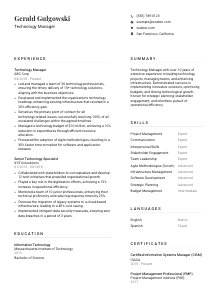
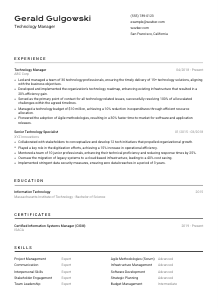
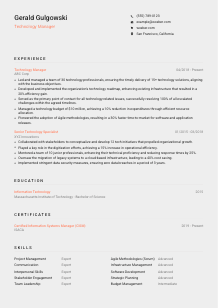
Leading tech teams, but your CV isn't getting a signal? Check out this Technology Manager CV example, made with Wozber free CV builder. Learn how to align your digital dexterity with job specs, ensuring your career trajectory is more streamlined than the latest software update!
Technology Managers are expected to keep delivery moving while making sound decisions about systems, budgets, and team capacity. A CV for this role needs to show that you can lead engineers and technical specialists, steer projects through execution, and improve the environment the business depends on, whether that means software delivery, infrastructure upgrades, or both.
When that story is tailored well, hiring teams can quickly distinguish strategic technology leadership from senior individual contributor work. Wozber's free CV builder helps you line up your experience with the job language and present it in an ATS-friendly CV format, so the CV shows where you have owned roadmaps, managed delivery, and led teams at the level the role requires.
For a Technology Manager, the top of the CV should confirm who you are, what role you are targeting, and whether there are any practical barriers to moving forward. Keep this section clean and businesslike so attention stays on your leadership scope and delivery record.
Use your full name as the most visible text on the page. Keep the formatting simple and professional. For leadership hiring, this section should feel steady and organised, much like the way you would present a roadmap, budget update, or status report to senior stakeholders.
Place "Technology Manager" directly below your name when that is the role you are pursuing. This immediately frames your background around team leadership, technical oversight, and execution responsibility rather than leaving the reader to guess whether you are aiming for an architect, program manager, or senior engineer path.
List a reliable phone number and a professional email address without errors. A straightforward format such as firstname.lastname@email.com works well. Small details matter here because this role often serves as the contact point for technology issues, vendor discussions, and cross-functional coordination.
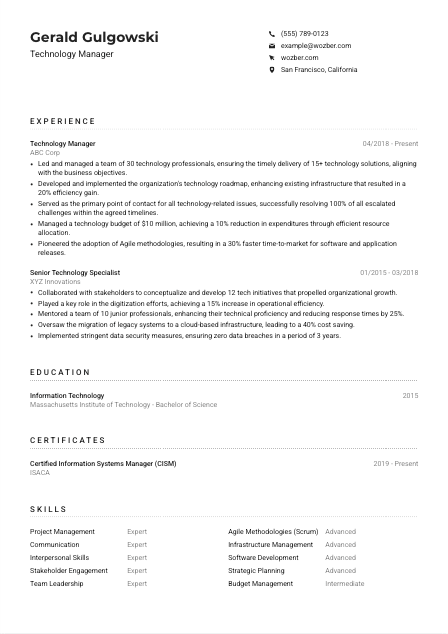
If the job requires local presence, show your city and state clearly. In the example, listing "San Francisco, California" immediately answers a stated requirement and removes uncertainty about relocation. Use this selectively based on the posting rather than treating it as a rule for every Technology Manager CV.
Include LinkedIn or a relevant professional site if it strengthens your application. For this level of role, an online profile can reinforce leadership progression, project scope, certifications, and technology initiatives that may be too detailed for the CV itself. Make sure the titles, dates, and major achievements match.
This section does not need personality flourishes. It should confirm role alignment, contact access, and any important logistical detail so the reader can move straight into your management scope and technical track record.




This is the section where a Technology Manager proves scale. Hiring teams want to see how many people you led, what kinds of systems or projects you owned, how you worked with stakeholders, and what changed under your direction. Broad statements about leadership are less useful than concrete outcomes tied to delivery speed, operational improvement, budget control, or technology modernization.
Read the job description closely and mark the responsibilities that define the role. Here, the clearest themes are leading technical teams, managing large-scale projects, shaping a technology roadmap, overseeing budgets, and working across functions. Those points should guide which experience bullets you move up, expand, or rewrite.
Use reverse chronological order and make each entry easy to scan with job title, company, and dates. For leadership roles, progression matters. A move from specialist or senior technical work into people management, roadmap ownership, or broader operational responsibility helps the reader understand how your scope has grown.
Focus each bullet on a result that mattered to the organisation. Team leadership, delivery ownership, infrastructure improvements, and issue resolution should all connect to a measurable outcome or business effect. In the example, leading 30 technology professionals and delivering 15+ solutions works because it shows both team scale and execution volume.
Quantify where the role naturally produces numbers. Good metrics here include team size, project count, budget value, delivery speed, cost savings, uptime improvement, escalation resolution, migration scale, or efficiency gains. The sample does this well with a $10 million budget, a 30% faster time-to-market, and a 20% efficiency gain tied to infrastructure enhancement.
If you have a mix of hands-on technical and management experience, give more space to the work that reflects ownership. Technology Manager hiring usually leans toward roadmap decisions, stakeholder communication, project governance, vendor coordination, and team leadership. Keep older or highly technical bullets only when they support your credibility in the systems, platforms, or delivery model the employer uses.
A Technology Manager CV becomes convincing when each role answers a practical question: what did you lead, what did you improve, and what scale did you handle. If those three points are clear, the reader can quickly see your readiness for broader technical leadership.
Most Technology Manager roles still expect a solid academic base in IT, computer science, or a related discipline, even when the hiring decision leans more heavily on experience. Keep this section straightforward, and use it to confirm that your technical foundation supports the leadership responsibilities described elsewhere on the CV.
If the posting asks for a bachelor's degree in Information Technology, Computer Science, or a related field, make sure that information is impossible to miss. In the example, "Bachelor of Science in Information Technology" lines up cleanly with the requirement and removes any doubt about baseline qualification.
List degree, field of study, school, and graduation year in a clean structure. Technology leadership CVs benefit from clarity. The same disciplined formatting you would use in project documentation or portfolio reporting should show up here as well.
When your degree title closely matches the role, let that work for you. Degrees in IT, computer science, information systems, or engineering support credibility for conversations about applications, infrastructure, security, and technical planning. If your degree is in a related area, label the field clearly enough that the connection is obvious.
Most experienced Technology Managers do not need to list courses, but there are cases where it helps. If you are earlier in management, or if coursework in systems architecture, networking, databases, project management, or information security directly supports the target role, include it briefly. Otherwise, keep the section lean.
Honors, leadership activities, or technical projects can stay if they strengthen your story and do not crowd out stronger professional material. For someone with 8+ years of experience, these details should only remain if they reinforce a specific qualification, such as leadership, technical breadth, or early project ownership.
This section should quickly confirm that you meet the academic expectation and have the technical grounding to lead technology work responsibly. Let experience carry most of the narrative once that foundation is established.
Certifications can strengthen a Technology Manager CV when they support the way the role is actually run. The most useful ones usually point to governance, project delivery, security, operations, or leadership in technical environments. List the credentials that sharpen your management profile, not every course you have completed.
Even when a posting does not require certifications, they can still help clarify your operating style and areas of authority. For technology management, this often matters when roles involve structured delivery methods, security oversight, or enterprise-scale decision-making.
Choose certifications that connect directly to the job's responsibilities. In the example, CISM supports leadership in information systems and governance, while PMP reinforces large-project oversight. Because the posting also prefers Agile or Scrum expertise, a Scrum-related certification could be worth featuring when you have it.
Show when the certification was earned and, if relevant, whether it remains active. This matters in technology because frameworks, standards, and practices change. Recent or maintained credentials suggest continued engagement with current delivery and management practices.
Technology Managers are often expected to stay current on tools, delivery models, security expectations, and operational trends. A selective certification list can show that you are still developing in areas that affect planning, risk management, and execution quality, especially when your current role includes broad oversight.
The right certifications add context to your experience. They should support the story that you can manage technology teams, oversee delivery, and make informed decisions in environments where process, risk, and execution all matter.
A Technology Manager skills section should read like an operating profile, not a keyword dump. The best mix usually combines delivery methods, leadership capabilities, technical domain knowledge, and the communication skills needed to work with executives, vendors, and cross-functional partners.
Start with the language in the posting, then group it into meaningful categories. Here, project management, Agile or Scrum, team leadership, stakeholder communication, roadmap development, infrastructure, software delivery, and budget oversight are all directly relevant. That combination tells the reader how the role functions day to day.
List skills you can back up in your experience section. If you claim Agile methodologies, there should be a bullet showing faster delivery, sprint-based execution, or process adoption. If you list stakeholder engagement or budget management, your experience should show meetings led, issues resolved, spend controlled, or decisions influenced.
Separate high-value skills from supporting ones and avoid padding the section with tools or concepts that do not matter to the target role. The sample works because it centers management skills such as project management, team leadership, stakeholder engagement, and communication, then adds relevant technical and operational capabilities like infrastructure management and software development.
This section should reinforce the management story already visible in your experience. If the reader can connect each listed skill to a real team, project, system, or business outcome, the section is doing its job.
For a Technology Manager, language ability matters when it affects collaboration, reporting, or stakeholder communication. In many roles, English is simply the working requirement. Additional languages become useful when the team, vendor base, or operating footprint is more international.
If the posting calls for English competency, list English clearly with an honest proficiency level. In the example, marking English as "Native" immediately covers that requirement and supports a role that depends on clear communication with technical teams and senior stakeholders.
Include additional languages when they genuinely support the work, such as coordinating with global teams, handling regional vendor relationships, or supporting international rollouts. They are helpful extras, not mandatory content on every Technology Manager CV.
Terms like Native, Fluent, Professional, or Intermediate are usually enough. Avoid overstating your level. For management roles, credibility matters because language skill often affects presentations, escalation handling, and cross-functional discussions where precision is important.
If the company works across regions, acquisitions, offshore development teams, or multilingual customer environments, language skills can strengthen your profile. Use them to support a broader point about communication range, not as a standalone selling point disconnected from the work.
A short, accurate language section is enough. Its job is to confirm communication capability, especially when the job names a required language, and to add any extra range that may help in collaborative or international technology settings.
For this kind of role, language details should support how you manage, communicate, and coordinate. Keep the emphasis on practical working proficiency and relevance to the environment.
The summary should quickly establish your management level, technical breadth, and the kind of outcomes you have delivered. For a Technology Manager, that usually means a short profile covering years of experience, team or project leadership, and a few strengths that match the employer's priorities such as roadmap planning, delivery management, infrastructure improvement, or budget control.
Identify the two or three themes that define the role and use them to shape your opening. In this case, the CV should point toward technology leadership, large-scale project delivery, and cross-functional coordination. That keeps the summary aligned with how the role will actually be evaluated.
Start with your title or leadership identity plus your years of relevant experience. A line like "Technology Manager with 10+ years of experience leading enterprise technology initiatives" immediately sets the context. It tells the reader you operate beyond hands-on execution and into ownership of delivery, people, and direction.
Use the next sentence to highlight the capabilities most relevant to the role, such as managing technology teams, improving infrastructure, overseeing budgets, or driving Agile delivery. The sample summary does this effectively by combining team leadership, infrastructure enhancement, budget optimisation, and strategic planning into a concise leadership profile.
Aim for a few sentences with concrete language rather than broad claims about passion or innovation. The summary should create a clear frame for the rest of the CV, not repeat every skill. Focus on leadership scope, technical environment, and measurable business contribution.
A well-written summary should make one thing obvious within seconds: you have already been trusted with technology decisions, delivery responsibility, and team leadership at the level the employer needs. That is the standard this section should meet.
A Technology Manager CV should make your leadership range easy to read: the teams you have led, the projects and systems you have owned, the budgets you have managed, and the operational improvements you have delivered. When those points are clear, the hiring team can quickly place you in the right level of responsibility.
Use Wozber's free CV builder and ATS CV scanner to tighten the language around the job description, strengthen ATS optimisation, and present your background in an ATS-compliant CV that surfaces the management, delivery, and technical oversight this role requires.
The final result should make it easy to judge one thing. You can lead technology work from roadmap to delivery with business discipline and technical credibility.




