




Use Wozber and land your dream job
Create CV
No registration required
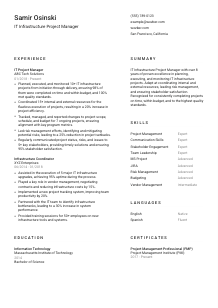
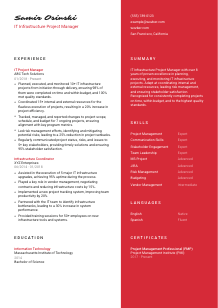
Juggling cables and deadlines, but your CV seems tangled? Unravel this IT Infrastructure Project Manager CV example, created with Wozber free CV builder. Learn how to highlight your skill in orchestrating tech projects and aligning with corporate frameworks, so your career architecture stands as sturdy as your server racks!
Infrastructure projects rarely get judged by plans alone. Hiring teams want to see whether you can move complex rollouts from kickoff to delivery without losing control of scope, budget, uptime, vendor coordination, or stakeholder communication. Your CV needs to make that operating discipline visible, especially when your past titles range from project manager to infrastructure coordinator or program lead.
A tailored IT Infrastructure Project Manager CV quickly clarifies whether your background lines up with the delivery model behind the role, including project tools, risk ownership, and status reporting. Wozber's free CV builder helps shape that experience into an ATS-compliant CV by aligning your wording with the job description and keeping the structure easy to parse, so hiring teams can immediately see your track record in infrastructure delivery.
This section is simple, but it still does important work. For infrastructure project roles, clean contact details and accurate location information remove friction before anyone gets to your delivery history or tool stack.
Place your name prominently at the top using a clear, readable format. In a CV that may be reviewed alongside project managers, program managers, and technical leads, easy identification matters more than visual flair.
Write "IT Infrastructure Project Manager" directly under your name when that matches the role you're applying for. It creates immediate alignment for both ATS screening and human review, especially when your previous title was broader or slightly different.
List a reliable phone number and a professional email address, then check both carefully. If a hiring manager wants to discuss infrastructure delivery experience, vendor coordination, or project governance, they should not hit a dead end because of a typo.
If the posting specifies a location requirement, reflect it clearly in your personal details. In this example, listing "San Francisco, California" helps address a stated requirement up front and avoids unnecessary questions about relocation or availability.
Include LinkedIn or a professional website if it strengthens your application. For this role, that profile should reinforce your CV with consistent dates, project scope, certifications, and tools such as MS Project, JIRA, or similar delivery platforms.
Your header should answer the logistical basics in seconds: who you are, what role you are targeting, how to reach you, and whether you meet any location requirement. Then the rest of the CV can focus on project delivery.




This is the core of the CV for an IT Infrastructure Project Manager. Hiring teams want to see how you handled delivery, change, risk, vendors, reporting, and measurable outcomes across real infrastructure work.
Start by identifying the responsibilities that drive the role. Here, that includes planning and monitoring infrastructure projects, coordinating internal teams and vendors, managing scope and budget changes, leading risk mitigation, and communicating status to stakeholders. Those themes should shape which bullets you keep and how you phrase them.
List your positions in reverse chronological order with job title, company, and dates. For infrastructure project work, clean chronology helps reviewers understand your progression from support or coordination roles into ownership of larger delivery scope.
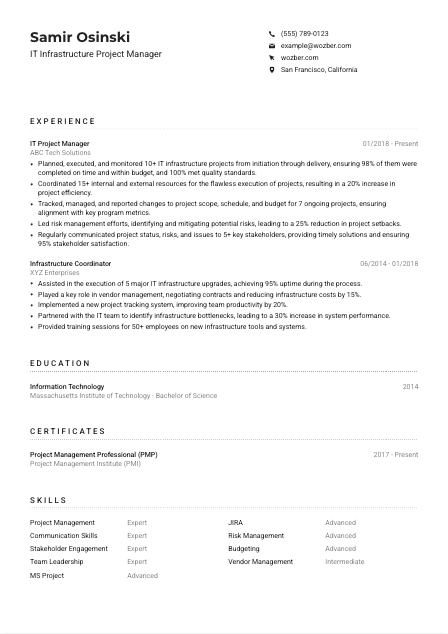
Each bullet should connect an action to a delivery result. Instead of saying you were responsible for project oversight, show what you delivered, improved, or protected. The example CV does this well with points about completing 10+ infrastructure projects on time and within budget, improving efficiency, and reducing setbacks through risk management.
Quantify with measures that matter in infrastructure environments: project count, on-time delivery rate, budget control, uptime during upgrades, efficiency gains, cost savings, stakeholder satisfaction, or reduction in escalations and delays. Numbers like 98% on-time delivery or 95% uptime during upgrades tell a hiring manager far more than broad claims about leadership.
Prioritise work that shows infrastructure execution, cross-functional coordination, reporting discipline, and operational impact. Leave out unrelated achievements unless they strengthen your case. The standard to use is simple: does this point help prove you can run IT infrastructure projects with control and consistency?
Your experience section should show that you can run infrastructure projects in the real world, not just participate in them. When the bullets clearly connect scope, execution, risk, and results, your fit for the role becomes much easier to judge.
Education usually will not outweigh project delivery history in this field, but it still matters. For infrastructure project roles, the degree section confirms that you have a grounding in IT, systems, or a related technical discipline.
If the job asks for a bachelor's degree in Information Technology, Computer Science, or a related field, make that information easy to spot. In the example, a Bachelor of Science in Information Technology directly supports the stated requirement.
List the institution, degree, field of study, and graduation year in a straightforward structure. This section should be easy to scan, especially when the reviewer is focused more heavily on your delivery record and certifications.
For IT Infrastructure Project Manager roles, the field matters because it helps frame your technical fluency. Spell out Information Technology, Computer Science, Information Systems, or another relevant discipline rather than leaving the degree too vague.
If you are early in your career or your academic work directly supports the target role, include relevant coursework, labs, or capstone projects. Topics like networking, systems administration, cloud infrastructure, cybersecurity, or enterprise architecture are more useful here than general academic detail.
Honors, scholarships, technical clubs, or strong academic projects can add value when they reinforce your infrastructure or project background. If you already have several years of delivery experience, keep these extras brief so the CV stays focused on execution.
This section should quickly confirm that your academic background supports the technical side of the role. Keep it direct and relevant, then let your experience carry the heavier weight.
Certifications carry real weight in infrastructure project hiring when they support the kind of delivery ownership the role requires. They can reinforce your command of project governance, risk control, and execution standards.
Put the most relevant certifications first. For this position, PMP is especially useful because the job description lists it as preferred and it directly supports project planning, stakeholder management, and control of scope, schedule, and cost.
Do not crowd this section with every certificate you have earned. Focus on credentials that strengthen your case for infrastructure delivery, project leadership, service management, cloud environments, or related operational domains.
List the year earned and, if relevant, renewal status or active period. With certifications such as PMP, dates show currency and ongoing commitment, which is more useful than leaving the timeline unclear.
Infrastructure environments change with new platforms, security requirements, cloud migrations, and governance demands. Keeping certifications current or adding relevant ones signals that your delivery approach evolves with the technical environment you manage.
A focused certification section strengthens your project management profile and can tip the balance when employers want formal proof of delivery discipline. Keep the list relevant, current, and tied to the work you actually do.
This section should reflect how the job gets done. For an IT Infrastructure Project Manager, that means balancing project controls, collaboration, and the tools used to keep delivery on track.
Read the posting for explicit skills and implied ones. Here, software such as MS Project or JIRA is named directly, while stakeholder communication, vendor coordination, risk management, budgeting, and cross-functional leadership are embedded in the responsibilities.
Build the list around capabilities you can support elsewhere in the CV. If your experience shows schedule tracking, risk mitigation, resource coordination, and status reporting, those should appear here alongside the relevant platforms. The sample CV pairs project management and stakeholder engagement with tools like MS Project and JIRA, which creates a coherent match.
Choose skills that are directly useful for the role instead of pasting in every technology or soft skill you have touched. A compact list of delivery tools, project controls, communication strengths, and infrastructure-relevant competencies gives a clearer picture than a long generic inventory.
Your skills section should quickly confirm that you understand both the management side and the operational side of infrastructure delivery. Keep it aligned with the role and supported by the rest of the CV.
Language proficiency matters more in project environments than many candidates realize. Infrastructure project managers spend a large part of the job communicating status, risks, dependencies, and decisions across technical and non-technical groups.
If the role requires fluent English, list it clearly and near the top of the section. That matters here because status reporting, stakeholder updates, vendor discussions, and issue escalation all depend on precise communication.
Additional languages can be an advantage in global IT organizations, distributed vendor environments, or regional support structures. They should follow the required language, not compete with it.
Choose straightforward levels such as Native, Fluent, Intermediate, or Basic. Clear labels help hiring teams understand whether you can lead meetings, write executive updates, or collaborate in multilingual environments without overstatement.
For infrastructure project management, extra language skills are most useful when the work involves cross-border teams, offshore vendors, or multinational stakeholders. They are a plus, but they should support the role rather than distract from delivery experience.
Do not inflate proficiency. If you claim a language you cannot use in live project calls or written updates, that gap will surface quickly. Accuracy matters because communication is part of the job's operational risk profile.
List language skills in a way that supports the communication demands of the job. For this role, the essential point is clear command of English, with any additional languages adding useful range.
Your summary should quickly establish the kind of infrastructure project manager you are. It works best when it connects experience level, delivery scope, and the ways you keep complex projects moving under control.
Start with your title and years of relevant experience, then anchor that introduction in infrastructure delivery. A line such as "IT Infrastructure Project Manager with 8+ years leading enterprise infrastructure projects" tells the reader far more than a broad statement about being results-driven.
Use the next sentence or two to highlight the strengths that define your candidacy for the target role. For this kind of position, that often means planning and monitoring projects, coordinating internal and vendor teams, managing risk, and communicating status across stakeholders. Mention tools or certifications only if they are truly relevant to the target posting.
Aim for a compact paragraph of 3 to 5 lines. The summary should surface your project management profile quickly, not repeat the full experience section. Tight writing matters because reviewers often decide within seconds whether the rest of the CV deserves closer attention.
Close on a result that belongs to infrastructure project work, such as consistent on-time delivery, budget control, quality outcomes, smooth upgrades, or reliable stakeholder reporting. The sample summary works because it ties years of experience to execution, coordination, and project outcomes without wandering into vague claims.
A well-written summary should make your project delivery profile clear before the reader reaches the first job entry. When it names your scope, strengths, and results in plain terms, the rest of the CV lands with more force.
An effective IT Infrastructure Project Manager CV shows how you run delivery across moving technical, financial, and stakeholder demands. Every section should support that story, from the title you use to the metrics you choose in your experience bullets.
Use Wozber's free CV builder, ATS-friendly CV templates, and ATS CV scanner to tailor your content around the job description, strengthen ATS optimisation, and present your background in an ATS-friendly CV format. The finished CV should make one thing clear right away: you can lead infrastructure projects with control, accountability, and dependable results.




