



Use Wozber and land your dream job
Create CV
No registration required
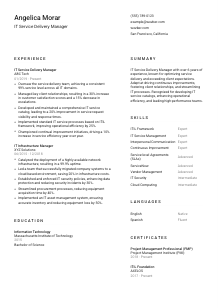
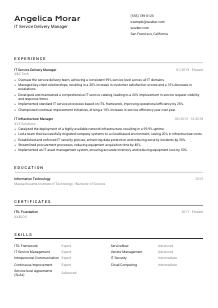
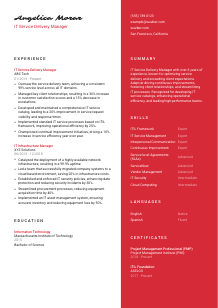
Coordinating top-tier tech, but your CV runs into downtime? Check out this IT Service Delivery Manager CV example, built with Wozber free CV builder. Learn how to match your IT service expertise to job prerequisites, ensuring your career trajectory stays as glitch-free as a perfectly debugged system!
IT Service Delivery Managers sit where operational reliability meets customer expectation. Hiring teams want to see whether you can keep services stable, lead response when issues escalate, and improve the way support, infrastructure, and service management actually run. Your CV needs to make that operating range visible, from SLA performance and service process design to stakeholder communication and team oversight.
A tailored CV quickly separates someone who has owned service delivery from someone who has only supported it. Using Wozber's free CV builder helps you align your wording with the job description, keep an ATS-compliant CV structure, and surface role-specific terms like ITIL, service catalogue, and escalation management so the reader can immediately understand the level of service responsibility you have handled.
For an IT Service Delivery Manager, the header should do one simple job well: confirm who you are, how to reach you, and whether basic logistics line up with the role. Keep it clean, professional, and easy to scan.
Your name should be the most visible text in the header, using a larger font than the rest of the contact details. Skip unnecessary labels or design elements. In service delivery roles, where the rest of the CV will be measured on structure and clarity, a tidy header already sets the right tone.
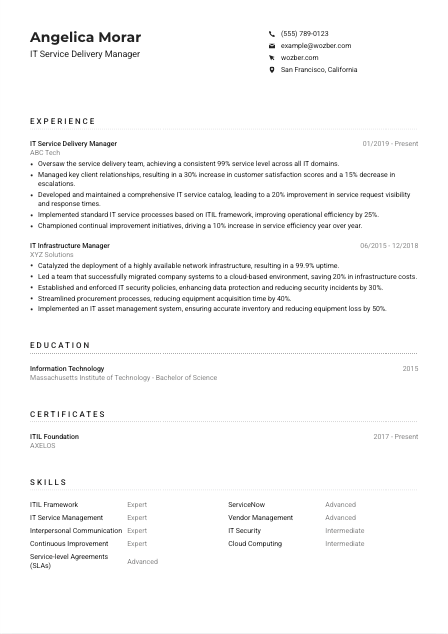
If you are applying for an IT Service Delivery Manager position, use that exact title beneath your name when it matches your background. This immediately anchors your profile in the right function. If your current title is adjacent, such as IT Infrastructure Manager, you can still orient the CV toward service delivery as long as the experience supports it, as the sample CV does.
List a reliable phone number and a professional email address that uses your name, not a nickname or outdated handle. Add a LinkedIn profile or professional website only if it strengthens your application with relevant leadership, ITSM, or infrastructure experience. Every link should work and reflect the same career story as the CV.
Some service delivery roles are tied closely to where the team, clients, or on-site operations are based. Here, the employer asks for someone located in San Francisco, CA, so showing "San Francisco, California" in your personal details directly addresses that filter. If a posting does not specify location, city and state are usually enough.
A website, portfolio, or LinkedIn profile is useful when it adds detail on service operations, client-facing leadership, certifications, or transformation work. For this profession, that might include ITIL-focused process improvements, service desk modernization, cloud migration oversight, or governance work. Do not include links that are sparse, outdated, or unrelated to IT leadership.
Your personal details should remove friction, not create it. By the time a hiring manager leaves the header, they should know your target role, how to contact you, and whether any stated location requirement is already covered.




This is the section that carries the most weight for an IT Service Delivery Manager. Hiring teams look for proof that you have managed service performance, handled escalations, improved processes, and worked across technical teams and business stakeholders without losing control of delivery.
Read the posting for the operating responsibilities behind the title. In this case, the core themes are SLA ownership, client relationship management, service documentation, ITIL-based process improvement, and continuous service improvement. Your experience bullets should map to those priorities, using the same language where it reflects work you have actually done.
List your most recent role first, then work backward with job title, employer, and dates clearly shown. For service delivery roles, progression matters. A move from infrastructure management into direct service delivery leadership, like the example CV shows, tells a coherent story about growing operational scope, customer exposure, and accountability.
Focus each bullet on what changed because of your work. Good service delivery bullets often include service levels, uptime, response times, customer satisfaction, escalation reduction, process adoption, or team performance. "Oversaw the service delivery team" is stronger when paired with a result such as maintaining 99% service levels or reducing escalations by 15%, because it shows operational control rather than just responsibility.
Quantified results matter here because service delivery is measured through performance indicators. Use metrics such as SLA attainment, incident resolution time, CSAT, service availability, cost savings, request turnaround, backlog reduction, or year-over-year efficiency gains. The sample CV does this well with results like a 30% increase in customer satisfaction and a 20% improvement in service request visibility and response times.
You do not need to include every infrastructure or technical duty from past roles. Keep the details that strengthen your case for managing live services, governance, support processes, vendor coordination, or customer-facing operations. Even when your earlier work was more infrastructure-heavy, frame the parts that connect to reliability, uptime, change execution, asset control, or service continuity.
Your experience section should show that you can run services, improve them, and communicate across technical and business groups while keeping performance on track. If the reader can quickly spot service outcomes, leadership scope, and process ownership, this section is doing its job.
Education usually is not the deciding section for an experienced IT Service Delivery Manager, but it still needs to confirm that you meet the baseline requirement. Keep it concise and make the match easy to see.
When the job asks for a bachelor's degree in Information Technology, Computer Science, or a related field, make sure that information appears clearly. If you hold the exact degree requested, present it plainly rather than burying it under extra details. That immediate match helps with both ATS screening and human review.
Include your degree, field of study, school name, and graduation year or date. That is enough for most mid-level and senior service delivery roles. Clean formatting matters because this section is usually skimmed quickly, especially when the employer is mainly confirming that you meet the listed education threshold.
A Bachelor of Science in Information Technology aligns neatly with this posting and reinforces the technical foundation behind service management experience. If your degree is in a related field, that is still valid. Just let the rest of the CV carry the service delivery depth through your experience, skills, and certifications.
Most experienced candidates do not need course lists. Include them only if they help explain a less direct degree path or strengthen a relevant area such as systems administration, IT governance, networking, project management, or service operations. Keep the focus on material that supports your current target role.
Honors, major projects, or capstones are worth adding only when they connect to IT operations, service management, or leadership and do not distract from more recent experience. For early-career applicants this can add useful depth. For seasoned candidates, keep the section lean unless the achievement is genuinely notable.
This section should quickly show that you meet the educational baseline and have the technical foundation expected for service delivery leadership. Once that is clear, the heavier proof belongs in your experience and certifications.
Certifications carry real weight in IT Service Delivery because they connect your experience to recognized frameworks and methods. They are especially helpful when the role calls out ITIL or project delivery credentials by name.
When a job description mentions certifications such as ITIL Foundation, PMP, or PRINCE2, move any matching credentials to the top of this section. For this role, ITIL Foundation is especially relevant because the responsibilities include process improvement based on the ITIL framework. A PMP also supports the coordination and governance side of service delivery work.
Include certifications that strengthen your case for service management, service improvement, governance, project execution, or infrastructure leadership. A short list of relevant credentials is more persuasive than a broad list with only loose connection to the role. Keep the section focused on what supports IT service operations and delivery management.
Certification dates help the employer understand whether your knowledge is current, especially for frameworks and methods that shape service operations. If a certification requires renewal or continuing education, the date can also show that you have maintained it. Use a consistent format across entries.
If you are aiming for senior service delivery roles, ongoing certification can strengthen your profile over time. ITIL remains foundational, while project and governance credentials can broaden your reach into transformation, service transition, or multi-vendor environments. Add new certifications when they support the type of service delivery work you want next.
Well-chosen certifications tell the reader that your service management approach is grounded in established practice, not only on-the-job improvisation. For this role, they should reinforce your ability to run and improve IT services in a structured way.
The skills section should reflect how IT Service Delivery Managers are actually evaluated: service management knowledge, delivery control, stakeholder handling, and enough technical fluency to work effectively with infrastructure and support teams. Keep it specific and closely aligned with the target role.
Start with the skills the employer has already emphasized. Here that includes ITIL knowledge, IT service management, communication, and service improvement. These are not filler keywords. They point to how the role works day to day, from SLA discussions and escalation handling to process design and client communication.
List the abilities that support delivery performance and operational coordination. That can include ITIL Framework, service-level agreement management, incident and problem management, vendor management, service catalogue ownership, customer communication, and tools such as ServiceNow when relevant. The example CV balances framework knowledge with practical delivery skills, which is exactly the right approach.
Order matters. Lead with the skills most tied to the job's responsibilities, then follow with supporting technical capabilities. For an IT Service Delivery Manager, that usually means service management and stakeholder-facing skills before secondary technical areas. A shorter, well-ordered list is easier to scan and gives a clearer picture of your operating strengths.
A useful skills section should read like the toolkit of someone who can manage service quality, coordinate teams, and improve delivery processes. If the list could fit any IT role, it is too generic.
Language skills matter most when they affect communication with clients, users, vendors, or distributed teams. For IT Service Delivery Managers, clear business communication is often just as important as technical fluency during escalations, reporting, and service reviews.
If the posting specifies strong English, place English first and mark your level clearly as Native or Fluent, whichever is accurate. In service delivery work, this matters because so much of the role involves meetings, written updates, incident communication, and stakeholder management.
Additional languages are worth listing when they help with client-facing work, regional support coverage, or collaboration across global teams. Spanish, for example, can be useful in many service environments, but include extra languages because they add operational value, not just because you know them.
Choose clear levels such as Native, Fluent, Intermediate, or Basic. Avoid vague wording that leaves your communication ability open to interpretation. In a role that depends on precise updates and expectation management, credibility matters here too.
Some service delivery teams support one region, while others manage multi-country users, offshore support models, or international client accounts. If the role has broader geographic reach, language capability becomes more relevant. If it does not, keep the section simple and do not overstate its importance.
Language skills can strengthen your ability to handle escalations, build trust with stakeholders, and navigate cross-cultural communication during service reviews or transitions. Present them as a practical advantage tied to delivery effectiveness, not as a side detail.
This section should confirm that you can communicate clearly in the required language and, where relevant, support broader client or team coverage. For service delivery roles, that translates directly into smoother coordination and stronger stakeholder trust.
The summary should quickly establish the scale and character of your service delivery experience. In a few lines, show the reader that you understand operational performance, customer expectation, and process improvement, then back that up with one or two concrete results.
Start with your title and years of relevant experience, then anchor that experience in the right domain. For example, "IT Service Delivery Manager with 6+ years of experience in IT service management and infrastructure operations" gives immediate context and positions you at the right level.
Use the next line to show what you actually manage. That might include service teams, client relationships, SLA performance, escalations, ITIL-based processes, or continuous improvement programs. Keep the description tied to live service operations rather than broad leadership language.
Numbers make the summary more credible when they reflect service delivery outcomes. Results like improving customer satisfaction, maintaining high service levels, or increasing operational efficiency work well because they mirror how the role is evaluated. The sample summary is stronger because its claims are supported by measurable results elsewhere in the CV.
Aim for 3 to 5 lines with no wasted wording. This is not the place for a full career history. It should read like a concise executive snapshot that makes the hiring manager want to examine your experience in detail.
A sharp summary should make your service delivery strengths clear before the reader reaches the first job entry. If it highlights your level, your scope, and your most relevant outcomes, it has done its work.
A strong IT Service Delivery Manager CV shows that you can keep services running, improve the processes behind them, and manage stakeholder expectations when pressure rises. That means clear evidence of SLA ownership, escalation handling, ITIL-based improvement, client communication, and team leadership across the sections that matter most.
Use Wozber's free CV builder to structure your content in an ATS-friendly CV format, strengthen job-specific wording with AI-assisted tailoring, and check alignment with an ATS CV scanner before you apply. The finished CV should make it easy to see that you can lead service delivery with control, consistency, and measurable results.




