



Use Wozber and land your dream job
Create CV
No registration required
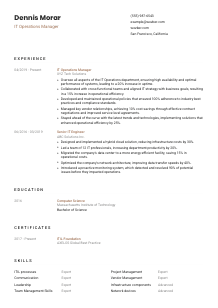
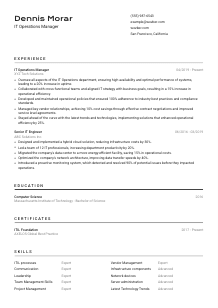
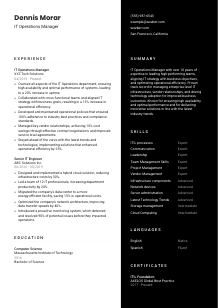
Orchestrating tech harmony, but your CV seems offbeat? Sync up with this IT Operations Manager CV example, created with Wozber free CV builder. Learn how to strike the right chord between your operational expertise and the job at hand, setting your career's rhythm to resonate with opportunity!
IT Operations Manager CVs are reviewed through an operational lens. Hiring teams want to see how you keep business-critical systems available, run stable support and infrastructure environments, and lead teams through incidents, upgrades, and process improvement without losing sight of service quality. Your CV should make that operating range visible, from uptime and SLA performance to policy ownership and vendor oversight.
When the CV is tailored well, it becomes much easier to distinguish a true operations leader from a senior systems engineer with partial management exposure. Using Wozber's free CV builder helps you align your wording with the posting, present an ATS-compliant CV, and surface the infrastructure, ITIL, and leadership experience that matters first for this kind of role.
For IT operations leadership, the header should do one simple job well. It should confirm who you are, what role you are targeting, and whether basic logistics such as contactability and location line up before the reader gets into uptime metrics, infrastructure scope, or team leadership history.
Use your full name in a clean, readable format so it stands out immediately at the top of the page. For a management role, the header should feel direct and professional, matching the operational tone of the rest of the CV rather than relying on design flourishes.
Place "IT Operations Manager" under your name when that is the role you are pursuing. This helps frame your background around operations ownership, service delivery, and team management from the first line, and it supports ATS matching when the title appears exactly as the employer uses it.
List a phone number you answer reliably and a professional email address. Small errors here create friction before anyone reaches your experience in infrastructure management, incident response, or vendor coordination, so review every character carefully.
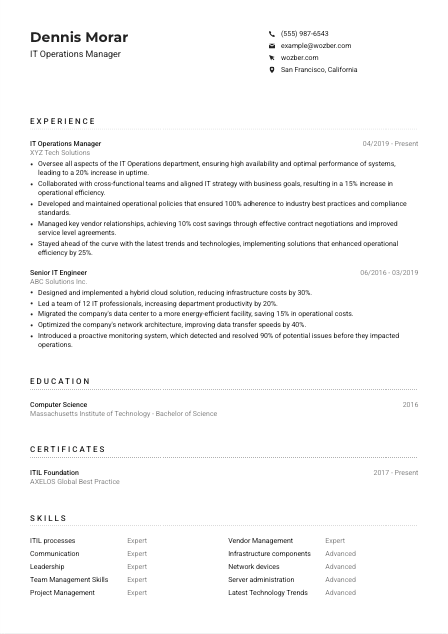
Some postings treat location as a screening requirement rather than a preference. In the example here, listing "San Francisco, California" directly in the header answers that requirement early and avoids unnecessary questions about availability or relocation.
Add LinkedIn or a professional website if it supports your candidacy with consistent career history, certifications, or large-scale IT work. For operations leaders, that profile should reinforce details such as team scope, infrastructure environments, and certifications rather than introduce conflicting information.
Your header should remove basic uncertainty in seconds. Once that is done, the reader can focus on whether you have the operational ownership, infrastructure depth, and leadership range the role requires.




This section carries the most weight for an IT Operations Manager. Employers are looking for proof that you have run environments, improved reliability, led teams, worked across departments, and made sound decisions around vendors, process, and infrastructure performance.
Read the job description for the operating priorities behind the wording. For this role, that includes high availability, cross-functional alignment, policy and procedure ownership, vendor management, and continuous improvement. Use those priorities to decide which parts of your background deserve the most space.
Use reverse chronological order so the reader sees your current operational scope first. For senior IT roles, recent work usually carries the clearest evidence of leadership maturity, escalation ownership, infrastructure complexity, and budget or vendor responsibility.
Each bullet should show what you led, changed, stabilized, or improved. Instead of saying you were responsible for IT operations, show the result. The sample does this well with bullets tied to uptime, policy compliance, cross-functional efficiency, and negotiated vendor savings.
Numbers give operations work real shape. Use metrics that fit the field, such as uptime improvement, incident reduction, response time, cost savings, infrastructure performance, compliance rates, or team productivity. A line such as a 20% increase in uptime or 10% savings through better SLA negotiations tells far more than a broad claim about strong performance.
Keep the emphasis on experience that reflects operational leadership rather than deep technical execution alone. Earlier engineering roles still matter, especially if they show infrastructure depth, cloud migration, monitoring, or network optimisation, but your most visible bullets should point to team leadership, operational policy, and business-facing decision-making.
By the end of your experience section, it should be clear that you can run an IT operations function, improve reliability, and lead people as well as systems. That is the distinction this section needs to make.
Education matters here mainly as a baseline qualification. For an IT Operations Manager, the degree confirms formal grounding in computing or information systems, while your experience and certifications do most of the heavy lifting afterward.
If the role asks for a Bachelor's degree in Computer Science, Information Technology, or a related field, make that easy to find. The example CV does this directly with a Bachelor of Science in Computer Science, which lines up cleanly with the stated requirement.
List the institution, degree, field of study, and graduation year or date in a consistent format. Straightforward structure works best for ATS parsing and keeps the reader focused on whether your background meets the baseline requirement without extra scanning.
Use the official degree title rather than shortening it too aggressively. Precise wording helps when a posting calls for a specific academic background and also keeps your CV aligned with application records and background checks.
For senior operations candidates, coursework and student projects are usually secondary. Include them only if they strengthen your case in a specific way, such as systems administration, networking, information security, or infrastructure-related capstone work. Otherwise, keep the section lean.
Academic honors, technical scholarships, or relevant organizations can stay if they support your professional story, but they should not crowd out more important career evidence. For an experienced IT Operations Manager, education should confirm qualification quickly and move the reader back to operations results.
Your education section does not need to carry the CV. It needs to confirm that you meet the academic requirement and then get out of the way so your operational track record can lead.
In IT operations, certifications can sharpen your credibility, especially when they map directly to service management, infrastructure, or platform knowledge. They are particularly useful when a posting mentions a preferred framework such as ITIL.
Match certifications to the job's priorities before listing everything you have earned. Here, ITIL matters because the posting calls for strong proficiency in ITIL processes and prefers certification. That makes an "ITIL Foundation" credential highly relevant, while something like CCNA adds useful infrastructure depth.
Focus on certificates that reinforce operations leadership, service management, networking, cloud, security, or platform administration. A shorter list of relevant credentials reads better than a long catalogue that mixes unrelated tools or outdated certifications.
Include earned dates or validity periods when that helps show the credential is current or was maintained over time. In operations roles, current certifications can support your case when the team relies on established frameworks, compliance expectations, or vendor-specific environments.
A current certification profile suggests you stay engaged with changes in service management practices, infrastructure tooling, and operational standards. That matters in a role expected to improve efficiency and recommend better solutions, not just maintain the status quo.
Relevant certifications help confirm the frameworks and technical domains you work in. For this role, they should reinforce your operational judgment and service management background, not sit on the page as isolated badges.
An IT Operations Manager skill section should read like the toolkit behind reliable service delivery. That means balancing infrastructure knowledge with operational process, leadership, communication, and vendor-facing capability in language that matches the posting naturally.
Start with the employer's language and then keep only the skills you genuinely use. In this case, terms such as "ITIL processes," "leadership," "team management," and "infrastructure components" should appear because they are central to the work and likely important for ATS optimisation.
Include the skills that support day-to-day operational leadership. That usually means a mix of service management, incident handling, vendor management, project coordination, infrastructure oversight, and communication across technical and business teams. The example balance between ITIL, vendor management, project management, servers, storage, and network devices is a solid model.
Avoid turning this section into a full inventory of every tool or platform you have touched. Choose the skills that support the kind of environment you would be managing. For a manager role, breadth across operations functions often matters more than a long list of narrowly technical tools unless the posting calls for specific platforms.
The skills section should support the story your experience already tells. When the terms match your actual accomplishments, the CV reads as operationally grounded and easier to trust.
Language ability is usually a supporting section for IT operations, but it can still matter. Operations managers spend a large part of the job in meetings, escalations, policy communication, vendor conversations, and cross-functional coordination, so communication language should be presented clearly.
If the posting calls out English communication skills, list English at the top with an honest proficiency level such as "Native" or "Fluent." That directly addresses a stated requirement and supports the management side of the role, where clear written and verbal communication matters every day.
Additional languages can be useful when your environment includes distributed teams, global vendors, or multilingual support contexts. They are a helpful bonus, but they should remain secondary to your operational leadership and infrastructure background.
Choose clear levels such as "Native," "Fluent," "Intermediate," or "Basic." Avoid inflating your proficiency. Operations roles rely on accuracy, and the same standard should apply to how you describe communication ability.
If another language has helped you work with offshore teams, regional vendors, or international stakeholders, it can add context to your candidacy. Keep that relevance brief and grounded rather than treating languages as a headline qualification for an operations management role.
If you are actively improving a language and it has practical relevance to the company or environment, you can note it. Otherwise, keep the section concise so it does not distract from service delivery, infrastructure oversight, and leadership experience.
For IT Operations Manager roles, languages support the larger story of communication and coordination. Present them clearly, then let your operations record stay in the foreground.
The summary should quickly establish the level of environment you have managed and the kind of outcomes you deliver. For IT operations, that usually means reliability, team leadership, infrastructure oversight, process discipline, and business alignment rather than a broad personal statement.
Before writing the summary, identify the few themes that matter most in the posting. Here, those include IT operations leadership, alignment with business goals, ITIL-informed process management, infrastructure oversight, and operational improvement. Build your opening around that mix rather than generic ambition.
Lead with your title or specialty, years of experience, and level of responsibility. The sample summary works because it establishes more than 10 years in IT operations and immediately points to team leadership, business alignment, and enterprise infrastructure rather than vague strengths.
Use one or two outcomes or specialties that match the job. That could be improving uptime, driving efficiency, managing vendors, leading cross-functional initiatives, or maintaining high-availability environments. Keep the claims close to what the rest of the CV proves.
Aim for three to five lines with no filler. Every phrase should earn its space by clarifying your operating scope, leadership level, or business impact. If a sentence could describe almost any manager, rewrite it with language that sounds native to IT operations.
A good summary tells the reader, within a few lines, that you can lead IT operations with discipline and business awareness. Once that is clear, the rest of the CV has a stronger frame.
An IT Operations Manager CV should leave little doubt about your ability to keep systems running, lead teams effectively, and improve the way IT supports the business. When your experience, skills, certifications, and summary all point in that same direction, the hiring read becomes much stronger.
Use Wozber's free CV builder to shape the content into an ATS-friendly CV template, tighten role-specific phrasing, and improve ATS optimisation around the operational terms employers actually search for. The finished CV should make it easy to judge your readiness to run infrastructure, processes, vendors, and people with confidence.




