



Use Wozber and land your dream job
Create CV
No registration required
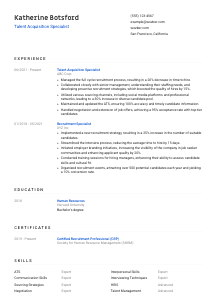
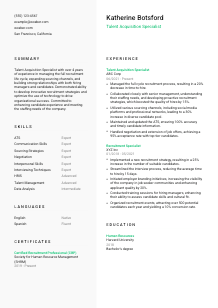
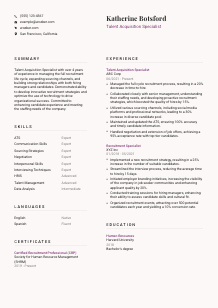
Finding top talent, but your CV feels like a bad interview? Check out this Talent Acquisition Specialist CV example, created with Wozber free CV builder. It shows how to spotlight your recruitment skills to match job specifics, ensuring your career story reflects the caliber of candidates you bring on board!
Talent acquisition work sits at the point where hiring speed, candidate quality, and manager trust all meet. A CV for this field needs to show more than that you posted jobs and scheduled interviews. It should make your recruiting judgment visible through full-cycle ownership, sourcing range, hiring outcomes, and the way you support managers from intake to offer stage.
That becomes much easier to read when the CV mirrors the language of the target role. Wozber's free CV builder helps you align titles, recruiting terms, and measurable results in an ATS-friendly CV format, so a hiring team can quickly see whether you have handled the workflows they need, from sourcing strategy to ATS accuracy and offer management.
Recruiters notice missing basics faster than most candidates realize. In talent acquisition, where communication, responsiveness, and process discipline are part of the job, your header should immediately show that you are reachable, professional, and aligned with any stated logistics for the opening.
Use your full name as the clearest identifier on the page and give it enough visual weight to stand apart from the rest of the header. For a Talent Acquisition Specialist, this is simple but important. Your CV should look as organised as the hiring process you run.
Place "Talent Acquisition Specialist" under your name when that matches the role you are pursuing. It creates instant alignment with the opening and avoids vague alternatives that can blur your specialization across recruiting, HR generalist work, and coordinator-level support.
List a phone number you answer reliably and an email address that looks business-ready. Since this profession depends on timely follow-up with candidates and hiring managers, even small errors in contact details can undercut confidence in your process habits.
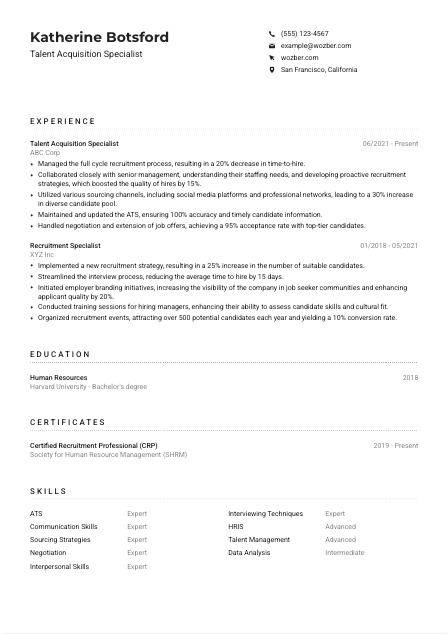
If a role has a location requirement, reflect it in your header. In the example, listing "San Francisco, California" directly addresses the employer's stated preference and removes an early question about local availability. When location is not a factor, city and state are usually enough.
A LinkedIn profile can reinforce your employer branding work, network depth, and career progression. If you include a website or portfolio, make sure it adds something useful, such as speaking engagements, recruiting projects, or talent brand initiatives, and that it matches the details on your CV.
Do not include age, marital status, gender, photo, or other personal identifiers unless a local hiring norm explicitly requires them. In recruiting, you already know how easily unnecessary details can distract from qualifications. Keep the focus on information that supports communication and role alignment.
Your personal details section should read like the top of a well-run recruiting workflow: clear, accurate, and easy to act on. When the header is polished and aligned with the posting, the reader can move straight to your hiring results.




This is the section hiring teams read most closely for talent acquisition roles. They want to see the kinds of searches you have run, how you partnered with hiring managers, whether you improved hiring efficiency, and how well you handled the mechanics of ATS upkeep, interview flow, offers, and onboarding.
Start with the core responsibilities named in the job description and map them to your own background. For this role, that means full-cycle recruitment, sourcing across multiple channels, ATS and HRIS use, hiring manager partnership, and offer handling. Your bullets should make those workflows visible through work you have already done, not through generic claims about being people-focused.
Lead with your most recent role and keep each entry easy to scan. Include title, company, and dates without clutter. In talent acquisition, progression matters. A hiring manager should be able to follow how you moved from supporting searches to owning requisitions, improving process quality, or influencing recruiting strategy.
Most Talent Acquisition Specialists have screened candidates, coordinated interviews, and worked with managers. The difference comes from outcomes. Show what changed because of your work: faster time-to-hire, stronger candidate quality, better acceptance rates, cleaner ATS records, or a broader pipeline. The example does this well by tying full-cycle recruiting work to a 20% reduction in time-to-hire and hiring manager partnership to a 15% lift in quality of hires.
Numbers carry real weight in recruiting CVs because hiring performance is measured. Use metrics such as time-to-fill, offer acceptance rate, candidate conversion, sourcing yield, interview throughput, diversity pipeline growth, ATS accuracy, or event-to-application volume. The sample CV's 95% offer acceptance rate and 100% ATS accuracy are strong examples because they connect recruiting activity to operational discipline and business results.
If you have worked across recruiting, HR, and people operations, put the sharpest recruiting evidence first. Emphasize requisition ownership, channel strategy, stakeholder management, screening, interview calibration, employer branding, and onboarding where relevant. A bullet about training hiring managers, for example, is useful because it shows influence on selection quality, not just process support.
Your experience section should leave no doubt that you can run searches, manage stakeholders, and improve recruiting outcomes. When the bullets combine process ownership with measurable results, your background reads like proven hiring capacity, not just recruiting exposure.
Education usually does not outweigh recruiting results, but it still matters when a posting sets a degree baseline. For talent acquisition roles, the education section should confirm that you meet the requirement cleanly and, when useful, show academic grounding in HR, business, organizational behaviour, or related people-focused work.
Read the posting carefully and mirror the educational baseline when you meet it. Here, the employer asks for a bachelor's degree in Human Resources, Business Administration, or a related field, so that qualification should be easy to find on the page.
Keep the structure simple and standard. Recruiters and HR teams should be able to confirm your degree in seconds without digging through extra text.
If your education directly supports the role, let that alignment work for you. A Human Resources degree, as shown in the example, reinforces your foundation in hiring, workplace structure, and people processes. If your degree is adjacent rather than direct, the field still belongs here as long as your experience carries the recruiting weight.
Early-career candidates can benefit from including recruiting research, HR analytics projects, labour relations coursework, or campus hiring experience. If you already have several years of talent acquisition work, keep this section lean unless a project closely matches the employer's environment or industry.
Academic distinctions, SHRM chapter involvement, business society leadership, or university recruiting projects can help when they support a people, communication, or leadership angle. For experienced candidates, these details should stay brief and should never crowd out more valuable recruiting accomplishments elsewhere on the CV.
Education should quickly confirm that you meet the posting's academic baseline and, where relevant, support your credibility in HR and recruiting. Keep it concise, accurate, and proportional to your level of experience.
Certifications can add useful credibility in talent acquisition, especially when they point to structured knowledge in recruiting, interviewing, HR practices, or workforce planning. They are most effective when they support the kind of recruiting work the role actually involves.
List credentials that are clearly relevant to recruiting or HR. Even when a posting does not require certification, a recognized credential can support your standing with hiring leaders who value process knowledge and professional development. The example's Certified Recruitment Professional is a good illustration because it directly supports recruiting specialization.
Do not stack every course certificate you have ever earned. Prioritise recognized, role-relevant credentials over short workshops or outdated training. A smaller list of meaningful certifications is easier to trust and easier to scan.
If a certification is current, renewable, or recently earned, include the date range or completion year. In recruiting and HR, this helps show that your knowledge stays current with interviewing practices, compliance expectations, and evolving sourcing methods.
The field changes quickly through new sourcing channels, market conditions, ATS workflows, and candidate expectations. Ongoing certification or training in areas like behavioral interviewing, DEI recruiting practices, employment law, or talent analytics can strengthen future applications and keep your CV current.
Relevant certificates can sharpen your profile when they reflect real recruiting expertise and current practice. Include the ones that support your specialization and leave out anything that does not move your candidacy forward.
For a Talent Acquisition Specialist, the skills section should read like a practical operating toolkit. It needs to cover the systems, sourcing methods, communication strengths, and selection skills you use in actual recruiting work, not just a broad collection of HR buzzwords.
Start with the language the employer uses, then keep only the skills you can back up in your experience. Here, that includes sourcing channels, ATS and HRIS proficiency, interpersonal communication, interviewing, and negotiation. This creates better alignment than generic labels that never appear elsewhere on the CV.
Talent acquisition hiring usually looks for both system fluency and relationship management. Include hard skills such as ATS, HRIS, sourcing strategy, interview process design, and data analysis alongside communication, stakeholder partnership, and candidate management. The example's mix of ATS, sourcing strategies, interviewing techniques, negotiation, and interpersonal skills is a solid model because each one connects to core recruiting work.
Put the most relevant skills near the top and avoid padding the section with vague terms. A concise list is stronger when it mirrors the role's real demands, such as full-cycle recruitment, sourcing, offer negotiation, and ATS hygiene. If you use proficiency levels, make sure they are consistent and believable.
A well-chosen skills list should support what the rest of the CV already proves: that you can source, assess, coordinate, communicate, and close. Relevance matters more than volume here.
Language skills can matter in recruiting because communication sits at the centre of the job. Whether you are screening candidates, briefing hiring managers, writing outreach, or handling offer conversations, the languages you list should reflect your real working ability and the employer's actual needs.
Some talent acquisition roles require a specific business language for interviews, stakeholder meetings, or written communication. In this case, strong English communication is explicitly required, so English should be listed clearly with an honest proficiency level.
Lead with the language the job calls for, especially when it affects day-to-day recruiting work. That makes it easy for the reader to confirm you can handle screening calls, candidate messaging, interview coordination, and hiring manager communication in the required language.
Additional languages can be valuable when you recruit across diverse communities, support multilingual candidate pools, or partner with global teams. Spanish in the example is a useful secondary language because it can widen candidate communication options, even if it is not a formal requirement for every Talent Acquisition Specialist role.
Choose straightforward terms and use them consistently so expectations are realistic.
If multilingual ability helps you engage broader talent markets or improve candidate experience, include it. If a language is only conversational and not useful in recruiting work, it does not need priority. The section should support the job you want, not serve as a complete personal profile.
Language skills add value when they clarify how you communicate with candidates and stakeholders. Be accurate, keep the ordering purposeful, and let the section support the recruiting environment you are targeting.
The summary is your chance to frame your recruiting profile before the reader reaches the bullet points. For Talent Acquisition Specialist roles, it should quickly establish your level, your recruiting scope, and the outcomes you are known for, whether that is faster hiring, stronger pipelines, better candidate experience, or tighter partnership with hiring managers.
Pull out the themes that define the opening and choose the ones you can prove best. In this case, full-cycle recruitment, sourcing depth, ATS and HRIS use, hiring manager collaboration, and strong communication are central. Those should shape the summary more than broad statements about passion for people.
Start with a direct line that identifies you as a Talent Acquisition Specialist and states your experience clearly, such as 3+ years or 4+ years. This gives immediate context and helps the hiring team place you at the right level before they move into the rest of the CV.
Use the middle of the summary to spotlight what you do well and what it leads to. The sample summary works because it highlights full recruitment life cycle management, sourcing expansion, technology use, and relationship building. You can make this even stronger by echoing outcomes that show business value, such as improved time-to-hire, stronger candidate quality, or higher offer acceptance.
Aim for a short paragraph of three to five lines. Every phrase should earn its place by pointing to real recruiting capability, relevant tools, or measurable hiring impact. Skip generic adjectives and save detail for the experience section, where your results can do the heavy lifting.
Your summary should quickly tell the reader what recruiting scope you handle and what outcomes tend to follow your work. When it is specific and grounded in real hiring results, the rest of the CV has a clear frame.
You now have the core sections needed for a Talent Acquisition Specialist CV that reads like actual recruiting work, not generic HR language. Use Wozber's free CV builder to organise your experience, tailor your wording to the target posting, and produce an ATS-compliant CV that highlights full-cycle recruiting, sourcing reach, stakeholder partnership, and hiring results.
Before sending it, run it through the ATS CV scanner to catch missing terms, tighten alignment, and improve section-level match where needed. The final version should make one thing easy to judge: whether you can step into the search, manage the process cleanly, and deliver strong hires.




