



Use Wozber and land your dream job
Create CV
No registration required
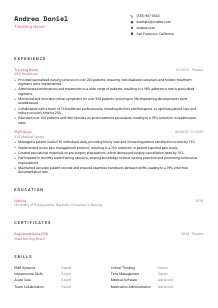
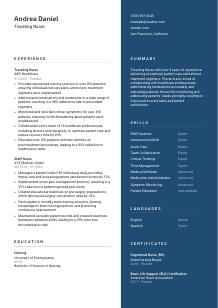
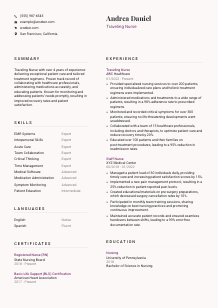
Swapping locations but your CV feels grounded? Jet-set to this Travelling Nurse CV example, created with Wozber free CV builder. Learn how to highlight your healthcare prowess while matching regional job specs, so your career can roam as adventurously as you do!
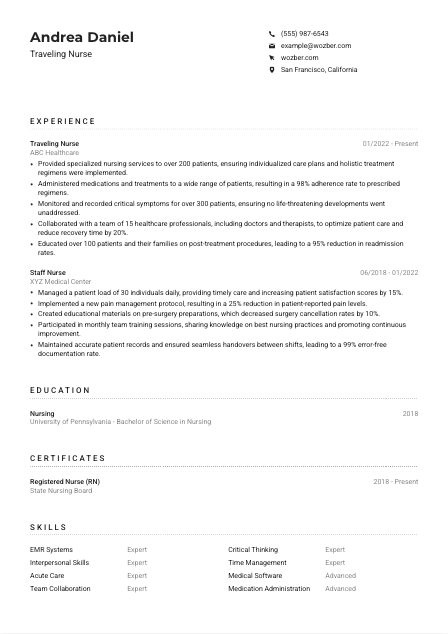
Travelling nurses step into unfamiliar units and are expected to deliver safe care almost immediately. That makes your CV less about broad nursing identity and more about showing how quickly you can adapt to new workflows, manage acute patient needs, document accurately, and work smoothly with physicians, therapists, and bedside teams from day one.
A targeted CV helps hiring teams separate travel-ready nurses from candidates whose experience is solid but less mobile or less acute-care focused. Using Wozber's free CV builder to align your language with the posting and keep an ATS-compliant CV structure makes it easier to surface the right details first, such as acute care experience, EMR proficiency, licensure, and patient education work that transfers cleanly into a new setting.
Travel nurse hiring moves quickly, and small omissions in the header can slow everything down. This section should confirm who you are, how to reach you, and whether you match any practical requirements tied to licensure or location.
Use the name you practice under and make it easy to scan. In healthcare hiring, consistency matters. Your name should match your RN license, certification records, and application documents so there is no confusion during credentialing or onboarding.
Place "Travelling Nurse" directly below your name when that is the job you want. This keeps your CV aligned with the posting and helps ATS systems connect your background to travel nursing openings rather than general staff nurse roles.
Include one reliable phone number and a professional email address you check often. Travel assignments can move fast, and missed calls about interviews, start dates, or compliance paperwork can cost you an opportunity.
If a posting requires you to be in a certain city or willing to relocate, say so plainly in your header. For the example role, listing San Francisco, California immediately supports the employer's location requirement. Use this kind of detail when it removes a real concern, not as filler.
A LinkedIn profile can help if it mirrors your CV, shows stable work history, or includes endorsements tied to acute care, patient education, or EMR use. Skip it if it is outdated or inconsistent with the experience you are presenting.
Your header does not need personality flourishes. It needs to make credentialing, contact, and location review easy so the reader can move straight to your clinical background.




For a travelling nurse, experience is where hiring teams look for real operating confidence. They want to see acute care exposure, patient volume, medication administration, interdisciplinary coordination, and the ability to keep documentation and handoffs tight under pressure.
Read the job description line by line and map your experience to the work being asked for. In this posting, that includes acute care, individualized care plans, medication administration, symptom monitoring, EMR use, patient education, and collaboration across disciplines. Build bullets around those functions instead of relying on generic nursing statements.
List roles in reverse chronological order with job title, employer, and dates. For travel nursing, this timeline helps reviewers quickly confirm that you meet the requested 2+ years of clinical experience and shows whether your recent work is close to the patient population and pace of the opening.
Focus on patient load, adherence, recovery, readmissions, documentation quality, pain reduction, handoff accuracy, or care coordination. The sample CV does this well by tying nursing actions to results, such as a 98% medication adherence rate and a 20% reduction in recovery time through team collaboration.
Metrics are especially useful in travel nursing because employers are hiring for speed of trust. Numbers like patients served, daily caseload, documentation accuracy, reduction in readmissions, or improvement in patient satisfaction show scale and consistency. Choose figures that reflect patient care realities, not inflated business language.
Prioritise experience that shows you can perform in fast-moving care environments, adapt to different teams, and maintain quality across shifts. Older or unrelated bullets can stay brief unless they strengthen a key requirement such as acute care exposure, discharge teaching, or EMR documentation.
The best bullets show what kind of patients you supported, what clinical work you handled, and what changed because you were on the floor. That is what makes a travel nurse CV credible.
Education is usually a quick screen in nursing applications, but it still matters. Hiring teams want to confirm that your degree lines up with the posting and supports licensure, clinical training, and safe practice expectations.
If the posting asks for a bachelor's degree in nursing or a related field, use the full degree name exactly as awarded. "Bachelor of Science in Nursing" is a direct match here and removes guesswork for both recruiters and ATS screening.
List your degree, school, and graduation year in a clean format. Nursing CVs rarely need a long academic section unless you are early in your career or the role values a specific concentration, clinical placement, or honors distinction.
When the employer names a preferred academic background, do not paraphrase it loosely. Use the degree title that connects cleanly to the opening. In the example, the BSN from the University of Pennsylvania directly supports the posted education requirement.
Specialised coursework can help if it ties to the patient population or care setting, such as acute care, medical-surgical nursing, critical care foundations, or community health. For an experienced travel nurse, keep these details short and only include them when they add something your experience section does not already show.
Honors, leadership roles, or nursing research are worth mentioning if they reinforce clinical discipline, communication, or evidence-based practice. If you have several years of bedside experience, these should stay secondary to your patient care record.
This section works best when it quickly verifies that you have the nursing degree the role asks for and then gets out of the way so your clinical experience can lead.
For travel nursing, credentials are operational, not decorative. A missing or vague license entry can stop an application before anyone reads your experience, so this section needs to be exact and current.
Put your RN license first and name it clearly. If you hold licensure in the state of practice, say so. If you are in the process of endorsement for another state, note that only when it is accurate and relevant. The posting here specifically requires a valid RN license in the state of practice, so that item should be impossible to miss.
List the credentials that matter most for direct patient care and rapid deployment, such as BLS, ACLS, PALS, or specialty certifications that fit your unit background. The sample includes BLS, which supports immediate clinical readiness without overloading the section.
Use issue dates, renewal dates, or a current range when appropriate. In nursing, expiration matters. A recruiter or compliance coordinator should be able to tell at a glance whether your credentials are active enough for submission.
Additional certifications can strengthen your profile if they reflect the kind of assignments you pursue, such as telemetry, emergency care, trauma, or infusion therapy. Choose credentials that expand your clinical range or reinforce safe practice in high-acuity environments.
Your licenses and certifications need to answer a practical question fast: can this nurse be cleared for the assignment? When that answer is clear, the rest of the CV carries more weight.
The skills section should reflect how you actually work in patient care settings. For travelling nurses, that means a mix of clinical execution, documentation systems, communication, and the adaptability to function well across different teams and protocols.
Start with the skills the employer explicitly names, then add closely related abilities you genuinely use. In this case, that includes EMR systems, medical software, communication, interpersonal skills, acute care, medication administration, symptom monitoring, and interdisciplinary collaboration.
Travel nurses need both. Clinical skill keeps care safe, while communication keeps handoffs, patient teaching, and team coordination effective. A list that combines EMR proficiency with acute care judgment, patient education, and collaboration reads much closer to real nursing work than a generic soft-skills block.
Order matters because recruiters often skim this section quickly. If the role centers on acute care and documentation, lead with those instead of broad traits like time management. The example CV sensibly foregrounds EMR systems, acute care, collaboration, and medication-related skills before less specific items.
If a skill would matter during a shift change, medication pass, patient assessment, or discharge conversation, it likely belongs here. That is the standard to use.
Language ability matters in nursing because communication affects consent, education, discharge understanding, and patient trust. For a travelling nurse, clear language skills can also ease transitions into diverse communities and multidisciplinary teams.
If the employer asks for English proficiency, list it clearly and use an accurate level. The job description here makes effective English a stated requirement, so English should appear first in the section rather than being assumed.
Use labels such as Native, Fluent, Intermediate, or Basic. Avoid vague wording. In patient care settings, the difference between conversational ability and fluent clinical communication matters.
Additional language skills can be especially useful in hospitals and clinics serving diverse populations. Spanish, for example, may strengthen communication with patients and families in many markets, but it should be presented as an added asset rather than a universal requirement.
Only claim a level you can sustain during patient education, symptom discussion, or coordination with staff. Overstating language ability can create safety risks in healthcare and quickly undermine trust.
If another language has helped you explain procedures, support discharge instructions, or reduce misunderstandings with patients and families, that is worth reflecting elsewhere in your CV too. It shows communication value in a clinical context, not just a personal attribute.
List the languages you can truly use in clinical communication, and make the level easy to understand. In nursing, that practical honesty matters.
Your summary should quickly establish what kind of nurse you are, how much relevant experience you bring, and which parts of your background match the assignment. For travel roles, this section works best when it points to acute care strength, adaptability, and reliable patient outcomes.
Before writing, identify the few things this employer needs confirmed early. Here, that means acute care experience, RN qualification, EMR comfort, interdisciplinary work, and patient-facing communication. Those should shape the summary more than broad statements about passion or dedication.
Start with a direct line such as your title and years of relevant experience. The sample summary does this effectively with "Travelling Nurse with over 4 years of experience," then moves into patient care and treatment support. That opening immediately places the candidate in the right lane.
Choose strengths with clear hiring value, such as medication administration, symptom monitoring, EMR documentation, acute care judgment, or patient and family education. If you include an achievement, keep it brief and relevant, like improved recovery outcomes or strong patient satisfaction trends.
Aim for a concise paragraph that can be scanned in seconds. Three to five lines is enough to set context for the rest of the CV. Avoid repeating bullets from your experience section. Use the summary to frame your clinical profile, not duplicate it.
A useful summary tells the hiring team what kind of nurse they are looking at before they reach the first job entry. For travel nursing, that first impression should point to safe care, adaptability, and immediate contribution.
A travelling nurse CV works when it makes the practical hiring questions easy to answer: Are you licensed, clinically experienced, comfortable in acute care, able to document accurately, and ready to adapt to a new team without a long runway?
Use Wozber's free CV builder to shape that story in an ATS-friendly CV format, refine your wording with role-specific terminology, and check alignment with an ATS CV scanner before you apply. The final document should make your bedside judgment, patient care range, and assignment readiness clear from the first screen.




