



Use Wozber and land your dream job
Create CV
No registration required
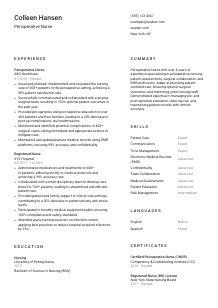
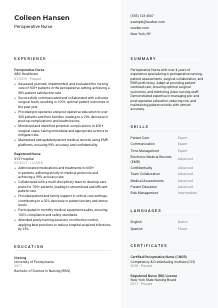
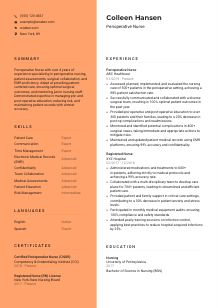
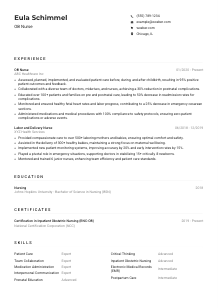
Navigating the operating theater, but your CV feels off the OR schedule? Check out this Perioperative Nurse CV example, created with Wozber free CV builder. It shows how to stitch your surgical skills and patient care together, creating a career profile as precise and efficient as your scalpel work!

Perioperative nursing leaves little room for vague claims. Hiring teams want to see how you support patients through the surgical experience, how you work alongside surgeons and anesthesia staff, and how you handle documentation, education, and risk when timing and accuracy matter.
When that experience is tailored well, the CV quickly shows whether your background matches the pace and clinical demands of the OR. Wozber's free CV builder helps you shape an ATS-compliant CV around the language of the posting so your perioperative care, EMR work, and surgical-team collaboration are easier to recognize at first pass.
This section is brief, but in healthcare hiring it still carries practical weight. Contact details, licensure context, and location can affect how quickly your application moves forward, especially when the employer has state-specific or on-site requirements.
Use your full name as the clearest text at the top of the page. Keep it simple and professional so the focus stays on your nursing background, credentials, and perioperative experience rather than on styling choices.
Add the exact role title you are pursuing, such as "Perioperative Nurse." In clinical hiring, this instantly frames your experience around surgical care rather than general inpatient nursing, and it helps align your CV with the wording used in the posting.
List a reliable phone number and a professional email address you check regularly. Hospitals and surgical centers often move quickly once interviews begin, so even small errors here can slow down a qualified application.
If the employer specifies a city or state, show that information clearly in your personal details. In the example, listing New York, NY supports a posting that requires the candidate to be located there and already removes one common logistical question from the review process.
A current LinkedIn profile can support your application if it reflects the same employment dates, credentials, and nursing scope shown on your CV. Keep it aligned with your perioperative work, certifications, and clinical progression rather than using it as a separate biography.
Your personal details should confirm that you are reachable, professionally presented, and aligned with any location or title requirements. In healthcare roles, that kind of clarity helps the rest of your CV get reviewed on its actual merits.




For a perioperative nurse, experience is where hiring teams look for operating room judgment, patient throughput, complication management, and collaboration under pressure. Generic nursing bullets will not do enough here. Your work history needs to show what kind of surgical support you provided and what outcomes followed.
Before writing bullets, identify the responsibilities that define the role. In this case, the posting emphasizes perioperative assessment, care planning, patient education, EMR documentation, complication monitoring, and collaboration with the surgical team. Those themes should shape the way you describe your own cases, workflows, and results.
Use reverse chronological order and make each entry easy to scan with job title, employer, and dates. For perioperative candidates, put the strongest OR-related role first so the reviewer immediately sees your exposure to surgical settings, not just your broader nursing history.
Describe what you assessed, coordinated, taught, monitored, or documented, then connect that work to a result. The sample CV does this well by pairing perioperative duties with outcomes such as patient satisfaction, fewer post-op complications, and accurate records, which makes the scope of care much easier to understand.
Quantify patient volume, charting accuracy, satisfaction scores, reduction in complications, readmissions, or compliance rates where those numbers are credible. Metrics like "500+ patients," "98% patient satisfaction," or "99% record accuracy" help translate routine nursing work into measurable surgical support and patient safety performance.
Keep the emphasis on perioperative care, surgical coordination, post-op recovery support, education, infection control, and risk response. Earlier bedside or general RN work still belongs if it builds toward the role, but frame it through transferable strengths such as care planning, medication accuracy, audit compliance, or interdisciplinary teamwork.
A strong experience section makes your clinical judgment visible. By the time someone finishes reading it, they should understand how you support surgical flow, protect patient safety, and contribute to better perioperative outcomes.
Education is usually a straightforward section for perioperative nurses, but it still needs to answer the posting clearly. Reviewers want to confirm that your nursing degree matches the clinical standard required for licensure and hospital hiring.
List the nursing degree that best matches the requirement in the posting. Here, a Bachelor of Science in Nursing fits a stated BSN-or-equivalent requirement and immediately confirms the academic baseline expected for the role.
Include degree, field of study, school name, and graduation year in a clean, consistent format. Education sections are often reviewed quickly, so clarity matters more than extra description unless you are early in your career.
If a posting specifically calls for a BSN, write it exactly that way instead of leaving the reviewer to infer it from a longer program name. Matching the employer's wording helps both ATS screening and human review move faster.
If you are early in your nursing career, you can include relevant clinical rotations, perioperative coursework, simulation training, or honors that point toward surgical care. Experienced perioperative nurses usually get more value from expanding clinical achievements elsewhere on the page.
Additional learning such as infection control training, perioperative seminars, or hospital-based development programs can reinforce your commitment to current practice. If those items are substantial, they may fit better in certifications or a separate professional development line.
This section does not need decoration. It needs to show, clearly and quickly, that you have the nursing education expected for perioperative practice and for the specific role you are targeting.
Certifications matter in perioperative hiring because they show validated knowledge beyond baseline nursing qualification. They are especially useful when a role involves surgical workflows, sterile technique, patient safety standards, and specialised perioperative judgment.
Start with the certifications most relevant to the posting. A current RN license belongs here when listed as a job requirement, and a CNOR credential deserves prominent placement when the employer prefers candidates with perioperative specialization.
Choose certifications that support your work in perioperative care, patient safety, or core nursing practice. The example pairs RN licensure with CNOR certification, which gives the reader both the required legal qualification and a stronger specialty signal for the OR.
Licenses and clinical certifications often need renewal, so include dates or active ranges where appropriate. That helps the employer see that your credentials are current and usable without needing follow-up just to confirm status.
Perioperative practice changes with updated safety protocols, documentation standards, and surgical procedures. Ongoing certification maintenance or relevant continuing education shows that your knowledge is active, not static, which is especially important in high-acuity environments.
Certifications should reinforce the clinical picture your experience section already paints. When they are current and well chosen, they tell the reader that your perioperative knowledge has been formally recognized as well as practiced.
A perioperative nurse skills section should reflect how care is delivered around surgery. That means balancing clinical capability with team coordination, patient education, and documentation accuracy, not filling the page with broad workplace traits.
Pull the required and preferred skills directly from the job description, then keep only the ones you genuinely use. Here, EMR proficiency, communication, perioperative patient care, record accuracy, and risk monitoring all deserve space because they connect directly to the employer's daily workflow.
Perioperative nursing depends on both. Include skills tied to clinical execution, such as medical assessments, EMR documentation, patient education, and risk management, alongside collaboration and communication skills that matter when coordinating with surgeons, anesthesiologists, and recovery staff.
Order your list so the most role-relevant skills appear first. In the sample, patient care, EMR, team collaboration, and confidentiality all fit the realities of perioperative work better than generic filler, and they help the reviewer picture how you function in a surgical environment.
Every skill you include should support a real part of perioperative practice, whether that is patient preparation, surgical teamwork, charting, or complication response. Relevance matters more than length here.
Language ability matters in nursing because instructions, consent support, education, and documentation all rely on clear communication. For perioperative roles, that can affect patient understanding before surgery and coordination across the care team.
Some roles ask specifically for English proficiency, as this one does. Make that visible on your CV so there is no doubt that you can handle charting, patient education, and team communication in the language required for care delivery.
Put the required language first, then add any others that could support patient communication in the local population or care setting. English should lead here, while another language such as Spanish can add value when working with diverse patients and families.
Terms such as "Native," "Fluent," "Intermediate," and "Basic" are usually enough. They give a realistic picture of how comfortably you can explain procedures, answer questions, or support perioperative education without overstating your level.
Language skills can become especially relevant in hospitals serving multilingual communities. If an additional language helps with pre-op instruction, family communication, or discharge education, it is worth including as a practical care asset rather than as a personal detail.
For a perioperative nurse, language ability supports comprehension, trust, and smoother handoffs. Include it when it strengthens your ability to educate patients, respond to concerns, and collaborate clearly across the surgical journey.
This section is most effective when it reflects real clinical communication value. If your language ability helps patients understand procedures or helps teams coordinate more smoothly, it belongs on the CV.
Your summary should give a fast, accurate picture of your perioperative background before the reader reaches the experience section. In a clinical CV, that means naming your specialty, your years of practice, and two or three strengths that matter in surgical care.
Read the posting for the themes that matter most, then reflect them in your opening lines. For this role, perioperative care, patient assessment, surgical-team collaboration, education, and EMR accuracy are more useful than broad statements about being hardworking or passionate.
Start with a direct line such as "Perioperative Nurse with 4+ years of experience" and then narrow into your specialty focus. That gives the reviewer immediate context and helps distinguish you from general RN candidates.
Choose details that match the posting and are supported by the rest of your CV. The sample summary does this by mentioning perioperative nursing, patient assessments, surgical collaboration, EMR proficiency, and patient education, all of which connect directly to the documented experience below.
Aim for a short paragraph that can be read in seconds. If a line does not strengthen your perioperative profile, cut it and use the space for a clearer specialty, credential, or patient-care outcome.
Your summary should sound like a perioperative nurse speaking about perioperative work. When it is tailored well, the reader immediately understands your specialty, your level, and the kind of surgical care you are prepared to support.
A well-tailored perioperative nurse CV makes it easy to see your clinical background, your role in surgical care, and the credentials that support safe patient outcomes. With Wozber's free CV builder, ATS-friendly CV templates, and ATS CV scanner, you can organise that experience into language that matches the posting and reads cleanly in an ATS-friendly CV format.
Keep the focus on the work itself: perioperative assessments, surgical-team coordination, patient education, EMR accuracy, and complication response. That is the picture a hiring team needs to see before they invite you into the next stage.