



Use Wozber and land your dream job
Create CV
No registration required
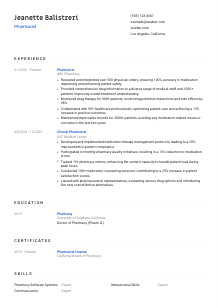
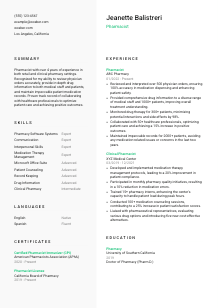
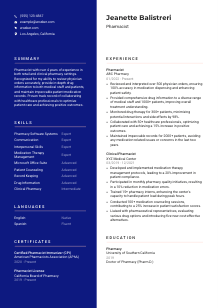
Dispensing prescriptions, but your CV isn't the right dosage? Check out this Pharmacist CV example, created with Wozber free CV builder. Learn how to blend your pharmaceutical expertise with job requirements, keeping your career healthy and drug-interaction-free!
Pharmacist CVs are reviewed with patient safety in mind. Hiring teams look quickly for the kind of work that affects dispensing accuracy, therapy monitoring, counseling quality, and collaboration with prescribers or care teams. If those responsibilities stay buried under generic duty lists, even experienced candidates can look less prepared than they are.
A tailored CV makes your pharmacy background easier to read in the same terms used in the opening, which matters for both ATS screening and human review. Wozber's free CV builder helps you align section wording, structure, and role-specific terminology into an ATS-compliant CV, so your document surfaces the experience that matters most first, whether that is order verification, medication therapy management, or patient-facing counseling.
In pharmacy hiring, the top of the CV should confirm basic eligibility fast. Your name, title, contact details, and location do more than introduce you. They help the employer see that you are licensed, reachable, and available for the practice setting they are hiring into.
Place your full name at the top in a clean, readable font that stands out from the rest of the page. In a profession where accuracy matters, even the header should feel orderly and professional.
Add the job title directly under your name when it matches your target role. Using "Pharmacist" immediately connects your CV to the opening and keeps your positioning clear, especially when you also have experience in titles such as Clinical Pharmacist or Staff Pharmacist.
Pharmacy employers often move quickly when a candidate already meets licensing and experience requirements, so your contact information needs to be flawless.
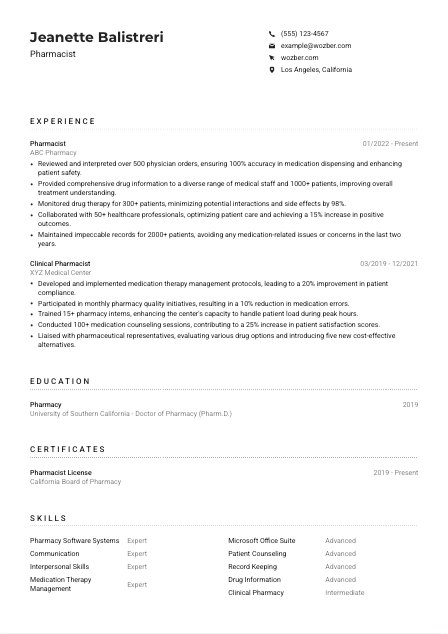
If the employer wants someone already based in a specific area, say so clearly. Here, listing Los Angeles, California helps confirm that you meet a stated location requirement without forcing the employer to guess about relocation or commute issues.
Include a website or LinkedIn profile only when it supports your application with relevant licensing, career history, or professional activity. Keep the content consistent with your CV so the hiring team sees the same employment dates, credentials, and practice background across both.
This section should answer the practical questions first: who you are, what role you do, how to reach you, and whether you meet immediate logistics such as location. Clean personal details give the rest of your pharmacy experience a stronger start.




Pharmacist hiring decisions are heavily shaped by what you have handled in practice. Your experience section should show the scale of your dispensing work, the kinds of patients or care teams you supported, and the outcomes tied to safety, compliance, counseling, and therapy management.
Start by identifying the work that appears repeatedly in the posting. For a pharmacist role, that usually means reviewing orders, dispensing medications, monitoring drug therapy, counseling patients, maintaining medication records, and working with physicians or other clinicians. Those should become the backbone of your strongest bullets.
Begin with your most recent pharmacy position and work backward. For each entry, include the title, employer, and dates so the hiring manager can quickly follow your progression across retail, hospital, ambulatory, or clinical settings.
Do not stop at listing responsibilities. Show what your work improved or protected. A bullet such as "Reviewed and interpreted over 500 physician orders, ensuring 100% accuracy in medication dispensing" works because it links a core pharmacist duty to a patient-safety result.
Quantify your work where the numbers are meaningful. Prescription volume, number of patients monitored, reduction in medication errors, adherence improvement, patient satisfaction, immunization counts, or care-team collaboration all help define scope. The sample CV does this well with metrics like monitoring therapy for 300+ patients and improving outcomes by 15%.
If you have a long work history, prioritise experience that matches the target setting and responsibilities. Retail employers may care more about dispensing volume, counseling, and medication record accuracy. Clinical employers may focus more on therapy interventions, protocol development, and interdisciplinary collaboration. Choose bullets that mirror the opening instead of trying to preserve every past duty.
Your experience section should make it easy to see how you practice pharmacy, not just where you worked. When your bullets connect medication safety, patient outcomes, and workflow responsibility, your background reads as immediately job-relevant.
Education carries special weight in pharmacy because the degree itself is a licensing gateway. Present it clearly so the employer can confirm that you meet the formal academic requirement before moving on to your practice experience.
Read the posting for the exact academic requirement and make sure it appears plainly in your education section. For this role, a Doctor of Pharmacy, or Pharm.D., from an ACPE accredited school is essential, so that credential should never be abbreviated into something vague.
List your degree, field, school, and graduation year in a clean structure. That gives hiring teams and compliance reviewers a quick way to confirm your academic foundation without searching through other sections.
Use the same core terminology the employer uses when it accurately reflects your background. If your degree is a Pharm.D., state it exactly. In the sample CV, "Doctor of Pharmacy (Pharm.D.)" works well because it mirrors the requirement and leaves no ambiguity.
Most experienced pharmacists do not need to list courses, but newer graduates can use relevant coursework, rotations, or academic projects to support practice readiness. Topics such as pharmacotherapy, patient counseling, ambulatory care, or medication safety can add value when hands-on experience is still limited.
Honors, leadership roles, research, or residency-related academic work can be useful if they connect to the role you want. Keep them if they show clinical depth, specialty interest, or professional development. Leave them out if they distract from stronger practice-based qualifications.
For pharmacists, education is a core qualification, not a background detail. When your degree is listed clearly and accurately, the employer can move quickly from academic eligibility to the substance of your clinical or retail experience.
Licensure and professional certifications carry real weight in pharmacy because they show what you are legally authorized to do and where you have extended your practice scope. This section should focus on credentials that matter in day-to-day pharmacy work, not generic course completions.
Prioritise certifications and credentials that strengthen your profile for the role. An active pharmacist license belongs here if your CV format separates licenses and certificates, and additional credentials such as immunization authority can support patient-facing pharmacy work.
Place the most relevant items first. For example, a California pharmacist license is central for a pharmacist job in that state, while a credential like Certified Pharmacist Immunizer can add value for retail or community positions that include vaccination services.
Include issue dates or active periods when the credential is current or time-sensitive. That helps the employer confirm recency and ongoing standing, especially for licenses, immunization credentials, or specialty certifications that require renewal.
Review this section each time you apply. Pharmacy practice changes quickly, and current credentials in immunization, medication therapy management, specialty areas, or state licensure can shift how your application is ranked against other licensed candidates.
A well-chosen certificate section shows more than professional interest. It clarifies licensure status, added competencies, and the kinds of pharmacy services you are prepared to deliver from day one.
The best pharmacist skills sections read like a compact snapshot of how you work. Include the systems, clinical capabilities, and patient-facing strengths that support safe dispensing, accurate documentation, and effective counseling in the setting you are targeting.
Scan the job description for required skills and recurring terms, then reflect the ones you genuinely use. For this posting, pharmacy software systems, Microsoft Office Suite, communication, interpersonal skills, and patient counseling are direct matches. Depending on your background, medication therapy management or drug information support may also be worth adding.
Pharmacy hiring usually requires both operational precision and strong communication. Pair system knowledge and documentation tools with skills tied to counseling, medication review, therapy monitoring, and collaboration with clinicians. That combination reads far better than a list made up only of software or only of soft skills.
Choose skills that reinforce the kind of pharmacist you are applying to be. A focused list is easier to scan and often more effective for ATS optimisation than a crowded inventory of generic abilities. Put the most role-relevant skills first so the employer sees your practical strengths right away.
Your skills section should support the rest of the CV, not repeat vague strengths. When the list combines pharmacy systems, patient-care capabilities, and workflow skills that match the opening, it strengthens both ATS alignment and the human read.
Language skills matter in pharmacy because clear communication affects counseling quality, medication understanding, and patient safety. If the role specifies English proficiency, make that visible. If you speak additional languages used by your patient population, that can be a practical advantage too.
When a posting calls out English communication, list English prominently and choose a proficiency level that accurately reflects your ability to explain medication use, answer patient questions, and communicate with prescribers or staff.
Additional languages can strengthen your CV when they help you serve a broader patient base. In many community and outpatient settings, bilingual ability can improve counseling, adherence, and trust during medication education.
Be clear about what you can actually do in each language. "Native," "fluent," and "conversational" should reflect your real communication level, especially if you may need to discuss dosing instructions, side effects, or follow-up concerns.
Do not treat this as a filler section. For pharmacists, language ability affects counseling accuracy, patient comprehension, and coordination with care teams. That makes English proficiency particularly important in a role that includes drug information and patient interaction.
If you can support patients in more than one language, that is more than a nice extra. It can help reduce misunderstandings at pickup, improve counseling effectiveness, and strengthen care in diverse communities. The sample CV's English and Spanish combination is one example of that value.
List languages in a way that reflects actual pharmacy communication needs. The hiring team should be able to tell, at a glance, whether you can counsel clearly and serve the patient population in front of you.
Your summary should frame you as a practicing pharmacist with the right setting, scope, and strengths for the role. In a few lines, connect your years of experience to the kinds of pharmacy work that matter most, whether that is dispensing accuracy, therapy oversight, patient counseling, or collaboration across care teams.
Before writing the summary, identify the responsibilities the employer emphasizes most. For pharmacist roles, that often includes order review, safe dispensing, drug information, patient counseling, medication record accuracy, and therapy monitoring. Build your opening around the parts you do best and most often.
Open with your title and a concise description of your experience level and environment. A line like "Pharmacist with over 4 years of experience in retail and clinical pharmacy settings" works because it immediately places you in relevant practice contexts.
Use the middle of the summary to highlight strengths that match the opening. For example, you might mention accurate physician order review, patient counseling, interdisciplinary collaboration, medication therapy management, or record integrity. The sample summary is effective because it links those strengths directly to patient care and outcomes.
Aim for a short paragraph that feels grounded in real pharmacy work. Avoid broad claims like "results-driven professional" when you can say something concrete about dispensing accuracy, patient volume, therapy interventions, or collaboration with medical staff instead.
A well-written summary gives the employer a fast read on your practice background and where you add value. Keep it specific, aligned to the opening, and anchored in the actual responsibilities you want to keep performing.
Your pharmacist CV should now show the essentials clearly: the required degree, active licensure, relevant practice setting, and the kind of work that protects patients and supports treatment outcomes. When each section is aligned to the opening, the hiring team can quickly see whether your background fits the pace and responsibility of the role.
Use Wozber to turn that alignment into a polished, ATS-friendly CV format. Its tools, including the ATS CV scanner and AI-powered tailoring support, help you surface missing requirements, match the language of the job description, and present your experience in a way that is easier to review. The final document should make one thing clear right away: you can step into the pharmacy workflow and contribute safely, accurately, and confidently.




