



Use Wozber and land your dream job
Create CV
No registration required
Dispensing medications and dosages, but your CV feels like the wrong prescription? Refill your job prospects with this Clinical Pharmacist CV example, created with Wozber free CV builder. Learn how to present your pharmaceutical expertise to match job criteria, elevating your career from the generics to the specialties!
Clinical pharmacists are trusted to make medication decisions that affect safety, adherence, and treatment outcomes in real time. A CV for this work has to make that clinical judgment visible. Hiring teams want to see how you manage medication therapy, work through reconciliation issues, contribute to evidence-based recommendations, and communicate clearly with physicians, nurses, patients, and caregivers.
The first pass often depends on whether your CV clearly connects your background to the exact mix of direct care, documentation, and interdisciplinary collaboration in the opening. Using Wozber's free CV builder helps you shape that experience into an ATS-compliant CV with the right clinical terminology, so your medication management work, EMR fluency, and practice-setting experience are easy to recognize quickly.
Healthcare employers move fast when a candidate already meets the practical basics. In a Clinical Pharmacist CV, the header should confirm who you are, how to reach you, and any location or licensure context that removes avoidable questions before the reader gets to your clinical background.
Your name should be the most visible line in the header, presented in a clean, professional format. In pharmacy hiring, clarity matters more than design flourishes. Make it easy for a recruiter, department lead, or credentialing contact to identify your CV quickly during a high-volume review.
Place "Clinical Pharmacist" directly under your name when that is the role you are applying for. This immediately frames the rest of the CV around direct patient care, medication therapy management, and clinical decision support rather than retail, operational, or distribution-focused pharmacy work.
List a current phone number and a professional email address that you check regularly. If you include a website or LinkedIn profile, make sure it supports your pharmacy background with consistent titles, experience dates, and credentials. Any mismatch can slow down outreach, especially when employers are coordinating interviews around clinical schedules.
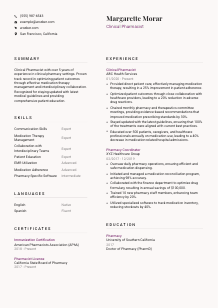
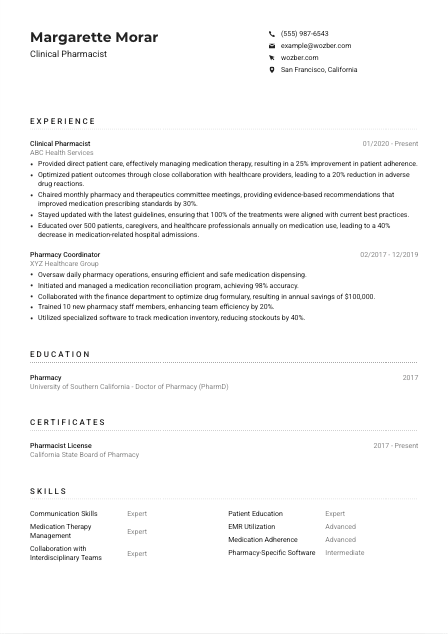
If an employer specifies a city or relocation requirement, address it directly in your header. In the provided example, listing San Francisco, California immediately answers a stated requirement and removes uncertainty about local availability. Use this approach when geography affects licensure timing, start date, or onsite expectations.
A polished LinkedIn profile can reinforce your hospital, ambulatory care, or clinical pharmacy experience, especially if it includes committee work, residency details, publications, or patient education initiatives. Leave it off if it is sparse or outdated. Every link should strengthen the picture of you as a practicing clinician.
This section does not need extra personality. It needs accuracy, professional consistency, and any detail that makes your application easier to move forward. When the basics are handled well, the reader can focus on your medication expertise and patient care results.




This section carries the most weight because clinical pharmacy hiring depends on applied practice, not just credentials. Employers want to see where you influenced therapy decisions, reduced medication-related risk, supported care teams, and worked within a documented clinical workflow using EMRs, protocols, and current treatment guidance.
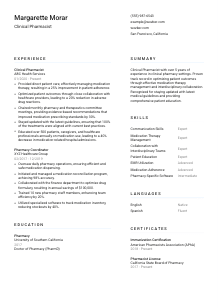
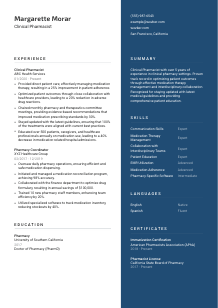
Read the job description for its real practice priorities, then mirror those themes in your bullets. For a Clinical Pharmacist opening, that usually means direct patient care, medication therapy management, reconciliation, evidence-based intervention, provider collaboration, and education. The sample CV does this well by linking patient care to adherence gains and interdisciplinary work to fewer adverse drug reactions.
List positions in reverse chronological order with job title, employer, and dates. That structure helps reviewers quickly track your clinical progression, whether you moved from coordinator work into bedside or ambulatory care, or expanded from operational pharmacy into broader medication management responsibilities. It also supports ATS readability.
Your best bullets show what you handled, how you contributed, and what changed because of your work. Focus on medication reviews, formulary input, therapy recommendations, patient counseling, reconciliation accuracy, or education outcomes. A line such as educating more than 500 patients and caregivers annually works because it ties communication to a meaningful care outcome rather than listing education as a duty alone.
Metrics are especially persuasive in pharmacy when they reflect safety, adherence, utilization, or care quality. Use numbers that belong naturally to your setting, such as reductions in adverse drug events, improvement in adherence rates, reconciliation accuracy, formulary savings, intervention acceptance rates, or treatment guideline compliance. The example's 20% reduction in adverse drug reactions and 98% reconciliation accuracy are the kind of outcomes worth surfacing.
Do not give equal space to every past responsibility. Prioritise work that supports the target role's clinical scope. If a past job included staffing, inventory, or administrative tasks, keep those only when they add something useful, such as formulary management, workflow improvement, or pharmacy software use. The reader should come away seeing a pharmacist who can contribute to patient outcomes and team-based care from day one.
A hiring manager should be able to scan this section and understand your clinical setting, your scope of medication-related decision making, and the outcomes tied to your work. When your bullets connect interventions to patient or operational results, your experience reads like current practice, not a generic job list.
For Clinical Pharmacist roles, education is not a background detail. It establishes whether you meet a core professional threshold. Keep this section clean and exact so the reviewer can confirm your degree quickly and move on to how you practice.
If the posting requires a Doctor of Pharmacy, list your PharmD clearly and use the standard title. That is a basic eligibility checkpoint for many clinical openings, and it should never be difficult to find. In the example, the PharmD is stated directly, which is exactly what you want.
Use a straightforward format that includes the institution, degree, field, and graduation date or year. Healthcare recruiters and credentialing teams are often reviewing for required qualifications first, so there is no benefit in making this section decorative or overly compressed.
If a job description uses specific wording such as "Doctor of Pharmacy (PharmD)," mirror that phrasing when it accurately reflects your degree. This helps both ATS matching and human review, especially in roles with formal educational requirements.
Most experienced pharmacists do not need course lists, but newer candidates can use a few carefully chosen items to support clinical focus. Pharmacotherapy, ambulatory care, infectious disease, or pharmacokinetics coursework can help if your experience section is still developing. Keep it selective and tied to the role you are pursuing.
Academic honors, leadership in pharmacy organizations, research, or clinically relevant capstone work can strengthen this section when they point toward evidence-based practice, patient counseling, or therapeutic specialization. For a more experienced pharmacist, these details should be brief unless they connect directly to the target area of practice.
This section should answer one question immediately: do you meet the educational requirement for clinical pharmacy practice? Once that is clear, the rest of the CV can focus on patient care, collaboration, and medication-related outcomes.
In pharmacy, credentials are operational, not ornamental. Your CV should make it easy to confirm that you can legally practice and that you maintain certifications relevant to patient care, immunization, or specialised clinical responsibilities.
Your active pharmacist license belongs at the top of this section because it is often a hard requirement. Include the issuing board and dates or active status. If you are licensed in the state of practice, say so clearly. If you are eligible and actively pursuing transfer or reciprocity, make that status easy to understand.
After licensure, list credentials that support the position's patient care scope. Immunization certification, anticoagulation training, MTM-related credentials, residency training, or board certification can all matter depending on the setting. In the example, Immunization Certification adds relevant patient-facing value without distracting from the required license.
Include issue dates, renewal windows, or "Present" where appropriate so the employer can quickly see what is active. In regulated clinical environments, unclear credential status creates extra follow-up and can weaken an otherwise qualified application.
Review this section regularly, especially if you add new certifications tied to ambulatory care, pharmacotherapy, diabetes education, or other practice areas. Clinical pharmacy changes with guidelines, patient populations, and scope of service, so your credentials should reflect your current level of practice and development.
Employers should not have to search for proof that you are licensed and current. A clear credential section supports faster review and reinforces that you are prepared for the legal and clinical responsibilities attached to the role.
A Clinical Pharmacist skills section should read like a concise picture of how you practice. It needs a balanced mix of clinical capabilities, systems knowledge, and communication strengths that matter in patient care settings, not a generic list of broad workplace traits.
Start with the skills the employer actually named or strongly implied. In this opening, that includes medication therapy management, EMR use, pharmacy-specific software, collaboration with interdisciplinary teams, and communication. These are not filler terms. They point to daily work in patient chart review, care coordination, intervention documentation, and education.
Build the section around the mix the job requires. Clinical skills might include medication reconciliation, therapeutic monitoring, patient counseling, or formulary review. Technical skills can cover EMR platforms and pharmacy systems. Team-based skills should reflect provider communication and care-team collaboration. The sample CV handles this balance well by pairing MTM and EMR utilization with communication and interdisciplinary teamwork.
A shorter, sharper list is stronger than a long inventory of vague abilities. Prioritise skills you can support elsewhere in the CV through accomplishments, certifications, or summary language. If a skill matters to pharmacy practice but does not relate to the target opening, move it down or remove it. Relevance matters more than volume here.
This section should confirm the kind of pharmacist you are. When the listed skills align with your experience and the employer's priorities, they strengthen the case that you can step into the clinical workflow quickly and contribute with confidence.
Language ability matters in pharmacy when it affects patient counseling, caregiver communication, and coordination across diverse care settings. Even when only one language is required, listing proficiency clearly can strengthen your CV, especially in communities with multilingual patient populations.
If the posting requires advanced English speaking and comprehension, list English first and state your level plainly. For a Clinical Pharmacist, this connects directly to counseling accuracy, provider communication, and safe interpretation of medication instructions and side effects.
Any additional language can be valuable when it improves communication with patients and families. In the example, Spanish is a useful secondary language because it can support education and adherence discussions in a diverse patient population. Treat added languages as assets, not substitutes for core clinical qualifications.
List languages in which you can actually communicate at the level claimed. In healthcare, overstating proficiency creates risk. If you can explain dosing, adverse effects, refill instructions, or adherence concerns in another language, that is worth noting. If not, use a more modest proficiency label.
Terms like Native, Fluent, Advanced, Intermediate, and Basic are easy to understand and sufficient for a CV. Keep the labels consistent and avoid inventing your own scale. Clear language helps both ATS parsing and human review.
In some positions, language skills are a secondary detail. In others, they directly support patient outcomes by reducing misunderstanding during counseling or medication education. If the employer serves a multilingual community, this section carries more weight and deserves careful attention.
Language skills should support the kind of care environment you are applying to. When listed honestly and placed in the right context, they add another practical dimension to your ability to educate patients and work effectively across the care team.
Your summary should quickly establish what kind of pharmacist you are, how much clinical experience you bring, and where you have made a measurable difference. Avoid generic statements about being dedicated or passionate. Use the space to frame your practice in terms that matter to medication management, patient outcomes, and interdisciplinary care.
Read the posting closely, then decide which two or three priorities belong in your opening lines. For a Clinical Pharmacist, that may be direct patient care, medication therapy management, evidence-based recommendations, or provider collaboration. Your summary should sound like someone already working in that environment.
A direct opener such as "Clinical Pharmacist with 5+ years of experience in clinical pharmacy settings" immediately gives the reader your role identity and depth of practice. This works because it is specific, easy to scan, and aligned with how healthcare employers review CVs.
Use the next lines to name the strengths most relevant to the opening. Mention areas such as optimising medication therapy, using EMRs, improving adherence, reducing adverse drug reactions, supporting formulary decisions, or educating patients and caregivers. The sample summary is effective because it ties experience to patient outcomes and collaboration rather than relying on broad claims.
Aim for three to five lines with no wasted words. This is enough space to position your experience, highlight a few differentiators, and reflect the posting's language naturally. If a sentence does not add something concrete about your practice setting, outcomes, or expertise, cut it.
A well-written summary gives the reader an immediate sense of your scope, your practice strengths, and the kind of contribution you can make in patient care. When it is tailored well, the rest of the CV feels consistent from the first line onward.
A Clinical Pharmacist CV works best when it shows how you think in practice, not just where you have worked. The strongest version ties your PharmD, licensure, and clinical experience to concrete outcomes such as safer therapy, stronger adherence, better reconciliation accuracy, informed formulary input, and clear patient education.
Use Wozber's free CV builder and ATS CV scanner to tighten your wording, align your CV with the posting, and present your background in an ATS-friendly CV format. The finished document should make it easy to judge your readiness for direct patient care, interdisciplinary collaboration, and evidence-based medication decisions.




