



Use Wozber and land your dream job
Create CV
No registration required
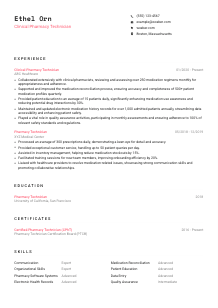
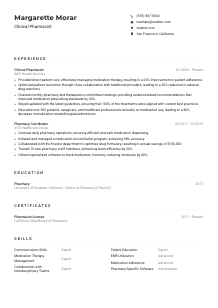
Mixing medications, but your CV feels like the wrong prescription? Browse this Clinical Pharmacy Technician CV example, created with Wozber free CV builder. Learn how to blend your patient-centric skills with job requirements, making sure your career doesn't come with any adverse effects.

Clinical pharmacy work sits close to patient safety. Hiring teams want to see that you can handle medication histories, reconciliation, patient-facing education, and daily coordination with pharmacists without losing accuracy. Your CV should make that operating standard visible quickly, especially in settings where documentation quality and adherence to pharmacy protocols affect care.
When a CV is tailored well, it becomes much easier to distinguish clinical pharmacy experience from retail or general dispensing work. Wozber's free CV builder helps you shape an ATS-compliant CV around the language used in the posting, so responsibilities like medication reconciliation, EHR documentation, and patient counseling are easy to spot and easy to connect to real hospital or clinical workflow.
In healthcare hiring, the top of the CV should answer practical questions fast: who you are, what role you do, and whether you can be reached and considered without delay.
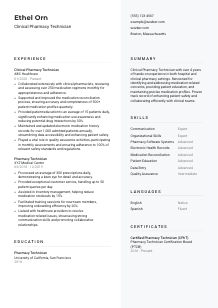
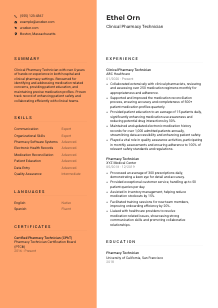
Use your full name in a clear, readable format at the top of the page. Keep it slightly more prominent than the rest of the header so the document is easy to identify when recruiters or pharmacy managers review multiple applications.
Place "Clinical Pharmacy Technician" directly under your name if that reflects your current or target role. This immediately positions you for clinical or hospital pharmacy work instead of retail-focused technician roles.
List a reliable phone number and a professional email address with no typos. A simple format such as firstname.lastname@email.com works well. If a hiring manager wants to schedule an interview after reviewing your medication safety or reconciliation experience, they should not have to hunt for your details.
If the employer asks for local availability, include your city and state. Here, "Boston, Massachusetts" directly answers the location requirement and removes uncertainty about relocation. Use this kind of location tailoring when geography is clearly part of the posting, not as a default rule for every application.
A LinkedIn profile or professional portfolio link can add value if it is current and consistent with your CV. For a Clinical Pharmacy Technician, that usually means matching job titles, employment dates, certifications, and healthcare-focused experience rather than trying to add personality for its own sake.
This section should make the basics effortless to confirm so the reader can move straight to your clinical pharmacy experience, certification status, and patient-care responsibilities.




This is the section that tells hiring teams whether you have worked at the pace, accuracy level, and patient-care depth the role requires. For clinical pharmacy positions, bullets should sound like real pharmacy operations, not generic task lists.
Before writing bullets, identify the responsibilities that define the role. In this case, those include collaboration with clinical pharmacists, medication regimen review, reconciliation, patient education, medication history maintenance, and quality assurance. Your experience section should mirror that scope using truthful examples from your own work.
List your most recent position first, followed by earlier roles. For each entry, include job title, employer, and dates. This structure helps reviewers quickly see whether your latest experience comes from a hospital, clinical pharmacy, or another setting relevant to medication management and patient support.
Replace routine descriptions with bullets that show what you handled, improved, or supported. The sample CV does this well with lines such as reviewing more than 250 medication regimens monthly and supporting 500+ patient medication profiles each quarter. That phrasing shows workload, clinical relevance, and accuracy in one sentence.
Quantify work where numbers add real context. Good measures for this field include medication profiles completed, patients educated per day, prescription volume, reduction in drug interaction risk, compliance rates, or quality review frequency. Metrics work best when they show patient safety, efficiency, or reliability rather than volume alone.
Prioritise hospital, clinical, medication-management, and documentation-heavy experience over unrelated work. Earlier roles can stay if they support the story, such as high-volume prescription processing or provider communication, but the emphasis should remain on the experience that proves you can function in a clinical pharmacy environment.
By the end of this section, a hiring manager should be able to see your patient-facing scope, documentation accuracy, collaboration with pharmacists, and contribution to safe medication use.
For pharmacy technician roles, education is often a qualification checkpoint before the hiring team even gets to the deeper parts of your application. Present it clearly and keep it closely tied to the training path expected for the role.
If the employer requests graduation from an accredited Pharmacy Technician program or equivalent preparation, make that visible. List the program, school, and completion year in a straightforward format so the requirement is easy to confirm.
Keep this section concise. Include the institution, program or field of study, and graduation date. In the example, listing "Pharmacy Technician" as the field makes the relevance obvious without extra explanation.
When the exact degree title is less important than the training itself, emphasize the field or program name. That is especially useful in technician roles where employers want to confirm specialised preparation rather than a broader academic background.
Relevant coursework can help if you are early in your career or applying into a more clinical setting. Topics such as pharmacology, medication safety, pharmacy calculations, sterile compounding, or healthcare documentation can support your case when professional experience is limited.
Honors, awards, or academic recognition are worth adding when they reinforce reliability, technical discipline, or commitment to the field. If you already have solid clinical pharmacy experience, keep these details brief so the CV stays focused on practice-based qualifications.
This section should confirm that you have the training foundation expected for technician work and leave no doubt about your relevance to the role.
For a Clinical Pharmacy Technician, certification is often one of the first items checked. Present it in a way that makes your eligibility and current standing immediately clear.
If the posting asks for active state or national certification, list that credential exactly. A certification such as "Certified Pharmacy Technician (CPhT)" should appear clearly, along with the issuing body, so there is no ambiguity about whether you meet the requirement.
List certifications that strengthen your case for clinical or hospital work before anything less relevant. The reader should see pharmacy-specific qualification first, especially when certification is tied to regulation, patient safety, or scope of practice.
Include dates or renewal status where relevant. In regulated healthcare roles, currency matters. A certification entry such as "2016 - Present" quickly shows continuity and ongoing compliance.
If you maintain additional training related to medication safety, sterile processing, healthcare systems, or continuing education requirements, include it when it strengthens the role match. This is a practical way to show that you stay current with standards and pharmacy practice changes.
A hiring team should be able to confirm your active pharmacy technician credentials in seconds and move on to evaluating your clinical experience.
A Clinical Pharmacy Technician skills section should reflect how the work actually gets done. Focus on the systems, patient-care tasks, and coordination abilities that support safe medication use in clinical settings.
Read the description closely for both stated and implied skills. Here, pharmacy software systems, electronic health records, communication, organisation, medication reconciliation, and patient education all point to the day-to-day demands of the role.
Only include skills that are backed up by experience, training, or certification. If you list medication reconciliation or EHR proficiency, your work history should show where you performed that work, such as maintaining medication histories or updating patient profiles.
Choose skills that reinforce clinical pharmacy value rather than filling space. A concise list like pharmacy software systems, electronic health records, medication reconciliation, patient education, quality assurance, and communication tells a clearer story than a long list of generic soft skills.
When this section is aligned well, it reinforces your experience instead of repeating generic strengths and makes your clinical pharmacy scope easier to read at a glance.
Language ability matters in healthcare because instructions, histories, and follow-up conversations need to be understood the first time. If a posting mentions English proficiency or serves a diverse patient base, list languages clearly and honestly.
If English proficiency is specified, include it plainly with your level. In a Clinical Pharmacy Technician role, language skills support patient education, medication history collection, and communication with pharmacists, nurses, and providers.
Additional languages can strengthen your application, especially in hospitals and clinics serving multilingual communities. The example CV lists Spanish, which is useful because it can improve clarity during counseling and reduce misunderstandings around medication use.
Describe each language truthfully using labels such as Native, Fluent, Intermediate, or Basic. In patient-facing healthcare settings, overstating proficiency can become a real problem when discussing dosage, side effects, or drug interactions.
If the employer serves a diverse population, multilingual ability may deserve more visibility. If the role is less patient-facing, languages can remain a supporting detail. Let the care environment determine how much emphasis this section gets.
On this kind of CV, language ability is not decorative. It can support safer patient education, more complete medication histories, and stronger communication across the care team, which is why it is worth listing when genuinely useful.
For clinical pharmacy roles, language skills matter most when they help you explain medications clearly, gather accurate information, and support better patient understanding.
The summary should tell the reader, in a few lines, what kind of pharmacy technician you are and what clinical value you bring. It works best when it combines setting, experience level, and a few core strengths tied to medication safety and patient support.
Before drafting your summary, identify the parts of the position that matter most. For this role, that means clinical or hospital experience, pharmacist collaboration, medication reconciliation, patient education, accurate documentation, and adherence to safety standards.
Begin with your title and years of relevant experience. A line such as "Clinical Pharmacy Technician with over 4 years of experience in hospital and clinical pharmacy settings" gives immediate context and helps separate you from candidates with only retail exposure.
Choose strengths you can support with the rest of the CV. The sample summary works because it points to medication-related problem solving, patient education, and accurate medication profiles, all of which connect directly to the employer's responsibilities.
Aim for a short paragraph that can be scanned quickly. Focus on what you do well in practice, such as supporting medication safety, maintaining precise records, and working effectively with clinical teams, instead of writing broad claims about being hardworking or passionate.
A well-written summary tells the reader right away that you understand clinical pharmacy workflow and have experience that supports safe, accurate patient care.
When each section speaks clearly to medication reconciliation, patient education, documentation accuracy, certification, and collaboration with pharmacists, your CV becomes much easier to shortlist for clinical and hospital pharmacy roles.
Use Wozber's free CV builder and ATS CV scanner to tailor your wording, strengthen ATS optimisation, and present your experience in an ATS-friendly CV format that keeps the focus on your clinical pharmacy readiness.
The final read should make one thing clear: you can step into the workflow and support safe medication use from day one.