



Use Wozber and land your dream job
Create CV
No registration required
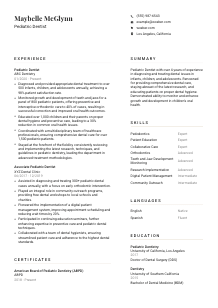
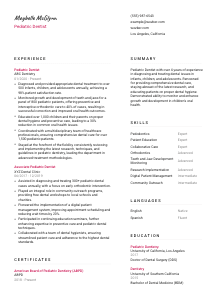
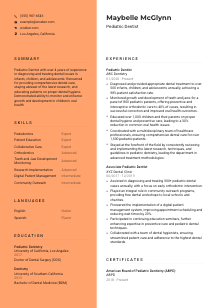
Caring for tiny teeth, but your CV feels a bit lost in the tooth fairy's bag? Check out this Pediatric Dentist CV example, created with Wozber free CV builder. It shows how to shape your child-centric dental skills to match job demands, so your career sparkles as bright as those little smiles!
Pediatric dentistry CVs are reviewed through a clinical lens first. Hiring teams want to see that you can treat infants, children, and adolescents safely, manage prevention and early intervention, and build trust with both young patients and parents. If your CV stays too general, it can blur the parts of the work that matter most in this specialty, especially chairside judgment, growth and development monitoring, and family education.
A tailored CV changes what stands out in that first pass. When your wording reflects pediatric case mix, preventive care, orthodontic monitoring, and interdisciplinary coordination, the clinical scope of your background becomes easier to read in both an ATS and by a practice owner. Wozber's free CV builder helps you organise those details into an ATS-compliant CV that surfaces the right terminology early, so the employer can quickly see your readiness for pediatric patient care.
In pediatric dentistry, the top of the CV should establish professional identity fast and remove any basic uncertainty around contactability, specialty, and practice eligibility. Keep this section clean, complete, and aligned with the job's practical requirements.
Use your full name as the most visible line on the page. Choose a straightforward format that feels clinical and professional, the same way a patient-facing practice would present provider information on a website or appointment system.
Place "Pediatric Dentist" directly under your name if that is the role you are targeting. Matching the job title helps frame the rest of the CV correctly and distinguishes your background from general dentistry, orthodontics, or broader pediatric care support roles.
Add a reliable phone number and a professional email address, then include any relevant website or LinkedIn profile if it supports your clinical background. If you have an online profile, make sure it reflects your pediatric focus, credentials, and practice experience rather than acting as a generic social link.
Some pediatric dentist openings include a location requirement, as this Los Angeles role does. Listing "Los Angeles, California" in your contact block immediately addresses that filter. If a job does not require local residence, city and state are usually enough without adding a full street address.
A professional website, faculty page, publications profile, or polished LinkedIn page can add value when it reinforces your clinical scope, community outreach, or continuing education. Leave it off if it is outdated or thin. Every link should support how you work with pediatric patients and families.
Your personal details should confirm who you are, how to reach you, what specialty you practice, and whether you meet any stated location requirement. Once that is clear, the hiring team can move straight to your clinical experience.




This section carries the most weight because pediatric dentistry is hired on applied clinical work, patient management, and treatment outcomes. Focus less on listing duties and more on showing the scale of your care, the kinds of patients you treated, and the results you produced in practice.
Mark the responsibilities and requirements that define the role, then mirror them in your experience bullets where they are true to your background. For this posting, that includes treating infants, children, and adolescents, monitoring teeth and jaw development, providing preventive and interceptive orthodontic care, educating families, and coordinating with other healthcare professionals.
List your jobs in reverse chronological order, starting with positions where pediatric patient care was central to your work. For each role, include your title, employer, and dates, then make sure the bullets show the pediatric setting clearly rather than reading like a general dental CV.
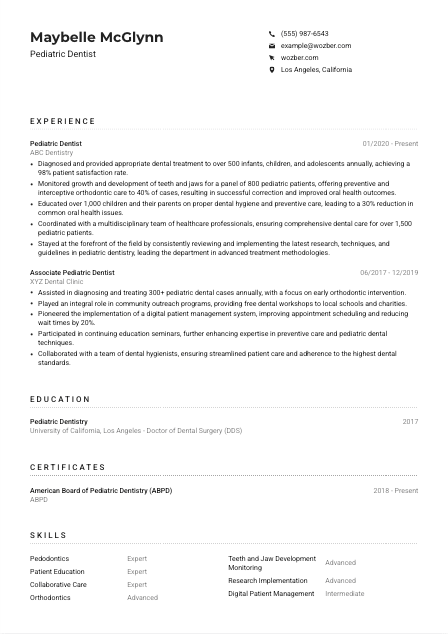
Your bullets should show what you handled and what changed because of your work. The sample CV does this well with lines such as treating more than 500 pediatric patients annually and educating over 1,000 children and parents, paired with a 30% reduction in common oral health issues. That combination of scope and outcome is far more persuasive than a broad statement about providing quality care.
Use numbers that fit how pediatric dentistry is actually evaluated. Patient volume, panel size, satisfaction scores, reduction in oral health issues, wait time improvements, percentage of cases needing interceptive care, or outreach reach all help define your impact. The sample's 98% patient satisfaction rate and 20% reduction in wait times are good examples because they connect clinical work to patient experience and practice efficiency.
If a bullet does not support your work with pediatric patients, family education, preventive care, interdisciplinary collaboration, or operational improvement in a dental setting, consider removing it. Space is limited. The experience section should make it easy to understand your pediatric case mix and the level of responsibility you already carry.
By the end of your experience section, a reader should know how long you have worked in pediatric dentistry, what kinds of cases and patient volumes you manage, and how your care improves oral health outcomes for children and adolescents.
Pediatric dentistry is a credential-driven field, so your education section needs to do more than list degrees. It should confirm that you completed the academic and specialty training required to practice, especially when the employer specifies accredited education and residency requirements.
Include your DDS or DMD exactly as awarded, along with the institution and graduation year. Since the job description specifically asks for a Doctor of Dental Surgery or Doctor of Medicine in Dentistry from an accredited institution, make that credential easy to find.
Keep each entry structured with degree, field or concentration if relevant, school, and date. For a regulated clinical role, simplicity works best. The reader should be able to scan your training quickly without digging through extra formatting.
If you completed a pediatric dentistry residency, list it plainly and include the program name. When the posting calls for a CODA-accredited residency, state that accreditation if you have it. This is one of the clearest qualifications that separates a pediatric specialist from a dentist with only occasional pediatric exposure.
Recent graduates can include pediatric-focused coursework, research, externships, or clinical distinctions if those details help show readiness for practice. Once you have several years of clinical experience, those items become secondary to residency, degree, and board-related credentials.
Academic honors, scholarships, or recognition in pediatric dentistry can add value when they are relevant and concise. Prioritise distinctions tied to clinical excellence, research, community service, or specialty training over general campus achievements.
Your education section should make your dental degree and pediatric specialty preparation easy to verify. For this profession, that foundation matters because employers are checking for formal training, not just interest in working with children.
For pediatric dentists, certifications and licenses are not an extra polish item. They are a core part of employability. This section should confirm that you can legally practice and that your specialty credentials are current, relevant, and easy to review.
When a role asks for board certification or board eligibility with the American Board of Pediatric Dentistry, list that credential prominently. The same goes for your state dental license. Put the highest-value, role-specific credentials first so the employer does not have to hunt for them.
You do not need to include every course completion certificate you have earned over the years. Prioritise licenses, board credentials, sedation permits if relevant to your background, and pediatric dentistry certifications that directly support clinical practice in the role you want.
Include issue dates, renewal ranges, or "Present" where appropriate. In healthcare hiring, current standing matters. The sample CV handles this well by showing both the ABPD credential and California dental license as active, which quickly answers a compliance question many employers check early.
If you regularly complete CE in preventive care, behaviour guidance, restorative techniques, pulp therapy, trauma management, or early orthodontic intervention, include the most relevant items selectively. This supports the responsibility to stay current with research, guidelines, and treatment methods in pediatric dentistry.
A hiring manager should be able to confirm licensure, board status, and professional currency in a quick scan. In a pediatric dentist search, that saves time and strengthens confidence in your readiness to practice.
The best pediatric dentist skills sections balance clinical competencies with the communication and coordination the role requires every day. Choose skills that reflect treatment delivery, developmental monitoring, parent education, and collaboration inside a care team.
Read the posting for direct skill cues, then add the practical skills implied by the work. In this case, technical items include pedodontics, preventive care, interceptive orthodontic awareness, and growth monitoring. Just as important are parent communication, behaviour guidance, and team-based coordination with hygienists and other healthcare professionals.
Use language that reflects actual clinical work. Skills such as patient education, collaborative care, teeth and jaw development monitoring, orthodontic screening, digital patient management, and community outreach all carry more value here than generic labels like "team player" or "detail oriented." The sample CV uses this approach effectively.
Do not overload this section with every skill you have ever used. Choose the capabilities most relevant to the target role and make sure they support the story told in your experience section. A compact list of well-chosen skills is easier to trust and easier for an ATS to map to the job description.
Your skills list should read like the toolkit of a pediatric specialist, not a general practitioner. It should reinforce that you can deliver treatment, guide families, and work smoothly within a pediatric dental care environment.
Language ability matters in pediatric dentistry because care depends on clear communication with both children and caregivers. In a diverse patient population, the right language section can also show your ability to reduce confusion around treatment plans, hygiene guidance, and follow-up care.
If the posting asks for strong English language skills, list English first and label your proficiency accurately as Native or Fluent. That directly addresses a stated requirement and reassures the employer that you can handle patient education, consent discussions, and chart-related communication confidently.
Extra languages can be especially helpful in pediatric settings serving multilingual families. In Los Angeles, Spanish may be a meaningful advantage, but the broader rule is to include languages that genuinely support patient rapport and clearer home-care instructions in the communities you serve.
Use clear levels such as Fluent, Conversational, Intermediate, or Basic. In clinical settings, overstating language ability can create real care issues, especially when explaining preventive care, treatment options, or post-procedure instructions to parents.
If another language has supported outreach work, reduced communication barriers, or improved the family experience in your practice, that context can strengthen its value. The sample CV's English and Spanish combination works because it supports both required communication and broader patient accessibility.
If you are studying a language that matters to your patient population, you can note that briefly. Keep it honest and practical. Employers care about how well you can communicate in clinical interactions now, not about vague plans to become bilingual later.
This section should show that you can communicate clearly with patients and caregivers and, where relevant, serve a broader family base. In pediatric dentistry, that can directly affect understanding, trust, and treatment follow-through.
The summary sets the clinical tone of the CV. For a pediatric dentist, it should quickly establish specialty experience, patient population, and the kind of outcomes or strengths that matter in practice, without drifting into broad personal branding language.
Start with the parts of the job that define success. Here, that means pediatric clinical experience, preventive care, developmental monitoring, patient and parent education, and staying current with treatment standards. Those themes should shape the summary more than generic statements about passion or dedication.
Your first line should tell the reader who you are professionally. A formula like "Pediatric Dentist with 4+ years of experience" works well because it establishes specialty and seniority immediately. If your background includes a notable focus such as early orthodontic intervention or high-volume pediatric care, that can follow naturally.
Use the next lines to show how you practice. The sample summary points to comprehensive care, patient education, and growth monitoring, which align well with the job description. You can make yours even stronger by tying those strengths to measurable scope, patient satisfaction, preventive results, or multidisciplinary care where accurate.
Aim for 3 to 5 lines. Every sentence should earn its place by clarifying your pediatric focus, clinical judgment, or patient-care impact. Save finer detail for the experience section, where you have room to show volumes, percentages, and specific accomplishments.
A well-written summary should make a reader expect pediatric depth when they move into the rest of the CV. It sets up your experience as that of a clinician who can treat young patients effectively, guide families clearly, and contribute to a high-standard practice from day one.
Your CV should now present the essentials with much less friction: the right dental degree, pediatric residency, active credentials, meaningful clinical experience, and the day-to-day strengths that matter in treating children and advising parents. That is the combination hiring teams look for when they need someone who can step into pediatric patient care with confidence.
Use Wozber's free CV builder to tighten the structure, match your language to the job description, and produce an ATS-friendly CV format that keeps pediatric terminology, board credentials, and treatment results easy to scan. With the right tailoring, your CV will show exactly what a practice needs to see before inviting you to interview.




