



Use Wozber and land your dream job
Create CV
No registration required
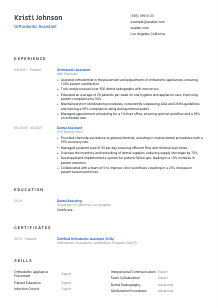
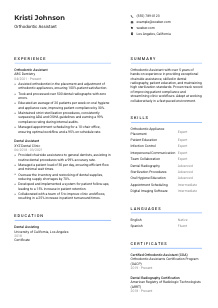
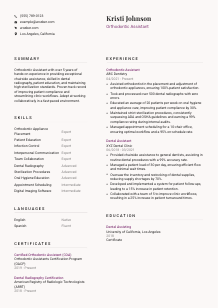
Straighten those bullet points, but your CV feels misaligned? Check out this Orthodontic Assistant CV example, built with Wozber free CV builder. Learn how to present your dental dexterity to fit the job, so your career can align with each patient's beaming smile!
Orthodontic assistants work in a fast-moving clinical setting where small details affect patient comfort, treatment progress, and practice flow. A CV for this role needs to show more than general dental support. It should make your chairside experience, appliance work, radiography, sterilization discipline, and patient communication easy to recognize within a few seconds.
When those details are tailored to the job ad, the CV is easier to sort in both human review and ATS screening. Wozber's free CV builder helps you align your wording with the posting, keep an ATS-friendly CV format, and surface the clinical tasks that matter most, such as appliance adjustments, radiographs, and patient instruction. That gives the practice a clearer view of how you would support treatment from the first visit to follow-up care.
For an orthodontic assistant, the top of the CV should confirm that you are reachable, professionally presented, and available for the practice's location requirements. Keep this section clean and practical so the employer can move straight to your clinical background.
Use your full name in a clear, readable format at the top of the page. In a patient-facing role where trust and professionalism matter, this section should look polished and easy to scan, especially in an ATS-friendly CV template.
Place "Orthodontic Assistant" directly under your name when that is the role you are applying for. This immediately connects your CV to the opening and helps distinguish you from general dental assistants whose experience may be broader but less specialised.
Include a phone number you answer regularly and a professional email address. Orthodontic offices often move quickly when scheduling interviews, so one typo can cost you a callback just as easily as a weak bullet point elsewhere on the CV.
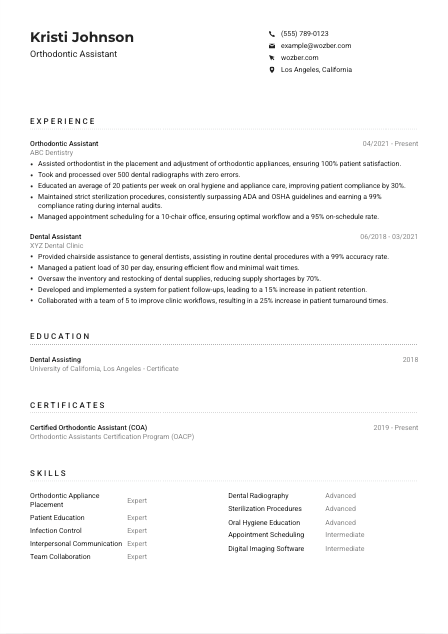
If the employer requests local availability, list your city and state. In the example, "Los Angeles, California" directly answers that requirement and removes doubt about whether commute or relocation will be an issue.
Include LinkedIn or a professional webpage only if it supports your application with consistent job titles, certifications, or dental experience. If your profile is sparse or outdated, leave it off rather than sending the practice to mismatched information.
This section does not need extra detail. It only needs to confirm identity, role focus, and availability so the reader can get quickly to your orthodontic experience and clinical qualifications.




Orthodontic employers look closely at what you actually handled in the operatory and how reliably you supported patient flow. Your experience section should connect daily clinical tasks to outcomes the practice cares about, such as accurate radiographs, smooth scheduling, patient compliance, and consistent infection control.
Read the posting line by line and note the duties that define the job. Here, chairside orthodontic assisting, appliance placement and adjustment support, dental radiographs, oral hygiene instruction, sterilization, and appointment management all deserve space in your experience section. These are the terms and responsibilities the practice is screening for.
Start with your most recent position and work backward. For each role, include job title, employer, and dates so the hiring team can quickly follow your progression from general dental support into more specialised orthodontic work, if that reflects your background.
Generic bullets like "assisted the orthodontist" are easy to overlook. Add scope, volume, or outcomes. The sample CV does this well by noting more than 500 dental radiographs with zero errors, 20 patients educated per week, and a 95% on-schedule rate for a 10-chair office. Those details show both technical control and day-to-day reliability.
If you have mixed dental experience, give more room to bullets tied to brackets, wires, appliances, post-adjustment care, and patient instruction. Earlier general dentistry work can still support your candidacy, especially if it shows chairside speed, high patient volume, or strong workflow habits, but the orthodontic content should lead.
The most convincing metrics in this field usually connect to patient volume, compliance, audit scores, imaging accuracy, scheduling efficiency, or treatment support. A line about maintaining sterilization procedures above ADA and OSHA expectations or improving patient compliance by 30% carries more weight than a vague claim about working hard in a fast-paced office.
A hiring manager should be able to tell how you supported treatment, protected clinical standards, and kept the day moving. Make each bullet prove that you can contribute chairside from day one.
Orthodontic practices usually expect a straightforward education section that confirms baseline eligibility for clinical support work. Keep it focused on the training that prepared you for chairside procedures, radiography, and patient care.
If the posting asks for completion of an accredited dental assisting program, make that credential easy to find. A line such as "Certificate, Dental Assisting" directly addresses the requirement and should appear before less relevant coursework or general education details.
List the institution, credential, field of study, and completion date. Dental hiring teams usually want quick confirmation that the educational requirement is met, not a long academic profile.
Name the program accurately. In the example, the UCLA dental assisting certificate is presented clearly and aligns with the role's request for formal training. Exact wording matters because ATS parsing and recruiter review both rely on recognizable credential titles.
If you have limited experience, including courses in dental anatomy, radiography, infection control, or orthodontic procedures can help fill in the picture. Once you have several years of chairside work, those course details usually become less important than clinical results.
Honors, volunteer programs, or student activities can stay if they connect to dental care, patient education, or community oral health. Skip unrelated achievements that do not strengthen your profile for an orthodontic setting.
This section should quickly confirm that you completed the training expected for orthodontic assisting. If the essentials are clear, the reader can move on to the experience and certifications that carry more hiring weight.
Certifications matter in orthodontic assisting because they often confirm that you can legally and safely perform key parts of the job. List the credentials that support radiography, orthodontic work, and any other required clinical responsibilities.
When a job specifically asks for current dental radiography certification, place it near the top of this section. That credential is directly tied to a core responsibility, so it should never be buried under unrelated training.
Choose certifications that strengthen your orthodontic profile, such as radiography, orthodontic assisting, infection control, or CPR when relevant. The sample CV pairs a dental radiography certification with a Certified Orthodontic Assistant credential, which is a strong combination for this specialty.
Hiring teams need to know whether a license or certification is active. Use dates or active ranges such as "2019 - Present" when appropriate, especially for credentials tied to patient safety or legal compliance.
If you have completed workshops or continuing education in digital imaging, orthodontic appliance systems, sterilization updates, or patient care protocols, include them when they are recent and relevant. They show that your methods reflect current clinical standards.
For this role, certifications are not background decoration. They confirm that you can step into radiography, chairside support, and compliant clinical work with the training the practice expects.
The skills section should read like the toolkit of someone who can support an orthodontist efficiently, work comfortably with patients, and maintain clinical discipline. Focus on skills that connect directly to treatment support, imaging, sterilization, and front-to-back office coordination.
Use the job description to identify the exact abilities the employer values. For this opening, that includes orthodontic chairside assisting, dental radiography, oral hygiene instruction, sterilization and infection control, scheduling, record management, and strong interpersonal communication.
Use the same terminology the practice uses when it matches your real experience. For example, "dental radiography," "orthodontic appliance placement," and "patient education" are clearer and more searchable than broad phrases like "clinical support" or "helping patients." This improves ATS optimisation without sounding forced.
Put your most role-specific strengths first. In the sample CV, orthodontic appliance placement, patient education, infection control, and dental radiography all belong near the top because they connect directly to daily orthodontic work. Leave out low-value filler skills that any candidate could claim.
Every skill listed should point to work you can perform in the operatory, at the imaging station, or in patient interactions. If the section reads like your actual day in an orthodontic office, it is doing its job.
Orthodontic assistants spend much of the day explaining care instructions, answering patient questions, and helping people feel at ease during treatment. Language skills matter when they improve patient understanding and support smooth communication across the office.
If English proficiency is specified, include it clearly. In this case, English is required for customer interactions, so it should appear in the section rather than being left assumed.
Place English at the top, then add other languages that may help in patient-facing care. In many orthodontic practices, additional language ability can improve patient education, follow-up clarity, and front-desk communication, especially in diverse communities.
Use plain labels such as "Native," "Fluent," or "Intermediate." These terms give the practice a quick read on whether you can explain appliance care, post-visit instructions, or scheduling details without confusion.
A second language is valuable when it helps patients understand treatment and oral hygiene guidance. The sample's fluent Spanish is a strong addition because it supports real communication needs, even though the posting only names English.
Do not inflate proficiency. If you can manage basic greetings but not clinical explanations, label that honestly. In a role built around patient instruction and reassurance, accuracy matters.
This section works best when it shows how you can communicate with patients and families in practical clinical situations. Keep it accurate and relevant to the way orthodontic offices actually operate.
Your summary should quickly establish your specialty, years of experience, and the clinical strengths that make you useful in an orthodontic practice. Keep it brief, but make it specific enough that the reader immediately understands your value chairside and with patients.
Before writing the summary, identify the two or three capabilities the job leans on most. In many orthodontic assistant roles, that means chairside support during appliance placement or adjustment, radiography, sterilization discipline, and patient education.
Lead with your role and years of experience, such as "Orthodontic Assistant with 5+ years of chairside experience." That framing tells the practice right away whether you likely meet the experience threshold before they read the rest of the CV.
Choose a few strengths that match the posting closely. The sample summary works because it mentions dental radiography, patient education, and sterilization standards, all of which connect directly to the job's daily responsibilities.
Aim for three to five lines and avoid generic personality claims. A short summary that references patient compliance, workflow improvement, or orthodontic chairside support is more convincing than broad statements about being passionate or hardworking.
By the time someone finishes this section, they should already know your specialty, your level of hands-on experience, and the parts of orthodontic care you handle confidently. That gives the rest of the CV a clear frame.
A tailored orthodontic assistant CV should show clinical support, patient communication, radiography, sterilization, and office coordination in terms a practice recognizes immediately. When those details are presented clearly, your application is easier to trust in both ATS review and human screening.
Wozber's free CV builder helps you organise that experience in an ATS-friendly CV format, sharpen role-specific wording with AI support, and check alignment with an ATS CV scanner before you apply. The finished CV should make one thing easy to judge: you can step into the operatory, support treatment efficiently, and keep patient care standards high.