





Use Wozber and land your dream job
Create CV
No registration required
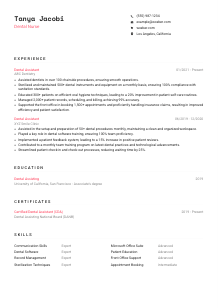
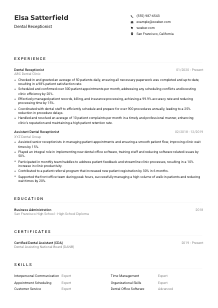
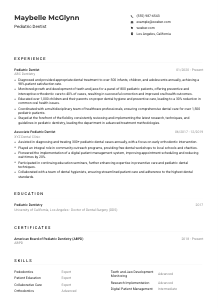
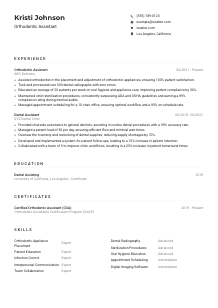
Assisting with fillings and crowns, but your CV feels like a cavity? Check out this Dental Nurse CV example, created with Wozber free CV builder. Learn how to mirror your chairside skills to match job criteria, helping your dental care career shine as bright as polished pearly whites!
Dental nursing sits at the intersection of clinical support, infection control, and patient communication. Hiring teams want to see that you can keep chairside procedures moving, maintain sterile instruments and treatment areas, and handle patient interactions with the same consistency you bring to records and scheduling. Your CV should make that day-to-day reliability visible, not bury it under broad healthcare language.
A tailored Dental Nurse CV quickly separates hands-on dental practice experience from general medical or administrative work. Using Wozber's free CV builder helps you shape an ATS-compliant CV around the posting's exact language, so chairside assistance, sterilization standards, patient education, and practice software proficiency are easy to identify in both screening systems and human review. That clarity matters when a clinic needs someone who can step into the flow of patient care fast.
In dental hiring, the header does more than identify you. It confirms whether you are reachable, professionally presented, and, when relevant, already based where the practice needs to hire.
Use your full name in a clean, readable format at the top of the page. Keep it slightly larger than the rest of the text so the practice can identify your application quickly when reviewing multiple candidates for a clinical support role.
Place "Dental Nurse" directly under your name if that is the role you are targeting. If your past title was "Dental Assistant," you can still align to the posting as long as the rest of your CV clearly shows relevant chairside support, sterilization, patient education, and front-office experience.
List a current phone number and a professional email address. Dental offices often move quickly when scheduling interviews, so one typo can cost you a callback. If you include a website or profile, make sure it supports your application rather than distracting from it.
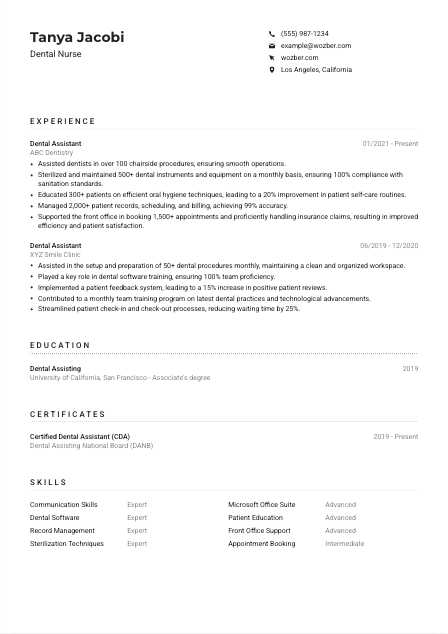
When a posting includes a location requirement, show your city and state in the header. Here, Los Angeles, California is a stated requirement, so listing it removes an avoidable question early. For other applications, treat location as a tailoring point rather than a universal rule.
A LinkedIn profile or professional website can help if it reflects your dental background, certifications, and work history consistently. Skip links that are sparse, outdated, or unrelated to clinical practice, patient support, or healthcare administration.
Your personal details should answer the basics immediately: who you are, how to reach you, and whether you meet practical requirements such as location. That lets the rest of the CV stay focused on dental work, patient care, and practice support.




For Dental Nurse roles, experience is where clinics look for pace, precision, and routine consistency. They want to see how you contribute during procedures, how well you handle sterilization and records, and whether you can support both patient care and practice operations without creating friction.
Before editing your experience section, mark the responsibilities that define the job. In this case, that includes chairside assistance, sterilizing instruments, educating patients, managing records, scheduling, billing, and helping with insurance-related front-office tasks. Your bullets should reflect that operating mix, especially if you have more than 2 years in a dental practice.
List your recent dental practice roles in reverse chronological order and keep the emphasis on direct clinic experience. If you have worked under a different title, highlight the parts of the role that map cleanly to dental nursing, such as preparing treatment rooms, passing instruments, or maintaining patient charts.
Each bullet should show what you handled and what changed because of your work. The sample CV does this well with lines such as assisting in more than 100 chairside procedures and managing 2,000+ patient records with 99% accuracy. That kind of wording tells a clinic you can support treatment flow and administrative accuracy at the same time.
Metrics carry weight when they reflect real dental practice performance. Procedure volume, sterilization counts, patient education reach, scheduling accuracy, claim handling, reduced wait time, or patient satisfaction all help. For example, "Sterilized and maintained 500+ instruments monthly" is far more useful than saying you were responsible for infection control.
Keep the section focused on work that supports a dental setting. Unrelated accomplishments can dilute the picture, especially when the employer needs someone comfortable with procedures, sanitation protocols, patient communication, and software-driven office tasks from day one.
Your experience section should show that you can function smoothly in a dental practice, support the dentist during treatment, keep instruments and records under control, and help patients move through the visit with confidence. Make those patterns obvious in the first few bullets.
Dental employers scan education quickly, but they do look for the right foundation. If the posting asks for dental assisting education or an accredited equivalent, your CV should make that qualification easy to confirm in a few seconds.
When a role asks for an Associate's degree in Dental Assisting or an equivalent accredited program, list that credential exactly and without extra wording around it. In the sample, the degree in Dental Assisting is placed clearly, which makes the match straightforward.
Include degree, field of study, school, and graduation year or date. Dental offices do not need a complicated education layout. A simple structure keeps attention on the qualification itself and supports smooth ATS parsing.
If your education matches the posting, use the same terminology the employer uses. "Associate's degree in Dental Assisting" is clearer than a broader phrase if that is your actual credential. Use equivalent wording only when it truthfully reflects your training.
If you are early in your career, a short note on coursework or clinical training can help. Topics such as radiography, dental materials, infection control, patient care, or dental office procedures are relevant. If you already have substantial practice experience, this can stay brief or be omitted.
Academic honors, scholarships, or student clinical distinctions can support your application when they relate to dental training or patient care. Keep them concise so the section stays focused on the qualification that the clinic needs to verify first.
Education should quickly establish that you completed the training expected for dental support work. If the role specifies a degree or accredited program, make that credential unmistakable.
In dental settings, certifications do more than decorate a CV. They confirm that you meet the practice's compliance expectations and can work within the state's rules for patient care and clinical support.
Lead with any active state licensure or dental assisting certification that the role requires. This posting asks for active state licensure or certification as a Dental Assistant, so that item should be impossible to miss. A CDA is a strong example when it matches the employer's expectation and your actual credentials.
Focus on certifications tied to dental practice, patient care, radiography, infection control, or recognized dental assisting standards. Avoid padding the section with unrelated training that does not help a dentist or practice manager understand your clinical eligibility.
Include the issue date and, when relevant, the active period or expiration date. In regulated clinical roles, current standing matters. A line such as "2019 - Present" immediately tells the employer the credential remains active.
If you have recent courses or renewals in infection prevention, dental technology, patient safety, or updated chairside procedures, include them when they add current professional value. Ongoing development matters in practices that expect staff to keep pace with evolving standards and tools.
Your certifications and licensure should show that you are qualified to work in a dental practice without ambiguity. Current, relevant credentials strengthen both ATS matching and employer confidence.
The skills section should reflect how dental work actually gets done. A useful list balances chairside support, infection control, patient communication, and the office systems that keep appointments, records, and billing accurate.
Start with the language used in the job ad. Here, that includes dental software, Microsoft Office Suite, interpersonal communication, written and verbal English, patient education, record management, scheduling, billing, and front-office support. Those are the terms most likely to appear in ATS screening and human review.
Only include skills you can support through experience, training, or certifications. If you list sterilization techniques, patient education, or dental software, your experience bullets should show where you used them in a real practice setting.
Choose the skills that matter in a dental clinic rather than filling the section with broad workplace traits. The sample does this effectively by prioritising dental software, record management, sterilization techniques, patient education, and front-office support over generic descriptors.
A dental practice should be able to scan this section and see both your clinical support capabilities and your operational reliability. Keep it aligned with the tools, tasks, and communication demands of the job.
In a dental office, language ability affects patient comfort, instructions, consent discussions, and handoffs with the team. If a posting names English proficiency, treat that as a core requirement rather than an extra detail.
This role specifically asks for strong verbal and written English, so list English prominently and use an accurate proficiency level. That matters in patient education, chart notes, appointment coordination, and post-operative instructions.
Lead with the language needed for the role, then add any others that help in patient-facing care. Ordering matters because it shows the clinic you noticed the communication requirement and addressed it directly.
Extra languages can be valuable in many dental practices, especially in diverse patient communities. The sample CV lists Spanish, which can be helpful in some markets, but treat this as an advantage where relevant rather than a requirement for every Dental Nurse position.
Use clear labels such as Native, Fluent, Advanced, or Conversational. Dental teams rely on accurate communication, so overstating your level can create problems in patient interactions and clinical coordination.
List languages that genuinely improve how you operate in the practice, whether that means explaining oral hygiene routines, reviewing post-op instructions, or helping patients complete scheduling and insurance conversations with less confusion.
Language skills are practical tools in patient care. When listed honestly and in the right order, they show how you can support clearer communication in the operatory and at the front desk.
The summary should give a dental practice a quick read on your clinical background, patient-facing strengths, and administrative support range. It works best when it sounds specific to dentistry rather than generic healthcare.
Start with the experience and duties that define dental nursing in practice. Chairside assistance, instrument sterilization, patient education, records, scheduling, and billing support are stronger anchors than broad statements about being hardworking or passionate.
State your title and years of relevant experience early. The sample summary does this well by leading with more than 4 years of experience, which gives immediate context for the rest of the profile.
Bring in the abilities the employer is actively seeking, such as dental software proficiency, patient communication, and oral hygiene education. Keep the wording natural and tied to real work rather than repeating the posting word for word.
Aim for 3 to 5 lines with concrete value in each sentence. A clinic should come away knowing your level of practice experience, the areas you support well, and the kind of dental environment you are ready to step into.
A hiring manager should finish the summary already knowing that you have relevant dental practice experience, can support both treatment and administration, and communicate well with patients. That is the right setup for the rest of the CV.
Once each section reflects the realities of dental practice, your CV becomes much easier to review for clinical relevance, compliance, and day-to-day usability. Wozber helps you pull that together with an ATS-friendly CV template, AI CV builder support, and ATS optimisation that keeps key details like chairside assistance, sterilization, patient records, and software skills visible.
Before you apply, check that the document clearly shows the required training, active credentials, hands-on dental experience, and the patient and front-office support range the practice needs. The final result should make one thing easy to judge: you can step into a dental clinic and contribute from day one.




