



Use Wozber and land your dream job
Create CV
No registration required
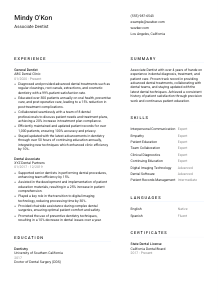
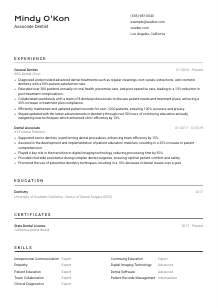
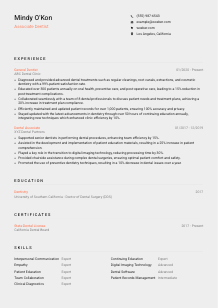
Polishing smiles, but your CV feels dull? Check out this Associate Dentist CV example, made with Wozber free CV builder. It shows how to match your dental expertise to job specifics, setting your career trajectory as straight and clean as a freshly flossed smile!
Associate Dentists are hired on trust as much as technical ability. A practice needs to see that you can diagnose accurately, perform routine and restorative procedures with steady clinical judgment, keep patients calm through treatment, and follow sterilization and recordkeeping standards without lapses. Your CV should make that day-to-day reliability visible, not just list that you worked in dentistry.
Small wording choices change how quickly a practice can place you. When your CV mirrors the posting's language around procedures, patient education, digital imaging, and licensure, it reads more clearly in an ATS and gives the team a faster clinical picture of your background. Wozber's free CV builder helps organise that alignment into an ATS-compliant CV, so your experience is easier to read as chairside capability, patient communication, and practice-ready professionalism.
Front-office details get checked quickly in dental hiring because practices need to know whether you are licensed, reachable, and realistic for the role's logistics. Keep this section clean and professional so nothing delays a conversation about your clinical background.
Use your full name as the most visible line on the page. In a field built on patient trust and professional standing, your name should look formal and straightforward, without nicknames or unnecessary credentials crowded into the same line.
Place "Associate Dentist" directly under your name if that is the position you are targeting. This helps the reader connect your CV to the opening right away, especially if your recent title was "General Dentist" or "Dental Associate" and your duties already align with associate-level clinical care.
Use a reliable phone number and a professional email address, ideally in a standard format such as firstname.lastname@email.com. Dental offices often move quickly when scheduling interviews or working interviews, so make it easy for the practice manager or lead dentist to reach you.
If the posting requires local availability or relocation, include your city and state. Here, listing Los Angeles, California directly addresses a stated requirement. If you are relocating, note that clearly so the employer does not have to guess whether scheduling and start date logistics will be a problem.
A LinkedIn profile or professional website can help if it supports your clinical story with consistent employment history, continuing education, or professional affiliations. Skip personal links that do not add anything relevant to dentistry, patient care, or your standing in the profession.
Your personal details should answer the practical questions first: who you are, what role you are pursuing, how to reach you, and whether location is workable. That clears the way for the hiring team to focus on your treatment experience and patient care approach.




This section carries the most weight for an Associate Dentist because practices want to understand what you have actually treated, how independently you work, and how you contribute to patient retention, compliance, and smooth clinical operations. Write it like a record of care delivered, not a list of tasks observed.
Before editing bullets, mark the procedures, workflows, and practice expectations named in the job ad. For this role, the core themes are diagnosis, cleanings, root canals, extractions, cosmetic dentistry, patient education, team case discussions, digital tools, and infection control. Those are the areas your experience bullets should cover first.
List positions in reverse chronological order with job title, practice name, and dates. That structure works well for ATS parsing and also helps a dental employer quickly see how much recent chairside experience you have in a practice setting, which matters for a role asking for 1 to 3 years of clinical experience.
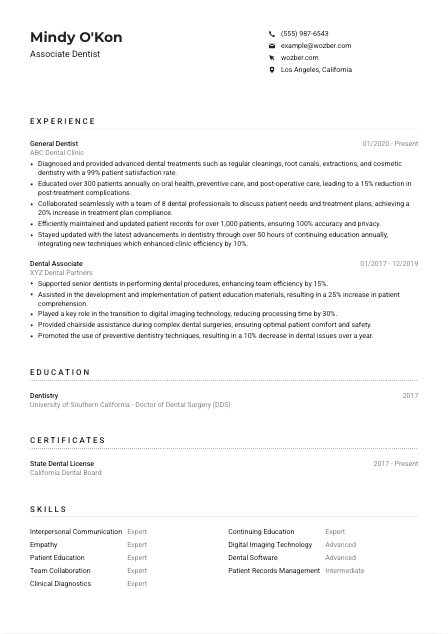
Each role should show what you treated and what changed because of your work. Strong bullets often pair clinical scope with an outcome, such as treatment types performed, patient education delivered, compliance improved, or records maintained accurately. The sample CV does this well by tying procedures to a 99% patient satisfaction rate and connecting patient education to fewer post-treatment complications.
Use metrics that make sense in a dental setting: patient volume, satisfaction scores, reduction in complications, treatment plan acceptance, record accuracy, turnaround time with digital imaging, or continuing education hours applied in practice. Numbers give credibility when they reflect real operational results, such as educating 300+ patients annually or reducing imaging processing time by 30%.
If you have broader healthcare or administrative experience, include only what supports dental practice performance. Prioritise bullets that show direct patient treatment, collaboration with hygienists or senior dentists, use of dental software, and adherence to safety standards. Relevance matters more than quantity when a practice is trying to judge how quickly you can step into the schedule.
Your experience section should leave no doubt about the procedures you can handle, the patient outcomes you influence, and the way you work inside a dental team. Make the reader picture you in the operatory, not just on payroll.
Dental hiring starts with the degree because it establishes your route into practice. After that, education can also reinforce the kind of dentistry you have pursued through advanced coursework, training, and professional involvement.
List your DDS or DMD exactly as awarded, along with the school name. Since the posting calls for a Doctor of Dental Surgery or Doctor of Medicine in Dentistry from an accredited institution, matching that wording helps the requirement register immediately. The example CV does this clearly with "Doctor of Dental Surgery (DDS)."
Include degree, institution, field if helpful, and graduation year. Dental employers usually do not need a long academic description here. They need to confirm your training path quickly so they can move on to licensure and clinical experience.
If you completed a GPR, AEGD, residency, or focused training in areas such as endodontics, oral surgery, pediatric dentistry, or cosmetic dentistry, include it when it strengthens the procedures emphasized in the posting. This is especially useful when you want to show depth beyond general practice exposure.
Dentistry changes through new materials, imaging workflows, restorative techniques, and patient care standards. If recent continuing education supports your current practice, mention it either here or in certificates. The sample CV's 50+ annual continuing education hours is a strong example because it connects learning to improved clinic efficiency.
Student leadership, dental research, volunteer clinics, or association involvement can be worth listing if they relate to patient care, underserved populations, or a clear clinical interest. Leave out minor campus activities that do not help a dental employer understand your professional direction.
Your education section should confirm that you meet the profession's baseline credentials and show whether you have built on them in ways that support the work you want to do now.
In dentistry, certificates do more than decorate a CV. They show legal eligibility to practice, current standing, and whether you have kept pace with new techniques, tools, and treatment approaches.
State licensure first when it is required for the role. For this posting, a current state dental license in good standing is essential, so that credential should be impossible to miss. The sample CV handles this directly with a California dental license entry.
After licensure, list certifications or advanced courses that relate to the procedures and technologies you actually use. Depending on your background, that might include Invisalign, sedation permits, implant training, advanced endodontics, digital dentistry, or infection control coursework. Pick items that add to your treatment profile, not just your total count.
If a credential needs renewal or reflects active standing, show the date range or renewal status. Practices want to know whether a license, permit, or certification is current without having to ask, especially in regulated areas tied to patient safety and compliance.
A short list of well-chosen credentials can signal that you stay current with evolving standards in imaging, restorative care, cosmetic procedures, and patient management. That matters more than a long list of loosely related courses. Focus on training that changes how you practice or expands the procedures you can perform confidently.
Use certificates and licensure to confirm you can practice now and that you continue to sharpen your clinical range. In dental hiring, current and relevant always beats long and unfocused.
For an Associate Dentist, the skills section should read like a quick map of how you work clinically and with patients. A practice is scanning for procedure-related strengths, software fluency, communication style, and the interpersonal judgment that shapes treatment acceptance and patient retention.
Look for named competencies and implied ones. Here, the obvious entries include dental software, digital imaging technology, English communication, empathy, patience, patient education, collaboration, and clinical treatment capability. Those terms are more useful than vague labels because they connect to actual dental workflows.
Prioritise the skills that line up with the role's procedures and environment. If you have experience with digital imaging systems, treatment planning discussions, patient records management, or cosmetic procedures, surface those early. The sample CV does this well by balancing patient-facing strengths like empathy and communication with technical items such as digital imaging technology and dental software.
Avoid turning this section into a grab bag. A shorter list with high-value clinical, technical, and interpersonal skills is easier to trust than a long list of generic traits. Choose the strengths that support diagnosis, treatment delivery, documentation, and patient communication, since those are central to day-to-day associate work.
This section should quickly confirm that you can work the clinical side of the role, communicate clearly with patients, and function smoothly inside a modern dental practice.
Language ability matters in dentistry because treatment plans, post-operative instructions, consent, and preventive education all depend on clear communication. If you speak more than one language, that can strengthen patient rapport and reduce misunderstandings in diverse communities.
Start with the posting. This one explicitly asks for strong English, so English should be listed clearly. Additional languages are not always required, but in many dental markets they can improve patient comfort, scheduling conversations, and treatment understanding.
When a job asks for English proficiency, reflect that directly with a clear proficiency label such as "Native" or "Fluent." This is especially important in roles that involve explaining procedures, discussing oral hygiene habits, and giving post-operative care instructions with precision.
If you can communicate with patients in another widely used language, include it. In some practices, Spanish can be particularly valuable because it helps during intake, education, and follow-up conversations. The sample CV uses this effectively by pairing native English with fluent Spanish.
Choose clear terms such as Native, Fluent, Intermediate, or Basic. Overstating language ability can become a real problem in a patient-facing setting where misunderstanding a symptom, consent question, or care instruction has clinical consequences.
If multilingual ability genuinely helps you connect with the patient population you serve, it deserves space on the CV. In dentistry, stronger communication can improve trust, treatment acceptance, and adherence to home-care instructions.
Language skills are worth listing when they improve patient understanding and comfort. For an Associate Dentist, that can have a direct effect on care quality and the patient experience.
The summary sits at the top of the CV, so it should give a dental employer a quick read on your experience level, clinical scope, and patient care style. Keep it tight, specific, and grounded in the kind of dentistry you actually practice.
Read the posting closely and decide which parts of your background answer it best. For an Associate Dentist, that usually means years in practice, treatment scope, patient communication, digital tools, and the ability to work well with a dental team. Use those anchors instead of generic career language.
Your first sentence should tell the reader who you are and how long you have been practicing. A line such as "Associate Dentist with over 4 years of hands-on experience" works because it establishes field, level, and clinical credibility immediately.
Use the next sentence or two to mention treatment areas, patient outcomes, or practice strengths that match the role. The sample summary works because it references diagnosis, treatment, team collaboration, and patient satisfaction rather than filling the space with broad adjectives.
Aim for 3 to 5 lines that can be read before the hiring manager moves into your experience section. Focus on what would matter in the operatory and in patient interactions, such as procedural range, education habits, communication style, and quality of care. Save the rest for the bullets below.
By the time someone finishes your summary, they should already understand your level of practice, the kind of care you deliver, and why your background matches the opening.
A polished Associate Dentist CV should show licensure, clinical experience, treatment range, patient communication, and comfort with modern dental systems in language a practice can review quickly. When those elements are clearly aligned with the posting, your background reads as immediately usable in the clinic.
Use Wozber's free CV builder to shape that into an ATS-friendly CV format, then refine it with the ATS CV scanner and AI CV builder tools so your procedures, software knowledge, and patient-care strengths match the role naturally. The finished CV should make one thing easy to judge: you can step into the practice and deliver dependable care from day one.




