



Use Wozber and land your dream job
Create CV
No registration required
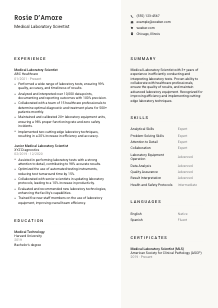
Unraveling cell mysteries, but your CV feels microscopic? Peer through this Medical Laboratory Scientist CV example, created with Wozber free CV builder. Learn how to showcase your scientific skills to match job specifics, ensuring your career profile shines under the clinical microscope!
Clinical laboratories run on precision, repeatability, and speed. A Medical Laboratory Scientist CV has to show that you can produce dependable results, work confidently with testing instruments, and document findings in a way clinicians can act on. Hiring teams look for that combination quickly because errors in specimen handling, analysis, or reporting affect patient care.
When your CV is tailored to the posting, the first read becomes much clearer: whether your background matches the lab's testing environment, equipment demands, and reporting standards. Wozber's free CV builder helps you organise that experience into an ATS-compliant CV, so core qualifications like MLS certification, clinical lab experience, and instrument proficiency are easy to surface before anyone questions your readiness for the bench.
This section is short, but it handles several practical checks right away. For a Medical Laboratory Scientist, it should confirm who you are, how to reach you, and whether you meet any basic location or communication requirements without cluttering the top of the page.
Place your full name prominently, then follow it with the job title you are targeting. If the posting says "Medical Laboratory Scientist," use that wording unless your credentialed title differs in a way that matters clinically. Matching the title helps frame your experience around laboratory testing, data interpretation, quality procedures, and instrument work from the first line.
List a reliable phone number and a professional email address that would not look out of place in a hospital or diagnostic lab setting. Check them carefully. If a lab manager wants to move quickly on candidates with the right bench experience or certification, a typo in your contact line is an avoidable problem.
Some postings include a location requirement, as this one does for Chicago, Illinois. If that applies to your target role, add your city and state in the header so the employer can confirm it immediately. Keep this practical. You do not need a full street address, just enough to show local availability or relocation alignment when relevant.
A LinkedIn profile or professional website can support your application if it reflects your lab background accurately. That can be useful when it expands on your clinical setting, instrumentation exposure, training work, or continuing education. Make sure dates, titles, and certifications match your CV exactly.
Do not include details unrelated to laboratory performance, such as marital status, age, or a photo unless local norms require it. The space is better used for information that supports your candidacy, especially in healthcare hiring where credentials, location, and communication details matter far more than personal background.
Your header should remove basic friction from the application. At a glance, the employer should see the role you do, how to contact you, and any posted requirement such as location or English communication.




This is where a Medical Laboratory Scientist CV earns attention. Hiring teams want to see what testing work you handled, how accurately you reported results, what equipment you maintained, and whether your contribution improved turnaround time, quality control, or lab workflow.
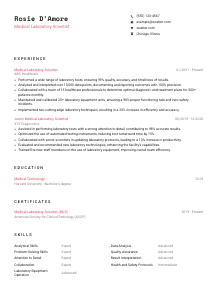
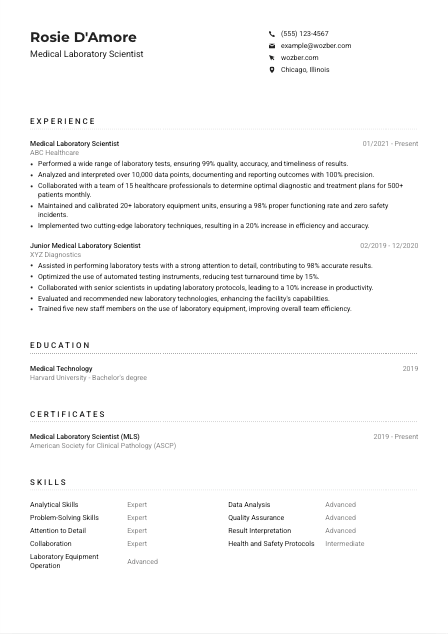
Review the job description and rewrite your bullets so they reflect the actual testing, analysis, reporting, and equipment responsibilities the employer needs. Prioritise work that shows clinical laboratory experience, result interpretation, quality standards, and collaboration with physicians or other healthcare professionals. In the sample CV, bullets around performing a wide range of tests and analysing more than 10,000 data points map directly to that need.
Use reverse chronological order and make each entry consistent: job title, employer, and dates first, then your strongest contributions underneath. For laboratory roles, a clean structure matters because hiring reviewers often scan for progression from junior bench work to broader responsibility with instrumentation, protocol updates, or team support.
Do not stop at "performed tests" or "reported results." Show what happened because of your work. Useful bullets mention testing volume, accuracy rates, turnaround improvements, calibration reliability, protocol improvements, or training contributions. The sample does this well with statements about maintaining 20+ equipment units and achieving zero safety incidents, which says much more than a generic maintenance line.
Quantification works especially well in laboratory CVs because so much of the work is measured. Use figures tied to accuracy, specimen volume, turnaround time, quality compliance, equipment uptime, productivity, or patient support. A line such as "reduced test turnaround time by 15% through better use of automated testing instruments" gives a hiring manager a concrete picture of your impact.
Keep older or unrelated work brief unless it adds something relevant, such as regulated documentation, safety protocol adherence, or technical troubleshooting. The priority is your clinical lab fit. If a bullet does not help prove you can produce accurate results, manage equipment, support diagnostic decisions, or work within quality procedures, trim it.
By the end of the experience section, your CV should show a laboratory professional who can test accurately, report clearly, maintain instruments, and contribute to efficient clinical operations.
For Medical Laboratory Scientist roles, education is not filler. It confirms that you have the scientific training behind specimen analysis, laboratory methods, and regulated clinical practice. Present it clearly so the employer can confirm the degree requirement without searching.
If the role asks for a Bachelor's degree in Medical Technology or a related field, list that information plainly. Use the official degree name and field of study as awarded. In the example, "Bachelor's degree" in "Medical Technology" makes the alignment easy to recognize.
List degree, field, school, and graduation year or date in a consistent order. This is one of the fastest sections for a reviewer to scan, so keep the format straightforward and free of extra commentary unless you are early in your career and need the space to show relevant coursework or lab training.
When your degree title closely matches the posting, use that exact terminology. If your program was in a related field such as clinical laboratory science or biology, keep the official wording and let your experience and certification reinforce the connection. Accuracy matters more than forcing a label that was never on your transcript.
If you are a recent graduate or have limited clinical experience, include selected coursework, practicum details, or capstone projects tied to hematology, microbiology, clinical chemistry, immunology, or laboratory quality control. For experienced candidates, those details usually give way to professional achievements on the bench.
Honors, scholarships, research, or student lab leadership can strengthen this section if they support your technical profile. Keep the focus on achievements that suggest scientific discipline, lab accuracy, or strong preparation for a clinical environment rather than general campus involvement.
Your education should make the technical baseline obvious. The reader should be able to confirm quickly that your academic training supports work in a clinical laboratory.
Certification carries real weight in laboratory hiring because it ties your knowledge to recognized professional standards. Present credentials in a way that makes required certification easy to find, current status easy to understand, and ongoing development visible.
If the posting requires MLS certification from ASCP or an equivalent body, list it clearly in its own section. Do not bury it inside the summary or education section. In this example, "Medical Laboratory Scientist (MLS)" from ASCP deserves immediate visibility because it directly answers a stated requirement.
Lead with credentials that matter for the target laboratory environment. Core licensure or MLS certification comes first. Additional certifications are useful when they support the role, such as specialised laboratory disciplines, quality systems, or safety training, but keep the list focused.
Include the issue date and, when relevant, renewal or active period. That helps employers confirm current standing without extra follow-up. An entry such as "2019 - Present" works well when it shows the credential remains active and maintained.
Laboratory methods, testing platforms, and quality expectations evolve. Updated credentials or relevant continuing education can reinforce that you stay current with new techniques, instrumentation, and compliance standards. That matters in roles where adopting improved testing processes can affect accuracy and efficiency.
A well-built certification section does two things fast: it confirms you meet non-negotiable credentials and shows that you keep your laboratory practice current.
A Medical Laboratory Scientist skills section should read like the toolkit behind your results. It needs to cover both the technical abilities used in testing and analysis, and the professional strengths that support careful documentation, safety, and collaboration with clinical teams.
Start with the language used in the job description. For this role, that includes analytical and problem-solving skills, attention to detail, and proficiency with laboratory equipment, including automated testing instruments. Those terms belong on the CV when they accurately reflect your work because they match both ATS screening and day-to-day laboratory expectations.
Do not build the section from soft skills alone. Pair technical capabilities such as laboratory equipment operation, quality assurance, data analysis, result interpretation, and health and safety protocols with strengths like collaboration and analytical thinking. That mix reflects how the job is actually performed in a clinical setting.
Choose skills that support the target role instead of listing every competency you have developed across your career. If the employer emphasizes automated instruments, quality, and precise reporting, those should appear before broader or less relevant abilities. The sample CV's mix of quality assurance, result interpretation, and equipment operation is a useful model for that prioritization.
This section should show that you can work accurately with lab systems, think through abnormal findings, and operate as a reliable part of a clinical testing team.
Language ability matters in healthcare because laboratory work depends on accurate communication, clear documentation, and coordination with clinicians and colleagues. Even when language is not a major differentiator, list required proficiency plainly so it does not become an open question during screening.
This posting explicitly requires English. Make sure English appears in your language section with an honest proficiency level such as Native or Fluent. That supports expectations around result documentation, policy compliance, and communication with clinical staff.
Additional languages can be worth listing, especially in hospitals and laboratories serving diverse communities. While they may not be central to every Medical Laboratory Scientist role, they can strengthen your profile in settings where teamwork and cross-functional communication extend beyond the lab bench.
Keep language levels easy to interpret with terms such as Native, Fluent, Intermediate, or Basic. Avoid vague descriptions. Hiring teams should understand immediately whether you can handle professional communication, casual conversation, or only limited use.
Be accurate about what you can actually use in practice. In healthcare environments, overstating language proficiency can create risk around communication and documentation. Honest labeling is more valuable than an inflated claim.
A second language can help round out your profile when it supports your work environment, as with the example's Spanish entry. Treat it as an asset, not a substitute for core laboratory credentials, testing accuracy, or technical competence.
Your language section should settle required communication ability right away and show any additional language strengths that could support the clinical setting.
The summary sits at the top of the CV, so it needs to tell the reader quickly what kind of laboratory professional you are. For this role, that usually means years of clinical lab experience, testing and interpretation strengths, equipment proficiency, and one or two concrete results that support your credibility.
Before writing, identify the few points the posting emphasizes most. Here, that includes clinical laboratory experience, laboratory testing accuracy, data interpretation, equipment proficiency, and MLS certification. Those priorities should shape the summary rather than a generic statement about being hardworking or detail-oriented.
Lead with your title and years of experience so the reader can place you quickly. A line like "Medical Laboratory Scientist with 3+ years of experience in clinical laboratory testing and result interpretation" works because it establishes both role identity and scope immediately.
Use the next sentence or phrase to bring in the capabilities the employer is screening for first, such as operating laboratory equipment, maintaining quality standards, collaborating with healthcare professionals, or improving test efficiency. The example summary does this effectively by combining testing, collaboration, quality, and equipment maintenance in a compact way.
Aim for 3 to 5 lines with concrete language. Mention one meaningful result if you can, such as improved turnaround time, high testing accuracy, or implementation of newer laboratory techniques. The summary should sound like a laboratory professional who has already worked in a clinical setting, not like a broad healthcare generalist.
A well-targeted summary should make one thing clear within seconds: you have the clinical lab background, credential base, and working precision the employer needs.
A Medical Laboratory Scientist CV works best when it makes the essentials easy to confirm: the right degree, current certification, clinical laboratory experience, equipment proficiency, and a track record of accurate, timely results. Each section should support that picture with concrete details drawn from your own bench work, reporting responsibilities, and quality standards.
Use Wozber's free CV builder to shape those details into an ATS-friendly CV format, then refine the wording with Wozber's AI CV builder and ATS CV scanner so the language matches the posting naturally. When your CV is tailored this way, a hiring team can quickly see whether you are ready to step into the lab and deliver dependable diagnostic support.