




Use Wozber and land your dream job
Create CV
No registration required
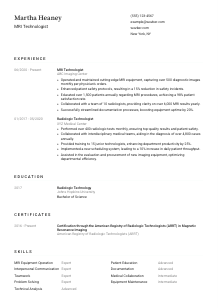
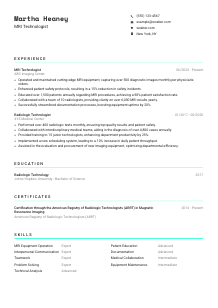
Capturing detailed images, but your CV appears fuzzy? Sharpen it up with this MRI Technologist CV example, created with Wozber free CV builder. Learn how to clearly align your scanning skills with job requirements, imaging a career that's always in high-resolution.
MRI work leaves little room for vague claims. Hiring teams want to see that you can run imaging protocols accurately, screen for contraindications, protect patient safety, and keep anxious patients informed while producing scans radiologists can use. Your CV should make that clinical judgment and technical control visible from the first section.
When MRI CVs are tailored well, the difference shows up quickly in ATS screening and in the first human read. Wozber's free CV builder helps you align your wording with the posting, keep an ATS-compliant CV clean, and surface the details that matter most in this field, such as ARRT MRI certification, hands-on scan volume, safety practice, and patient communication.
This section is simple, but in healthcare hiring it still carries practical weight. Clear contact information, the right title, and location details that match the posting remove friction before anyone gets to your clinical experience.
Use your full name in a larger, clean font so it anchors the page immediately. In a field where credentials and role match matter, your name should be easy to find above your title and certification-linked experience.
If you are applying for an MRI Technologist position, label yourself as "MRI Technologist" rather than a broader title like Radiologic Technologist unless that is your current scope. This helps the hiring team and the ATS connect your CV to MRI-specific work right away.
List a reliable phone number and a professional email address, then check them carefully. In hospital and imaging centre hiring, interview scheduling often moves quickly, and a typo can cost you a response.
When a role specifies a city, add your location clearly. Here, listing New York, NY supports a stated requirement and avoids questions about relocation timing or local availability for clinical scheduling.
A LinkedIn profile or professional website can be useful if it reinforces your imaging background, certifications, or healthcare experience. Keep it current and consistent with your CV, especially around titles, dates, and credentials.
Your personal details should confirm that you are reachable, locally aligned when required, and already operating at the MRI Technologist level. That lets the reader move straight to your clinical qualifications.




For MRI technologists, experience is where technical ability becomes believable. Employers look for evidence that you have worked with MRI systems in real clinical settings, followed safety protocols, supported patients through procedures, and produced reliable imaging under physician orders.
Review the posting line by line and pull out the work themes that matter most, such as MRI procedures, equipment operation, contraindication screening, patient education, documentation, and collaboration with radiologists. Then make sure those themes appear across your bullets using language that reflects what you actually did in prior roles.
Keep your experience in reverse chronological order and include job title, employer, and dates for each role. If your background includes both MRI and broader radiologic work, let the MRI-focused role lead and use the earlier role to show transferable imaging volume, teamwork, and operational discipline.
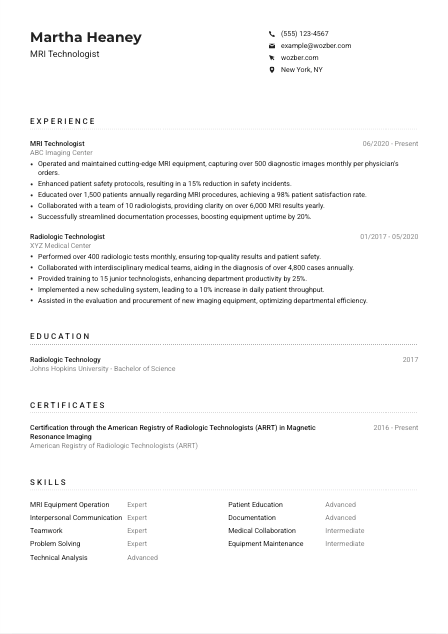
MRI hiring managers already know the baseline duties. What helps is seeing how well you performed them. The sample CV does this effectively with bullets like operating MRI equipment to capture more than 500 diagnostic images monthly and educating over 1,500 patients annually. That kind of detail shows workload, patient interaction, and clinical consistency.
Numbers work best when they reflect how imaging departments actually measure performance. Include scan volume, patient satisfaction, safety improvements, documentation efficiency, equipment uptime, throughput, or the number of radiologists and clinicians you supported. A bullet such as reducing safety incidents by 15% says much more than simply stating you followed protocols.
Prioritise MRI-relevant work over generic healthcare tasks. If a past role was broader, select bullets that still reinforce the posting, such as patient safety, imaging quality, equipment handling, procedure explanations, or collaboration on diagnostic workflow. Each line should help answer a practical question: can you step into this MRI environment and perform safely and efficiently?
The best experience sections show MRI work as it is actually done: scan execution, patient preparation, safety screening, image quality, and reliable documentation. When those points are backed by scope and outcomes, your background feels immediately usable.
Education matters here because it establishes the training behind your technical work. For MRI roles, the degree itself is usually straightforward, but the way you present it should clearly support the employer's requirement for an accredited Radiologic Technology background.
List your most relevant education first, especially if it is in Radiologic Technology or a directly related imaging field. For this posting, that academic foundation is part of the minimum qualification, so it should be easy to find.
Include the degree, field of study, school, and graduation year. A clean format works best because healthcare employers often review this section quickly to confirm licensure and training alignment before moving on to certification and experience.
If your degree is in Radiologic Technology, let that wording stand clearly without burying it under extra text. In the example, a Bachelor of Science in Radiologic Technology immediately supports the role requirement and strengthens the rest of the CV.
If you are earlier in your career or have limited MRI experience, selected coursework, clinical rotations, or imaging projects can help. Focus on content tied to MRI procedures, anatomy, patient care, radiation sciences, or imaging protocols rather than listing general classes.
Honors, scholarships, or relevant professional associations can be worth adding if they reinforce your imaging training or healthcare commitment. Leave them out if they distract from stronger proof such as MRI experience, certification, or clinical accomplishments.
This section does not need much space, but it should clearly show that your formal training supports MRI practice. Once that is established, your certification and experience can carry the heavier weight.
Certification carries real hiring weight in MRI because it speaks directly to scope, eligibility, and technical specialization. If the posting requires ARRT certification in Magnetic Resonance Imaging, that credential should be visible without any searching.
When a role calls for ARRT certification in Magnetic Resonance Imaging, list it prominently and use the full credential name if needed. This is one of the first checkpoints for a hiring team reviewing MRI applicants.
Keep this section focused on credentials that strengthen your MRI profile. MRI certification, radiologic credentials, and other directly relevant clinical certifications belong ahead of broad or less related courses.
Include the year earned and, when relevant, note that the certification is current. In regulated healthcare environments, an active credential is not a minor detail. It affects whether you can be considered for the role without delay.
MRI technology, safety standards, and employer expectations change over time, especially around protocols and patient screening. Up-to-date credentials show that your knowledge has stayed current along with your hands-on experience.
A clearly listed MRI credential tells the employer that you meet a core requirement before they even reach your bullet points. That makes the rest of your CV easier to trust.
The skills section should read like the working toolkit of an MRI technologist, not a generic healthcare list. Include the technical and interpersonal abilities that affect scan quality, patient safety, and coordination with radiologists and clinical staff.
Start with the terminology the employer already uses. For this role, that includes MRI equipment operation, technical and analytical skills, interpersonal communication, patient education, documentation, and collaboration. Matching real job language helps both ATS parsing and reviewer recognition.
Keep the list focused on capabilities you would use during a normal shift. Relevant examples include MRI equipment operation, safety screening, patient positioning, image quality control, equipment maintenance, EMR documentation, and communication with radiologists or referring providers.
MRI work is not only about operating the scanner. Patients often arrive nervous, claustrophobic, or unsure about contraindications and procedure steps. The sample CV handles this balance well by pairing MRI equipment operation with patient education and interpersonal communication. That mix reflects the actual job.
A focused skills section should sound like the work itself: running MRI procedures safely, communicating clearly, and keeping imaging operations dependable. If a skill would not matter on shift, it probably does not belong here.
In imaging environments, language ability matters when it improves patient understanding, consent discussions, and day-to-day coordination. This section is usually brief, but for patient-facing healthcare roles it can still add practical value.
If the posting requires strong English proficiency, list English clearly with an accurate level. MRI technologists need to explain procedures, answer patient questions, document correctly, and communicate with radiologists and clinical staff without ambiguity.
Any additional language can strengthen your profile when it reflects the patient population you serve. Spanish, for example, can be especially useful in many healthcare settings because it can make procedure explanations and comfort-focused communication more direct.
Be precise about your speaking ability. Terms like Native, Fluent, Conversational, or Basic work well if they reflect your actual comfort in clinical or patient-facing interactions.
Extra languages matter most when they improve the patient experience or reduce communication barriers during scheduling, screening, prep, or post-procedure instructions. In dense urban healthcare markets, that can be a meaningful advantage.
If you speak only English, you can still include it when the posting names it as a requirement. If you speak more than one language, keep the list concise and relevant rather than turning it into a secondary profile section.
For MRI roles, language skills are most useful when they support safe explanations, calmer patient interactions, and clearer coordination. Keep the section practical and truthful.
Your summary should give a concise clinical snapshot, not a string of broad traits. In a few lines, show your MRI experience level, the kind of work you handle, and the strengths that matter most for the target position.
Before writing the summary, identify the two or three points the employer is most likely to screen for first. In this case, that would include MRI procedure experience, ARRT MRI certification, patient safety, equipment operation, and communication with patients and radiologists.
A direct opening works best here. Something like "MRI Technologist with 5+ years of clinical imaging experience" immediately establishes level and specialty. The sample summary uses this approach effectively and gives the reader instant context.
Follow your opener with a few specifics that align with the posting, such as operating advanced MRI equipment, educating patients before scans, supporting radiologists with high-quality diagnostic imaging, or improving documentation and equipment uptime. These details make the summary feel grounded in department work rather than generic healthcare language.
Aim for 3 to 5 lines. That is enough space to present your MRI focus, years of experience, and a few role-matched strengths without repeating the bullet points that belong in your experience section.
A good MRI summary gives the reader an immediate sense of your specialty, your experience level, and how you support safe, accurate imaging. If it sounds like it could belong to any healthcare role, tighten it further.
Once each section reflects real MRI work, your CV becomes much easier to read as a clinical hiring document rather than a general healthcare profile. Wozber's free CV builder, ATS-friendly CV template, and ATS CV scanner can help you align your wording with the posting, strengthen ATS optimisation, and keep required details easy to find.
The final check is simple: your CV should show that you can step into an MRI department, operate safely, communicate clearly with patients, and deliver dependable diagnostic imaging from day one.