



Use Wozber and land your dream job
Create CV
No registration required
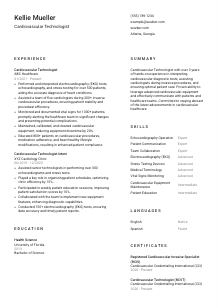
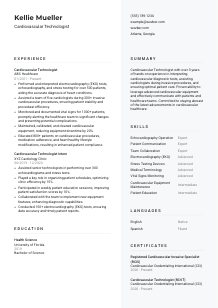
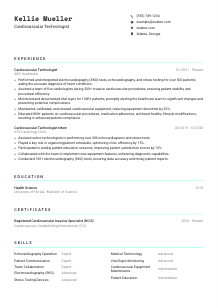
Navigating heart matters, but your CV feels off rhythm? Sync up with this Cardiovascular Technologist CV example, created with Wozber free CV builder. It shows how to align your medical maestro skills with job expectations, so your career always taps into its full potential!
Cardiovascular technologists work where technical accuracy and patient stability meet. Hiring teams want to see that you can run and interpret diagnostic testing, support invasive procedures without slowing clinical flow, and stay alert to changes in vital signs when every reading matters. Your CV should make that clinical judgment visible, not just list equipment or duties.
A tailored CV changes how quickly your background is understood, especially when an ATS first scans for terms tied to cardiac diagnostics, invasive support, and patient care. Wozber's free CV builder helps you align that language naturally in an ATS-friendly CV format, so the reader can immediately see whether your experience matches the pace, tools, and patient-facing demands of the role.
In healthcare hiring, the top of the CV should answer a few practical questions fast: who you are, what role you do, how to reach you, and whether you meet any basic logistics the employer has stated. For a Cardiovascular Technologist, this section should be clean, factual, and easy to scan.
Use your full name in a clear, readable format. This is not the place for nicknames or extra credentials after your name unless they are standard clinical designations you use professionally. Keep it simple so the rest of the CV can carry the detail.
Place "Cardiovascular Technologist" directly beneath your name if that is the job you are pursuing. When your background includes a more specialised invasive or non-invasive focus, you can reflect that elsewhere, but the title here should align closely with the posting so both recruiters and ATS systems categorize you correctly.
Clinical employers move quickly when scheduling interviews, so accuracy matters here.
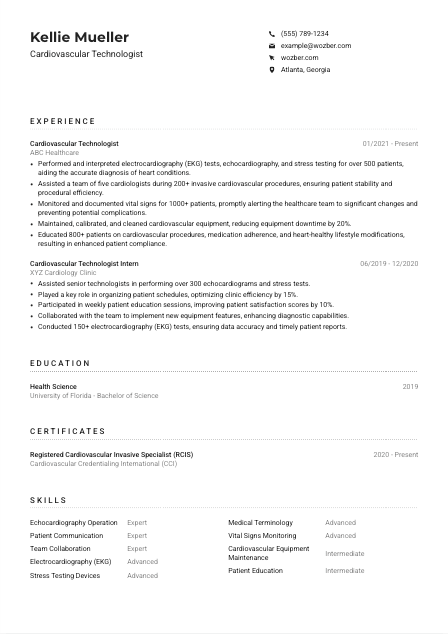
If a posting specifies that you must be based in a certain city or be willing to relocate, include that clearly. In the example, listing Atlanta, Georgia immediately supports a stated requirement. That kind of detail belongs here because it removes a practical question before anyone gets to your clinical experience.
Include LinkedIn or a professional profile only if it is current and consistent with your CV. For this profession, that might mean your certifications, hospital experience, procedure exposure, or continuing education are reflected accurately. If the profile is sparse or outdated, leave it off.
Your personal details should remove friction, not create it. When this section is precise and aligned with the posting, the reader can move straight to your cardiovascular experience and credentials.




This is the section that carries the most weight for a Cardiovascular Technologist. Employers want to understand what kinds of tests you performed, how closely you worked with cardiologists or physicians, what clinical volume you handled, and whether you contributed to safe, efficient patient care under real conditions.
Before writing bullets, isolate the work the employer needs done: diagnostic testing, invasive procedure support, patient monitoring, equipment upkeep, and patient education. Then check that each of those areas appears in your recent experience if you have done them. In the sample job description, those are the operating priorities, so the CV should mirror that structure rather than staying vague about "cardiology support."
Start with your most recent position and include job title, employer, and dates. That basic structure matters because hiring teams often look first at continuity in clinical settings, progression from intern or trainee work into full technologist responsibilities, and whether your recent experience is current enough for today's equipment and workflows.
Your bullets should show what you performed and why it mattered. Instead of saying you "helped with cardiac testing," specify the tests, patient volume, and contribution to diagnosis or procedure flow. The example does this well with lines about performing EKGs, echocardiography, and stress testing, then linking that work to accurate diagnosis. That gives the reader both task and clinical value.
Quantification is especially persuasive in this field because it shows pace, consistency, and scope. Patient counts, number of procedures assisted, equipment downtime reduced, satisfaction scores improved, or education volume can all work when they are true. Figures like "500 patients," "200+ invasive procedures," or "20% less downtime" help hiring teams picture the environment you have already handled.
Keep the emphasis on cardiac diagnostics, invasive support, monitoring, equipment calibration, and patient-facing education. Administrative or general healthcare tasks only belong if they show something useful, such as improving clinic efficiency or coordinating patient flow in a cardiology setting. Every bullet should strengthen your case for the specific clinical work ahead.
Your experience should show more than time on the job. It should show that you can produce accurate cardiac data, support procedures safely, and contribute to patient care in a busy clinical environment.
For Cardiovascular Technologist roles, education is usually a straightforward screening point. The degree itself matters, but so does how clearly you present the field of study when it matches cardiovascular technology, health science, or another closely related discipline.
If the posting calls for a bachelor's degree in Cardiovascular Technology, Health Science, or a related field, make sure your entry reflects that language as closely as is accurate. In the example, "Bachelor of Science" in "Health Science" directly supports the requirement and does not need extra explanation.
List your degree, field of study, school, and graduation year. This section should be easy to scan in a few seconds. In healthcare CVs, overly decorative formatting only makes it harder for a recruiter or ATS to confirm that you meet a baseline educational requirement.
If your degree title is broad, the field of study becomes more important. A Bachelor of Science can mean many things, so the specialization should be visible. When your education is directly tied to cardiovascular or health sciences, let that detail do the work for you.
This is most useful for early-career candidates. If you have limited professional experience, coursework in echocardiography, cardiac anatomy, hemodynamics, or invasive cardiovascular procedures can help bridge the gap between school and practice. Skip generic course lists once you have stronger clinical experience on the page.
Honors, projects, or student activities are worth mentioning when they connect to patient care, medical technology, or cardiology-related training. If they do not add anything to your clinical profile, keep the section concise and let certifications and experience carry more of the argument.
Present your education so the employer can confirm, at a glance, that you meet the academic threshold and that your training is relevant to cardiovascular care.
Certifications carry real weight in cardiovascular hiring because they tell employers you meet recognized technical standards. When a posting names RCIS or RCVT specifically, this section should be impossible to miss.
Lead with certifications that the employer explicitly requested. For this role, RCIS and RCVT are strong examples because they speak directly to invasive cardiovascular and technologist competency. If you hold one or both, list them clearly and use the full credential name as well as the acronym.
Prioritise credentials tied to cardiovascular diagnostics, invasive procedure support, patient monitoring, or related specialty practice. The point is not to display every certificate you have ever earned. It is to show the qualifications that matter in a cath lab, cardiology clinic, or diagnostic testing setting.
Employers want to know that your credential is current. Listing the year earned and, when relevant, showing that it remains active gives the section more credibility. The example's "2020 - Present" format makes that easy to read.
Cardiovascular technology changes with equipment, procedure standards, and clinical protocols. Updating this section when you renew credentials or add new specialty training helps your CV reflect the level of practice you can bring now, not just what you qualified for years ago.
In many applications, certifications are one of the fastest ways to establish professional credibility. Make yours clear enough that a recruiter or department lead can confirm your standing immediately.
A Cardiovascular Technologist skills section should read like a practical clinical toolkit. The best lists combine technical capabilities, patient-facing strengths, and the equipment knowledge needed to support safe diagnostics and procedures.
Pull skill terms directly from the job description when they match your background. For this role, that includes operating echocardiography machines, electrocardiographs, stress testing devices, communicating with patients and families, and maintaining cardiovascular equipment. This kind of wording improves ATS optimisation and keeps your CV aligned with how the employer describes the work.
Cardiovascular technologists are judged on more than technical operation. You also need to reassure patients, explain procedures clearly, and communicate changes quickly to nurses, cardiologists, and physicians. A skills list that includes both EKG and echocardiography operation alongside patient communication, education, and teamwork reflects how the job is actually performed.
Put the most relevant abilities first. Diagnostic testing, vital signs monitoring, invasive procedure assistance, and cardiovascular equipment maintenance usually deserve higher placement than broader healthcare skills. The sample CV handles this well by foregrounding echocardiography, EKG work, patient communication, and monitoring before more general capabilities.
Your skills section should quickly show that you can operate the right equipment, work smoothly with the care team, and support patients through cardiovascular testing and treatment.
Language ability matters in cardiovascular care because patient instructions, symptom descriptions, consent conversations, and post-procedure education all depend on clear communication. This section is simple, but it can add meaningful value in a clinical setting.
If the posting calls for strong English skills, include English and state your proficiency plainly. In patient-facing healthcare roles, this is not filler. It confirms you can explain procedures, document accurately, and communicate urgent changes to the team.
Additional languages can be a real advantage, especially in diverse communities or high-volume outpatient settings. If you can speak with patients and families in another language, include it. In the example, Spanish adds practical value because it can support education and rapport with a broader patient base.
Choose levels that reflect what you can actually do in clinical conversation and patient education.
Sometimes a language is especially useful in the market you are targeting. If that applies, it can strengthen your application, but keep the point practical. Mention it because it helps with patient communication, not because it sounds impressive on its own.
Language skills are supportive, not the centerpiece of a Cardiovascular Technologist CV. Include them when they are real and relevant, then let your testing, procedure support, and patient care experience stay in the lead.
When listed accurately, languages show that you can communicate care instructions clearly and serve a wider patient population with confidence.
Your summary should give a hiring manager a quick clinical snapshot. In a few lines, it should establish your level of experience, the cardiovascular work you actually do, and the patient care strengths that make your background relevant right away.
Before writing, identify the role's main priorities. Here, those include diagnostic testing, invasive procedure assistance, equipment proficiency, patient monitoring, and communication. Your summary should touch the areas where your background overlaps most strongly instead of trying to mention everything.
State your professional identity and years of experience near the start. A line such as "Cardiovascular Technologist with over 3 years of hands-on experience" works because it gives immediate context. The sample summary uses this approach effectively and then moves straight into relevant clinical functions.
Choose strengths that match the posting and are central to your practice. That might mean interpreting cardiovascular diagnostic tests, assisting during catheterizations or angioplasties, educating patients on procedures and medications, or maintaining diagnostic equipment. Focus on the work that best reflects your day-to-day contribution.
Aim for 3 to 5 lines with direct language. Avoid generic claims about being passionate or hardworking unless you tie them to patient care, diagnostic quality, or team support. This section works best when it reads like an accurate overview of your practice, not a collection of broad traits.
A well-written summary should make one thing clear within seconds: you already understand the clinical pace, tools, and patient responsibilities of a Cardiovascular Technologist role.
Once each section reflects the cardiovascular work you actually do, your CV becomes much easier to read for both recruiters and clinical leaders. Using Wozber's free CV builder, ATS CV scanner, and ATS-friendly CV templates can help you align terminology, surface missing requirements, and present your background in a clean ATS-compliant CV.
The final version should make it easy to judge your testing experience, procedure support, certifications, and patient care skills. That is the standard to aim for before you apply.