



Use Wozber and land your dream job
Create CV
No registration required
Caring bedside, but your CV feels bedridden? Nurture your job relevance with this Certified Nurse Aide CV example, created with Wozber free CV builder. Learn how to smoothly match your care skills to job specifications, helping your career bloom in the healthcare garden!
Certified Nurse Aides work where care is most visible. Hiring teams look for people who can handle daily living support, take accurate vital signs, keep resident spaces clean, and notice small changes in condition before they become larger problems. Your CV needs to make that hands-on reliability easy to see, especially if you have worked in long-term care, rehab, or another clinical setting where routine, documentation, and teamwork matter every shift.
When the CV is tailored well, the first read becomes much clearer. Wozber's free CV builder helps you shape an ATS-compliant CV around the exact language used in the posting, so duties like bathing assistance, vital sign recording, sanitation, and reporting condition changes show up where screening systems and nursing managers expect them. That makes it easier to recognize whether your background matches the pace and responsibility of resident care.
In healthcare hiring, simple details carry practical weight. A missing location, an unprofessional email address, or a title that does not match the role can create friction before anyone reaches your care experience. Keep this section clean, accurate, and aligned with how CNA applications are reviewed.
Use your full name at the top of the page in a clear, readable format. This is not the place for decorative styling. In a healthcare stack of CVs, your name should be easy to find on a printed page, in an ATS, or during a quick handoff between HR and nursing leadership.
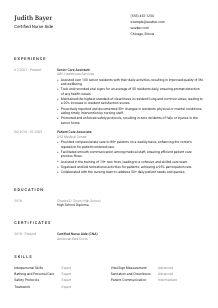
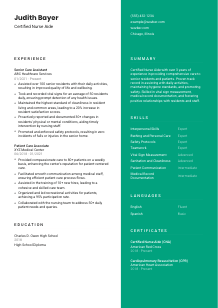
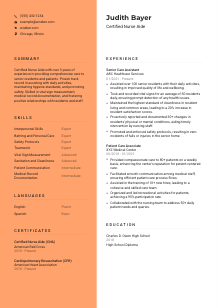
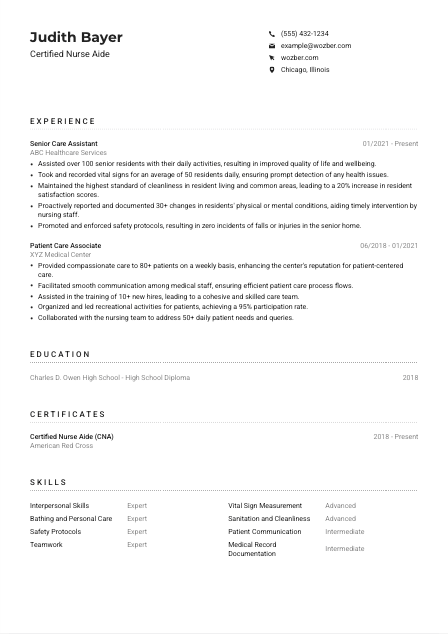
Place "Certified Nurse Aide" directly under your name when that is the role you are applying for. Matching the posted title helps with ATS alignment and shows that your background is focused on CNA-level patient support rather than a broader care role. The sample CV does this well by using the exact title instead of a loose variation.
List a current phone number and a professional email address you actually monitor. If you include a website or profile, make sure it supports your healthcare background and is up to date. A missed digit or outdated link can cost you an interview in a process that often moves quickly when facilities need dependable coverage.
If a posting requires local availability, show your city and state clearly. In this example, Chicago, Illinois matters because the employer specifically asked for candidates located there. Treat location this way when it is named in the posting, not as a universal CNA rule for every application.
Most CNAs do not need a portfolio, and that is fine. Include a LinkedIn profile or professional website only if it reinforces your work history, credentials, or training. If the link is sparse, outdated, or unrelated to patient care, leave it off and keep the section focused.
This section should tell the employer, in seconds, who you are, how to reach you, and whether you match any basic screening requirements such as location and role title. Keep it practical and error-free.




CNA hiring decisions are often made from the experience section. Facilities want proof that you have already worked around residents or patients, handled direct care tasks, followed safety routines, and communicated changes to nurses or supervisors. Your bullets should sound like real shift work, not generic claims about being caring or hardworking.
Start by showing experience in the environments most relevant to the job, whether that is long-term care, assisted living, rehabilitation, or a clinical unit. If the posting asks for at least 1 year in a clinical or long-term care setting, make that easy to spot through job titles, employer types, and bullet points tied to resident care. The sample CV does this by leading with senior care and patient care roles rather than unrelated work.
List roles in reverse chronological order with your job title, employer, and dates. That structure matters in healthcare because reviewers often want to see recent bedside or resident-facing experience first. Clear dates also help show whether your care work has been consistent and recent enough for the unit or facility's needs.
Focus each role on tasks that matter in daily care delivery. Include assisting with bathing, feeding, dressing, mobility, toileting, vital signs, room sanitation, observation, and reporting changes in condition when those duties reflect your actual work. One of the strongest sample bullets mentions assisting more than 100 senior residents with daily activities, which immediately connects to common CNA responsibilities.
Quantify your work where it adds real context. Resident volume, patients supported per shift, vital signs recorded per day, training contributions, satisfaction scores, or safety outcomes all help a hiring team understand your scope. In the sample, recording vital signs for 50 residents daily and maintaining zero falls or injuries gives a clear picture of workload and care quality.
Use the limited space for patient support, teamwork with nursing staff, sanitation standards, safety practices, and documentation habits. If a past task does not help explain your readiness for resident care, remove it. Hiring managers for CNA roles are looking for direct evidence that you can step into routine hands-on care and contribute safely from day one.
Your experience section should leave no doubt that you have delivered hands-on care in a real facility setting. When the bullets show patient volume, daily responsibilities, and safe follow-through, your background becomes much easier to trust.
Education is usually brief on a CNA CV, but it still matters because it confirms required entry points into the profession. Hiring teams often check this section quickly to confirm you meet baseline educational requirements and have completed the training that supports certification.
If the job asks for a high school diploma or GED, include it clearly with the school name and graduation year or completion date. For this posting, that requirement is explicit, so leaving it vague would create an avoidable question. Even when your care experience is strong, the basic credential still needs to be visible.
List the credential, school, and date in a consistent structure. CNA education sections do not need long descriptions unless you are early in your career and need to show relevant training. Simple formatting helps both ATS systems and human reviewers move quickly to the qualifications they need to confirm.
If you completed a state-approved Certified Nurse Aide training program, make sure it appears on the CV. Depending on your layout, you can include it in education or certifications, as long as it is clear and easy to find. Because this posting specifically requires approved CNA training, that detail should never be buried.
Relevant coursework can help if you are newer to the field or recently finished training. Topics like basic nursing skills, infection control, patient safety, anatomy, and resident care procedures can support your case when practical experience is limited. If you already have several years of strong facility experience, coursework usually matters less than your results on the floor.
Include honors, volunteer work, or school activities only if they reinforce your path into caregiving or show responsibility in a healthcare-adjacent setting. For example, service work with seniors, health clubs, or care-focused community programs can add context for entry-level candidates. Keep this section tight if you already have solid clinical experience.
Education for a CNA CV does not need much space, but it does need to answer the employer's requirements quickly. Show the diploma or GED, surface your training, and keep the section easy to scan.
For Certified Nurse Aides, certifications are operational requirements, not CV decoration. A hiring team cannot move forward without seeing the credential that allows you to work in the role, and they may also look for related certifications that support patient safety and emergency response.
Your valid state-issued Certified Nurse Aide certification should be the first item in this section. If the employer names certification directly, mirror that language so there is no ambiguity. This is the core qualification that confirms you are eligible for the work.
Keep the list focused on what supports bedside or resident care. CNA certification belongs at the top, and CPR is often a helpful addition because it reinforces emergency readiness. The sample CV uses exactly that approach by listing CNA and CPR rather than filling space with less relevant items.
Include issue dates, renewal periods, or expiration dates where relevant. In regulated healthcare roles, current status matters. A certificate listed without timing details can raise unnecessary questions about whether it is active.
If you have completed additional training in areas like dementia care, infection prevention, restorative care, fall prevention, or hospice support, include it when it is current and relevant. These credentials can help distinguish you for specialised units or long-term care settings without distracting from the required CNA certification.
This section should confirm, at a glance, that you hold the credential required to work and that your training supports safe resident care. Lead with the essentials and keep the dates current.
A CNA skills section works best when it mirrors real care tasks and unit behaviour. Hiring managers want to see the practical abilities that support daily resident care, along with the people skills needed to work closely with nurses, residents, and families during fast-moving shifts.
Use the job description to identify the skill mix the employer actually needs. For this opening, that includes interpersonal skills, teamwork, daily living assistance, vital sign measurement, sanitation, and reporting changes in condition. When your skills section reflects that language naturally, it strengthens both ATS optimisation and human review.
Choose skills that support the work you will do on the floor. Bathing and personal care, feeding assistance, mobility support, infection control, vital signs, documentation, and safety protocols all belong if they reflect your real experience. Avoid generic filler or broad traits that do not help explain how you contribute during a shift.
CNA work depends on both hands-on competence and reliable communication. Technical skills such as taking blood pressure or recording pulse matter, and so do teamwork, patient communication, and observation. The sample CV handles this balance well by pairing care tasks like vital sign measurement and sanitation with teamwork and interpersonal skills.
The best CNA skills sections read like a practical snapshot of what you can do with residents, patients, and the care team. Keep it grounded in real tasks and real unit support.
Communication affects safety, comfort, and documentation in every care setting. The languages section is not just a bonus on a CNA CV. It can directly support patient understanding, team coordination, and compliance with a stated job requirement.
If the job requires fluent English, list English first with the appropriate proficiency level. This posting states that requirement plainly, so your CV should answer it just as plainly. In resident care, language ability affects handoff communication, charting accuracy, and patient interaction.
Additional languages can be useful in hospitals, long-term care facilities, and community-based settings that serve diverse populations. If you can communicate with residents or families in another language, include it with an honest proficiency rating. The sample's Spanish entry is a good example of useful added context without overstating ability.
Choose realistic proficiency terms such as basic, conversational, fluent, or native. Overstating language ability can create serious problems in care environments where instructions, symptoms, and safety concerns must be understood correctly. Accuracy matters more than impressiveness here.
Some facilities place extra value on bilingual communication because of the residents they serve. If another language is especially relevant to the employer's setting, move it into clearer view. Use that as a tailoring choice based on the opening, not as a required CNA standard across every market.
Language skills help with trust, comfort, and smoother communication during care tasks such as explaining a routine, calming a resident, or relaying concerns to staff. Present them as practical care assets rather than as decorative CV extras.
For a CNA, language skills matter when they improve understanding and support safer interactions with residents, families, and staff. List them clearly and rate them honestly.
The summary should quickly establish the kind of care environment you know, the amount of experience you bring, and the patient support work you handle well. It is most effective when it sounds grounded in actual facility experience rather than broad statements about being compassionate.
Review the posting and identify the daily care functions at the centre of the job. For a CNA, that usually means assistance with activities of daily living, vital signs, sanitation, observation, reporting, and collaboration with nursing staff. Build the summary around those functions instead of writing a generic healthcare introduction.
Open with your experience level and the type of environment you have worked in, such as long-term care, senior living, rehabilitation, or hospital support. That gives immediate context. The sample summary works because it starts with more than 3 years of experience and points directly to care for senior residents and patients.
Choose two or three strengths that match the employer's priorities. Vital sign measurement, medical record documentation, resident support with daily activities, and strong communication with staff are all useful examples when they reflect your history. Keep the language close to what the employer uses so the connection is immediate.
Aim for a short paragraph that a nurse manager can scan in seconds. Three to five lines is usually enough to cover your experience, care setting, and strongest relevant skills. Every phrase should help explain how you support safe, consistent resident care.
A strong summary gives a quick, accurate picture of your background before the reader reaches the detail below. Keep it specific to CNA work, grounded in real responsibilities, and aligned with the setting you want to join.
A Certified Nurse Aide CV works when it reflects the realities of the shift: direct resident support, accurate vital signs, clean care environments, timely reporting, and steady teamwork with nursing staff. Shape each section around those responsibilities so the employer can quickly see that you meet the role's demands.
Wozber's free CV builder can help you organise that experience into an ATS-friendly CV format, align your wording with the posting, and strengthen ATS optimisation without losing the human side of your care work. The finished CV should make one thing easy to judge: whether you can step into the unit and provide safe, dependable support from day one.