



Use Wozber and land your dream job
Create CV
No registration required
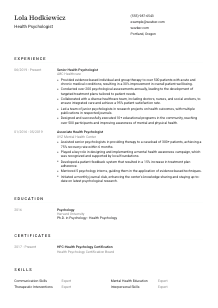
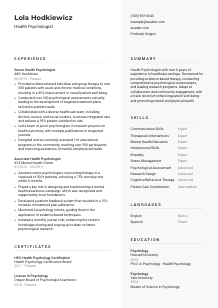
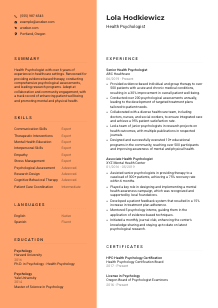
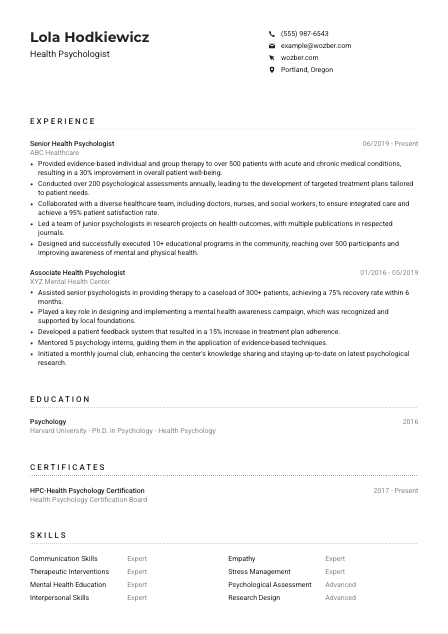
Working with minds, but your CV looks a bit scattered? Explore this Health Psychologist CV example, created with Wozber free CV builder. It shows how to blend your behavioral insights with job demands, nurturing a career path as resilient and vital as the individuals you help!
Health psychology sits at the point where medical treatment, mental health care, and behaviour change meet. Hiring teams want to see that you can work comfortably with medically complex patients, translate assessment findings into treatment plans, and contribute to coordinated care without losing the empathy that keeps patients engaged.
When that experience is tailored well, the CV quickly shows whether your background matches the clinical setting, patient population, and care model behind the opening. Wozber's free CV builder helps you shape that story into an ATS-compliant CV, so therapy work, assessment volume, interdisciplinary collaboration, and research contributions are easy to track from the first scan.
In healthcare hiring, small details carry operational weight. Your contact section should make it easy to see who you are, what role you practice in, and whether basic logistical requirements are already covered.
Use the same full name that appears on your licensure records, publications, or hospital profiles. Keep it prominent and easy to read so there is no confusion when your CV is reviewed alongside credentialing materials or interview notes.
Place "Health Psychologist" under your name if that is the role you are pursuing. This immediately frames your background around behavioral medicine, psychological assessment, and therapy in medical settings rather than broader counseling or general psychology work.
List the communication channels a hiring team can use without friction:
If the job calls for local availability, include your city and state. In the example, listing Portland, Oregon directly supports the employer's location requirement and removes a common screening question early.
A LinkedIn page, faculty bio, or professional website can help when it reflects publications, clinical specialties, speaking work, or community programs. Make sure the content matches your CV, especially around dates, titles, and areas of practice.
Do not include age, marital status, photo, or other personal identifiers unless they are specifically requested. For a Health Psychologist, the useful signals are licensure, specialization, clinical setting, and contact access, not unrelated personal details.
This section should remove basic uncertainty, not create it. When your title, contact details, and location are clean and accurate, the reader can move straight to your clinical experience and qualifications.




Experience carries the most weight for Health Psychologist roles because employers need proof that you can work with patients in real medical environments. Focus less on broad job descriptions and more on the patient groups you served, the interventions you delivered, and the outcomes your work supported.
Read the posting for clues about what kind of practice matters most. Here, the priorities are individual and group therapy, psychological assessment, integrated care, research, and community education. Shape your bullets around those functions so the employer sees direct overlap instead of having to infer it.
List roles in reverse chronological order and make each entry easy to scan:
Employers already know a Health Psychologist provides therapy and assessment. What matters is the scope and effect of that work. Write bullets that connect interventions to outcomes such as patient well-being, adherence, recovery, satisfaction, or care coordination. The sample does this well by linking therapy for more than 500 patients to a 30% improvement in well-being and assessments to targeted treatment planning.
Choose numbers that reflect how your work is actually measured. Caseload size, annual assessment volume, treatment adherence, patient satisfaction, group participation, publication count, and community reach all make sense here. Quantified details help distinguish someone who supported care from someone who drove measurable clinical results.
If your background includes broader mental health roles, highlight the parts most relevant to medical populations and interdisciplinary care. Prioritise work with acute or chronic conditions, collaboration with physicians and nurses, evidence-based interventions, and research or psychoeducation tied to health outcomes.
A hiring team should come away knowing what kinds of patients you treated, how you worked within a healthcare setting, and what changed because of your involvement. That is the level of detail that moves a Health Psychologist CV forward.
For a Health Psychologist, education is a core qualification, not a background detail. The degree line tells employers whether you meet the doctoral standard for practice and whether your academic training supports work at the intersection of psychology and medical care.
If the role asks for a Ph.D. or Psy.D. in Psychology with a health psychology focus or related specialization, make that degree easy to find. Do not bury it under older education. In the example, the Ph.D. in Psychology with a Health Psychology focus directly answers the requirement.
Present each degree using a consistent structure so reviewers can process it quickly:
Where your program had a concentration, track, dissertation focus, or formal emphasis related to behavioral medicine, chronic illness, rehabilitation, or integrated care, include that wording if it strengthens the match. This is especially useful when the employer wants a clear connection to health psychology rather than a general doctoral psychology background.
Most experienced Health Psychologists do not need course lists. Include selected coursework only if it adds useful context, such as psychophysiology, behavioral medicine, consultation-liaison practice, or research methods tied to health outcomes, and only when your work experience is still developing.
Honors, dissertations, assistantships, or research projects belong here if they strengthen your profile for the actual role. For example, research tied to health interventions, patient outcomes, or multidisciplinary medical settings can support applications that include a research component.
This section should confirm that you meet the doctoral standard and show how your academic path connects to health-focused psychological practice. Once that is clear, the reader can focus on your clinical and research record.
In psychology hiring, credentials often function as a gate before anyone reads deeply into the CV. Your certifications and licenses should show current authority to practice and any added specialization that strengthens your profile for health-focused clinical work.
Pull the required and preferred credentials directly from the job ad. For this opening, state licensure as a Psychologist is essential, while Health Psychology certification is preferred. If you hold both, list both prominently.
Lead with the certifications and licenses that matter to patient care, legal eligibility, and specialization. A current state psychology license belongs ahead of broader training certificates, and a credential such as HPC-Health Psychology certification adds value when the role emphasizes behavioral medicine or specialty practice.
Add the issue date, active range, or renewal period when appropriate. This helps employers see that your credentials are current and maintained, as in the example where both the Oregon license and Health Psychology certification are shown as active.
If you have recent training in evidence-based interventions, medical psychology, pain management, chronic illness adjustment, or integrated care, include it when it adds clear relevance. Choose certifications and advanced training that sharpen your clinical profile instead of listing every workshop you have attended.
For a Health Psychologist, this is one of the fastest screening checkpoints on the page. Clear licensure and relevant specialty certification tell the employer you can step into practice without avoidable uncertainty.
The best skills sections for Health Psychologists do not read like generic personality lists. They combine treatment capabilities, assessment strengths, collaboration skills, and patient-facing qualities that are directly relevant to medical settings.
Start with the competencies the role actually requires. In this case, that includes therapy delivery, psychological assessment, treatment planning, interdisciplinary communication, research, and patient education. Then add tools or modalities you genuinely use, such as CBT, motivational interviewing, behavioral health consultation, or care coordination.
Place the most job-relevant abilities first. Empathy and communication matter, but they carry more weight when paired with clinical capabilities such as evidence-based interventions, assessment, group therapy, health behaviour change, and collaboration with physicians, nurses, and social workers. The example balances both sides well by listing therapeutic interventions alongside interpersonal strengths.
Group skills in a logical way if your format allows it, such as clinical interventions, assessment and research, and collaboration or education. That structure helps a reviewer understand how you function in care delivery rather than reading a loose string of keywords.
If the section reflects the interventions you deliver, the teams you work with, and the patient needs you manage, it will support the rest of the CV instead of repeating vague strengths.
Language ability matters in psychology because communication is part of the intervention itself. In healthcare settings, it also affects patient trust, psychoeducation, teamwork, and how effectively you can work with diverse communities.
When a posting specifies professional English, treat that as a formal qualification and show it clearly. This matters in therapy documentation, assessment feedback, multidisciplinary discussion, and community education, where precision and tone both matter.
Put English at the top when it is explicitly required. Use an accurate proficiency label such as Native or Professional to remove any doubt about your ability to communicate in clinical and professional contexts.
Additional languages can strengthen your value, especially in community programs or patient populations where multilingual communication helps with engagement and adherence. In the example, fluent Spanish adds practical reach without distracting from the required English proficiency.
Be honest and specific with levels such as Native, Fluent, Advanced, or Intermediate. Avoid overstating fluency, especially in a profession where nuanced conversations, informed consent, and therapeutic rapport depend on precise language.
Extra languages are most useful when they connect to your clinical environment, outreach work, or regional patient mix. Include them when they strengthen your ability to deliver therapy, education, or collaborative care, not simply to fill space.
For Health Psychologist roles, language proficiency should clarify how well you can connect with patients, support teams, and contribute to education or outreach in the settings you serve.
The summary should give a hiring team a fast, accurate picture of your practice. For Health Psychologist roles, that usually means your years in healthcare settings, the kinds of interventions you provide, and one or two outcomes or strengths that show range beyond routine therapy work.
Use the job description to decide what deserves space in the first lines. For this role, the key themes are medical-setting experience, therapy, assessment, multidisciplinary care, research, and community education. Choose the ones you can prove most strongly in your own background.
Start with a direct statement of who you are professionally, such as your title, years of experience, and healthcare or medical environment. That immediately places you in the right part of the candidate pool and works especially well when the role requires at least 3 years of clinical experience.
Include details that sharpen your profile, such as evidence-based therapy for acute and chronic medical conditions, high assessment volume, publications on health outcomes, or successful patient education programs. The sample summary works because it combines clinical care, assessment, research leadership, and collaboration without trying to list everything.
Aim for a short paragraph that sounds credible in a hospital, clinic, or behavioral health setting. Avoid broad claims about passion or dedication unless they are anchored in specific practice areas, outcomes, or scope of work.
After reading these lines, the employer should already understand your level of practice, your health psychology focus, and the kind of contribution you can make in patient care, research, or integrated treatment planning.
A Health Psychologist CV works when it connects credentials, medical-setting experience, therapy work, assessment, and collaboration into one clear professional profile. Wozber's free CV builder helps you organise that information in an ATS-friendly CV format that keeps core qualifications easy to scan.
Before you submit, review the language of the target posting and tighten each section around the population served, care setting, and responsibilities involved. You can use Wozber's ATS CV scanner to check alignment, surface missing terms, and strengthen ATS optimisation so the final CV makes your readiness for health psychology practice easy to judge.




