




Use Wozber and land your dream job
Create CV
No registration required
Tending to patients, but your CV feels under the weather? Scroll through this Assistant Nurse CV example, brought back to health with Wozber free CV builder. Learn how to blend your caregiving skills with job requirements with ease, keeping your career journey as smooth as a well-monitored recovery room!
Assistant Nurse hiring moves quickly when a CV shows what bedside work actually looks like in practice. Managers want to see safe patient care, accurate charting, steady communication with patients and families, and the ability to work smoothly under RN or physician supervision. If those details stay vague, clinical experience can look thinner than it really is.
The first screen often comes down to whether your background clearly matches core care requirements such as clinical experience, RN licensure, and EMR documentation. Wozber's free CV builder helps you shape that experience into an ATS-compliant CV with the right nursing terminology, so the hiring team can quickly recognize where you have delivered patient support, documentation accuracy, and care-plan collaboration.
Healthcare employers should not have to search for the basics. Your personal details need to present you as accessible, professional, and logistically aligned with the role before the reader even reaches your clinical experience.
Use your full name as the clearest heading on the page. Keep the formatting clean and professional so it feels consistent with a healthcare CV, where precision and order already matter.
Place "Assistant Nurse" directly under your name when that is the role you are pursuing. Matching the title helps frame the rest of the CV immediately, especially when your recent work history includes close titles such as Nursing Assistant or patient care support roles.
List a phone number you answer and a professional email address that uses your real name. In clinical hiring, interview requests can move fast, so avoid casual handles or outdated contact information that creates friction.
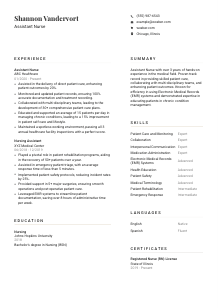
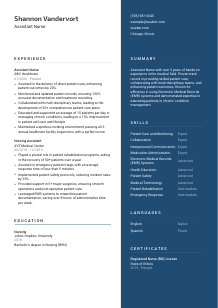
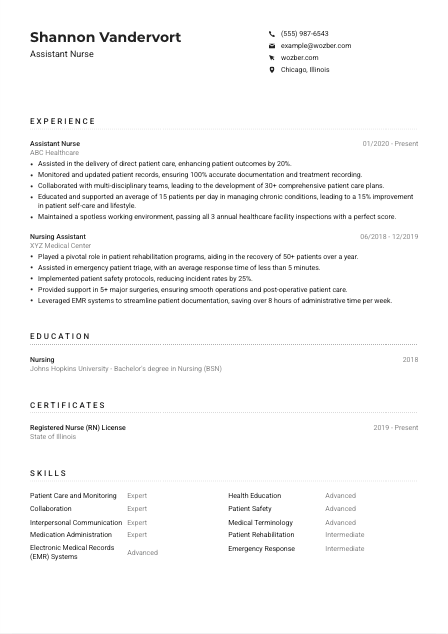
If the posting calls for candidates in a specific area, include your city and state. Here, Chicago, Illinois is part of the stated requirement, so showing that location, as the sample CV does, removes an avoidable question early. If you are relocating, say so clearly.
A LinkedIn profile can help if it matches your CV and includes nursing experience, licensure, or healthcare credentials. Skip links that do not add professional value. For this role, clinical history, certifications, and healthcare employers matter more than a general online presence.
This section should answer practical questions fast: who you are, how to reach you, and whether you meet the location expectation. Keep it tidy and aligned with the realities of clinical hiring.




For an Assistant Nurse, experience is where employers look for proof of safe patient care, dependable documentation, and teamwork in real clinical settings. Job titles alone do not carry much weight. The bullets need to show what you handled, how you supported care delivery, and what improved because of your work.
Before rewriting bullets, identify the care tasks and workflow signals in the job ad. In this case, that includes direct patient care, monitoring vitals, medication administration, EMR updates, patient education, and coordination with multi-disciplinary teams. Those are the themes your experience section should surface clearly.
Lead with your most recent healthcare role and include the employer, job title, and dates. This layout lets hiring teams track your clinical progression quickly, especially when they are checking whether you meet a minimum experience threshold such as 2+ years in a healthcare setting.
Rewrite responsibilities as results-driven statements. Instead of stopping at "assisted with patient care," show what kind of care you supported and what changed. The sample CV does this well by tying direct patient care to a 20% improvement in outcomes and patient education to better chronic-condition self-management.
Numbers are strongest when they reflect actual nursing performance. Patient volume, documentation accuracy, care plans completed, incident reduction, inspection results, or response time all work well when they are true. Examples from the sample include 100% documentation accuracy, 30+ care plans, and under-5-minute triage response, all of which make the scope of work easier to understand.
Prioritise experience that maps to bedside support, safety, charting, medication support, rehabilitation, patient communication, and care-team coordination. If you have unrelated tasks from a broader healthcare job, trim them unless they strengthen your case for this kind of clinical support role. Relevance here means showing that you can step into patient-facing nursing workflows with minimal ramp-up.
Your work history needs to show more than time served in healthcare. It should make your patient-care scope, documentation habits, and collaboration style easy to picture in a real unit or facility.
Education confirms that you meet the formal nursing baseline, but the value is in presenting it clearly and in the language the employer expects. For an Assistant Nurse role, that usually means making your nursing degree easy to find without burying it under extra detail.
If the employer asks for a Bachelor's degree in Nursing or equivalent, list that credential clearly. Use wording that closely reflects the posting when it is accurate to your background, since that helps both ATS parsing and quick human review.
Include the degree, school, field of study, and graduation year. Healthcare hiring teams typically scan this section for qualification confirmation rather than narrative, so a simple structure works best.
Write out your degree in a way that leaves no ambiguity. "Bachelor's degree in Nursing (BSN)" is clearer than a shortened or informal label, and it mirrors the requirement in this example posting.
If you are newer to the field, selected coursework in areas such as medical-surgical nursing, pharmacology, patient assessment, or chronic care can help connect education to bedside work. If you already have solid clinical experience, this usually adds less value than stronger experience bullets.
Honors, nursing society membership, or leadership in clinical training programs can help if they reflect sustained commitment to nursing practice. Keep these additions relevant. The section should still read as qualification-first, not as a full academic profile.
A hiring manager should be able to verify your nursing degree in seconds. When the section is clean and correctly worded, it supports the rest of your clinical story without distracting from it.
In nursing, certifications and licenses are not decorative extras. They often determine whether your application moves forward at all. Present them with the same accuracy you would use in patient documentation.
Review the posting for required credentials and place those first. Here, a valid Registered Nurse license in the state of practice is essential, so it should appear prominently rather than getting lost among optional certifications.
Prioritise licenses and certifications that directly affect your ability to work in a clinical setting, such as RN licensure, BLS, ACLS, or specialty care certifications when relevant. In the sample CV, the Illinois RN license is the key credential because it directly addresses eligibility for practice.
List who issued the credential and when it became active. If it expires or requires renewal, include that information when relevant. This helps employers confirm that your license or certification is current and usable.
Nursing credentials change over time, and an outdated section can create unnecessary hesitation. Update renewals, add clinically relevant certifications, and remove items that no longer support your target role. Ongoing credentials signal that you stay compliant and engaged with current standards of care.
For an Assistant Nurse, certification and license information should remove any doubt about your clinical eligibility. Lead with the credentials that allow you to work safely and legally in the setting you are targeting.
The skills section should reflect how assistant nursing work gets done day to day. Hiring teams want a quick read on your clinical tools, patient-facing abilities, and documentation strengths, especially when those skills are repeated in the job posting.
Read past the obvious keywords and identify the working skills behind the role. Here that includes EMR use, patient monitoring, medication administration, communication with families, collaboration with care teams, and maintaining a safe care environment.
List the capabilities most relevant to bedside support and clinical coordination first. In this example, skills such as patient care and monitoring, medication administration, EMR systems, patient safety, and interpersonal communication are stronger priorities than broad workplace traits.
Choose skills that reinforce the responsibilities in your experience section rather than creating a disconnected inventory. The sample CV keeps a useful balance by combining care delivery skills with operational ones like EMR documentation and emergency response. That gives the reader a sharper picture of day-to-day nursing support work.
A concise, targeted skills list helps the employer connect your background to the unit's daily workflow. Focus on the abilities that support patient care, charting accuracy, safety, and team communication.
Language ability matters in nursing because instructions, reassurance, and education have to be understood clearly. If a posting names a required language, your CV should answer that requirement directly.
When English proficiency is specifically requested, list it clearly. For a patient-facing clinical role, this helps confirm that you can document accurately, communicate with the care team, and explain care instructions to patients and families.
Lead with the language the employer requires, then add others that could support patient care. If you serve diverse communities, additional languages can strengthen your application because they improve communication during intake, education, and follow-up.
A second language is especially useful in healthcare settings with varied patient populations. The sample CV includes fluent Spanish, which can be a meaningful advantage in many clinical environments, though it is not a universal requirement for every Assistant Nurse opening.
Choose clear labels such as Native, Fluent, Intermediate, or Basic. Overstating language ability can create real risk in healthcare, where patient understanding and documentation accuracy both matter.
If the employer serves a multilingual community, language skills become more than a nice addition. They can directly support patient education, comfort, discharge instructions, and family communication. Include them when they are genuinely usable in clinical interactions.
For nursing roles, language skills are most valuable when they clearly support patient understanding and team coordination. List them in a way that is accurate, relevant, and easy to trust.
Your summary should quickly establish the kind of clinical support you provide and the setting you are prepared to work in. For Assistant Nurse roles, that usually means combining years of experience, core patient-care strengths, and one or two operational details such as EMR use or chronic-condition education.
Start by identifying the few themes the employer cares about most. In this posting, that means clinical experience, direct patient care, EMR proficiency, team collaboration, and communication with patients and families. Those points should shape the opening lines of your summary.
Begin with a direct statement of who you are and how long you have worked in clinical settings. The sample summary does this effectively with "Assistant Nurse with over 3 years of hands-on experience in the medical field," which gives immediate context before moving into specifics.
Mention two or three strengths that map directly to the posting, such as patient care, care-plan collaboration, medication support, EMR documentation, or patient education. Keep the language grounded in actual nursing work rather than generic claims about being dedicated or hardworking.
Aim for a short paragraph that introduces your value without repeating the full CV. A concise summary works best when every phrase points to bedside contribution, documentation reliability, or patient support. Save detailed metrics for the experience section, where they carry more weight.
By the time someone finishes this section, they should already understand your experience level, your core nursing strengths, and the kind of patient-care work you can step into confidently.
A tailored Assistant Nurse CV should make your clinical experience, RN eligibility, patient-care scope, and documentation habits easy to understand on a fast review. Each section should support that same picture, from location and licensure to EMR skills and measurable patient-care outcomes.
Wozber's free CV builder, ATS-friendly CV template, and ATS CV scanner can help you align your wording with the job description, strengthen ATS optimisation, and organise your qualifications into a cleaner clinical narrative. The final result should make one thing clear right away: you are ready to support safe, accurate, patient-centered care.