



Use Wozber and land your dream job
Create CV
No registration required
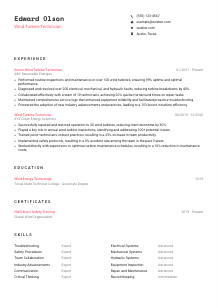
Harnessing the wind, but your CV feels static? Check out this Wind Turbine Technician CV example, created with Wozber free CV builder. Learn how to match your clean energy skills to job specifics, propelling your career to new heights and greener horizons!
Wind turbine technicians work where uptime, safety, and fault response meet. Hiring teams want to see whether you can inspect equipment at height, diagnose electrical or hydraulic issues, document service work accurately, and keep turbines producing with minimal downtime. Your CV needs to make that field capability visible quickly.
When the CV mirrors the employer's maintenance language, it becomes much easier to separate turbine-specific experience from broader mechanical work. Wozber's free CV builder helps shape that into an ATS-compliant CV by aligning your wording, structure, and keywords with the posting, so your background reads clearly as hands-on wind turbine maintenance experience.
This section is brief, but it still carries hiring value. For a Wind Turbine Technician, clean contact details, the right title, and location alignment can remove avoidable friction before anyone reaches your maintenance history or certifications.
Use your full name exactly as you use it professionally. Keep it clear and easy to read at the top of the page so supervisors, recruiters, and operations managers can identify your application immediately.
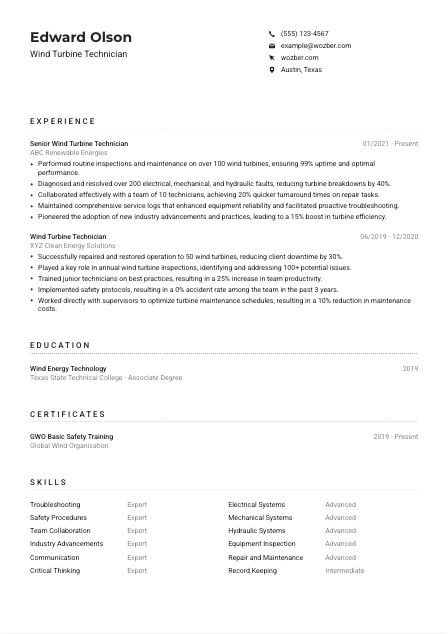
Place "Wind Turbine Technician" directly under your name if that is the role you are targeting. This instantly frames your background around turbine inspection, repair, and maintenance work instead of leaving room for your experience to be mistaken for general industrial or electrical service work.
Add a current phone number and a professional email address, then verify both. If you also keep a LinkedIn profile or similar professional page with renewable energy or field service experience, include it only if it is updated and supports your CV.
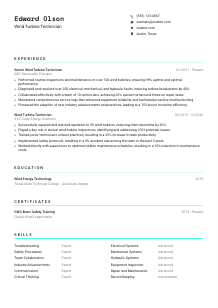
If a posting specifies a location requirement, reflect that clearly. In the example here, Austin, Texas is stated in the job ad, so listing Austin, Texas in the header removes immediate doubt about local availability and response time for site-based work.
A website is useful when it actually supports your candidacy, such as a professional profile, technical portfolio, or training record related to wind energy, electrical systems, or safety work. Skip personal links that do not strengthen your case for turbine operations.
Your personal details should confirm that you are reachable, professionally presented, and positioned for the job's basic requirements. For field roles like this, that kind of clarity matters immediately.




This is the section most likely to decide whether you move forward. Wind energy employers look for hands-on maintenance scope, fault diagnosis, safety discipline, and evidence that your work improved uptime, response times, or equipment reliability.
Read the job description closely and mark the operating language it uses. For this role, that includes routine maintenance, inspections, troubleshooting electrical and mechanical systems, repairs, safety procedures, record keeping, and collaboration with technicians or supervisors. Those are the terms your experience bullets should naturally reflect when they match your real work.
List your jobs in reverse chronological order with title, employer, and dates. For maintenance roles, this format helps hiring teams quickly track your progression from technician work into broader responsibilities such as mentoring, advanced troubleshooting, or leading repair execution on larger turbine fleets.
Each role should show what equipment you handled, what issues you solved, and what the result was. The sample CV does this well by tying turbine inspections and fault repairs to outcomes like 99% uptime, a 40% drop in breakdowns, and faster team turnaround. That combination of task and result is much stronger than listing duties alone.
Quantify the scale of your work whenever possible. Good measures for this field include number of turbines serviced, uptime percentage, fault volume resolved, repair turnaround, maintenance cost reduction, incident rate, or efficiency improvements. Metrics like "resolved 200+ electrical, mechanical, and hydraulic faults" tell a hiring manager far more than "responsible for troubleshooting."
Prioritise experience that supports wind turbine service, electro-mechanical repair, safety compliance, inspection routines, or technical reporting. If you have other industrial maintenance experience, keep only the parts that transfer well, such as working with hydraulic systems, troubleshooting controls, or following lockout and confined-work procedures.
A strong experience section shows that you have already done the kind of maintenance and repair this job requires, under real operating conditions. Focus on turbine systems, safety, and measurable equipment outcomes.
Formal training matters here because it supports safe, structured work on complex electrical, mechanical, and hydraulic systems. Your education section should make that technical foundation easy to confirm in a few seconds.
Put the degree most aligned with the role first, especially if the posting asks for an associate degree in Wind Energy Technology, Electro-Mechanical Technology, or a related field. A directly matched credential gives immediate context for your hands-on training and technical vocabulary.
List the degree, field of study, school name, and graduation year or date. That is usually enough for experienced technicians. In the example, "Associate Degree" in "Wind Energy Technology" from Texas State Technical College clearly satisfies the stated education requirement.
Keep the degree wording close to the language used in the job ad when it is accurate. If your program was in Wind Energy Technology, say that directly. If it was a related electro-mechanical field, use the official name and let your experience and skills connect it back to turbine work.
Newer technicians can strengthen this section with selected coursework, lab work, or capstone projects tied to motor controls, hydraulic systems, preventive maintenance, electrical troubleshooting, or renewable energy operations. That extra detail helps when your field experience is still growing.
If you earned honors, completed notable lab projects, or joined industry-relevant technical programs, include them when they reinforce your preparation for maintenance work. Keep the emphasis on practical relevance rather than general campus activity.
For this profession, education should confirm that you have structured technical training behind your hands-on work. If the degree aligns closely with wind or electro-mechanical systems, make that easy to see.
Certifications carry real weight in wind turbine hiring because they are tied to safe site work, compliance, and day-one readiness. This section should highlight current credentials that matter in turbine operations, especially those tied to work at height and core safety training.
If a posting names certifications, list those at the top of the section. Here, GWO Basic Safety Training and GWO Working at Heights should be impossible to miss because they directly affect site eligibility and safe work on turbines.
Choose certifications that support wind operations, maintenance safety, electrical work, rescue readiness, or equipment-specific competence. A shorter list of current, job-relevant credentials is more useful than a long list of unrelated training courses.
Many safety credentials are time-sensitive, so include the date earned and, when relevant, the renewal period or active status. The example CV handles this well by showing ongoing validity for both GWO certifications, which signals current compliance rather than outdated training.
Wind operations change with new equipment, service practices, and safety expectations. Refresh this section whenever you renew core certifications or add training that strengthens your ability to work safely and productively in turbine environments.
For a Wind Turbine Technician, certifications are not decoration. They show that you can enter the site, work safely, and meet the compliance expectations that come with turbine maintenance.
The skills section should reflect how the work is actually done. For wind turbine roles, that means technical troubleshooting, safety execution, inspection discipline, and the ability to work with crews and supervisors during maintenance cycles and repairs.
Start with the skills the employer names or implies through the responsibilities. In this case, troubleshooting, electrical and mechanical repair, safety procedures, inspections, record keeping, and team collaboration all belong because they connect directly to daily turbine service work.
Lead with the capabilities that are hardest to infer and most important to the job. Technical skills such as electrical systems, mechanical systems, hydraulic systems, equipment inspection, and repair work should sit near the top, followed by role-critical soft skills like communication and teamwork.
Group skills in a way that makes practical sense, such as technical systems, maintenance functions, and collaboration or communication strengths. The sample CV mixes system knowledge like hydraulics with field behaviors like safety procedures and record keeping, which works well for a role that combines hands-on repair with disciplined reporting.
A hiring manager should be able to trace your skill list back to actual maintenance work, repair outcomes, and safe site practices. Keep it specific to turbine service, not broad enough to fit any technician role.
Language ability matters most here when it affects safety communication, reporting, and coordination on site. This section should be simple, accurate, and tied to how work instructions, maintenance logs, and team communication happen in the field.
If the posting specifies English proficiency, list English first and state your level clearly. That matters because safety instructions, maintenance records, and coordination with supervisors often depend on precise technical communication.
Additional languages can be helpful when teams are multilingual or when field operations involve a broader service network. For example, Spanish may add practical value in some maintenance crews, but it should follow the required language rather than replace it as the main point.
Use honest levels such as Native, Fluent, Advanced, or Intermediate. Clear proficiency labels set realistic expectations for verbal communication, written reporting, and day-to-day coordination around maintenance or safety activity.
Extra languages are a useful addition when they strengthen collaboration or documentation support, but they do not need long explanations. For this kind of technical position, concise and accurate is enough.
For turbine work, language skills matter when they support safe coordination, accurate reporting, and smooth teamwork in the field. Put the required language first and keep the rest factual.
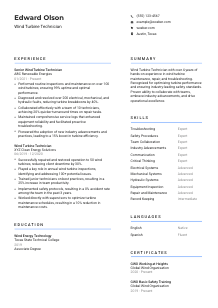
Your summary should quickly establish the kind of turbine technician you are. In a few lines, show your experience level, your technical focus, and the operating results or safety standards you consistently support.
Start from the core of the role: maintaining turbines, diagnosing faults, repairing systems, and following strict safety procedures. This keeps the summary grounded in the work itself rather than vague claims about being hardworking or motivated.
Lead with your title and years of experience, then identify your strongest technical areas. A line such as "Wind Turbine Technician with 4+ years of experience in maintenance, repair, and troubleshooting" tells the reader immediately where you fit.
Choose strengths that map directly to the posting, such as electrical and mechanical troubleshooting, preventive maintenance, safety compliance, service documentation, or team-based repair execution. The example summary works because it ties hands-on turbine work to performance optimisation and safety standards.
Aim for three to five lines. A concise summary with the right technical language, scope, and results is far more effective than a long paragraph that repeats generic qualities already implied elsewhere on the CV.
Your summary should make it easy to place you in a wind maintenance team from the first few lines. When it clearly states your experience, technical range, and safety focus, the rest of the CV lands with more force.
A tailored Wind Turbine Technician CV should show maintenance scope, troubleshooting depth, safety credentials, and the results of your work on uptime, reliability, or repair speed. When those details are easy to find, hiring teams can quickly connect your background to the demands of turbine service.
Use Wozber's AI CV builder to tighten that alignment, strengthen ATS optimisation, and present your experience in an ATS-friendly CV format that stays readable for both systems and field hiring managers. The final CV should make one thing clear: you are ready to maintain, repair, and support wind turbines safely and effectively.




