




Use Wozber and land your dream job
Create CV
No registration required
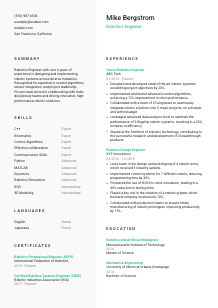
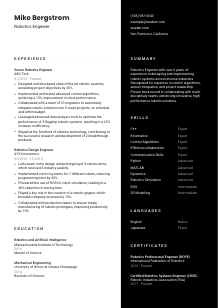
Blending steel and circuits, but your CV feels stuck in neutral? Check out this Robotics Engineer CV example, created with Wozber free CV builder. Learn how to program your robotic feats to match job blueprints smoothly, taking your career trajectory from algorithms to automation!
Robotics work gets reviewed through a practical lens. Hiring teams want to see whether you can move a system from concept to dependable behaviour by combining mechanical design, software, controls, sensing, and test data. A robotics CV needs to make that engineering chain visible, not just list tools or research interests.
When the CV mirrors the language of the role, it becomes easier to separate hands-on robotics engineers from adjacent profiles in software, mechanical, or research work. Wozber's free CV builder helps you shape that experience into an ATS-compliant CV that clearly surfaces the mix of control algorithms, sensor integration, simulation, and cross-functional delivery the role actually calls for.
For a Robotics Engineer, the header should remove friction fast. This role often involves cross-functional collaboration, technical reviews, and project handoffs, so the contact section should be clean, professional, and easy to act on from the first glance.
Make your name the clearest text on the page so the CV feels easy to navigate in both human review and digital systems. Use a professional font and enough spacing to keep the top of the document clean and technical, much like the rest of your engineering documentation should feel.
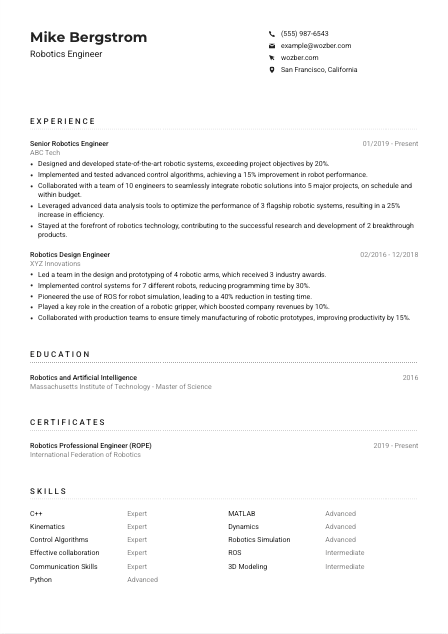
Place "Robotics Engineer" directly below your name if that is the role you are pursuing. It immediately frames your background around robot design, controls, simulation, and system integration instead of leaving the reader to infer whether you are coming from mechanical engineering, embedded systems, or software alone.
List a current phone number and a professional email address, ideally in a simple format such as firstname.lastname@email.com. Robotics hiring often moves through technical screens, panel interviews, and stakeholder rounds, so your contact information should be easy to scan and impossible to second-guess.
If the employer specifies a location requirement, reflect it clearly in your header. In this example, listing San Francisco, California addresses a stated requirement and removes relocation uncertainty early. For other applications, use location only when it helps meet the posting's expectations.
A LinkedIn profile, portfolio site, GitHub, or project page can strengthen your application if it shows real robotics work such as prototypes, simulation projects, ROS-based systems, publications, or hardware-software integration work. Keep it current and consistent with the achievements on your CV so the technical story matches across platforms.
This section is brief, but it still does important work. Clear contact details, the right title, and any required location information help the reader move quickly to the engineering substance of your CV without basic questions getting in the way.




The experience section carries the most weight for robotics roles because it shows whether you can translate theory into working systems. Hiring teams look for evidence of design work, control implementation, testing, performance improvement, and collaboration across hardware and software boundaries.
Read the posting for the technical threads that matter most, then make sure your bullets speak to them directly. For this role, that includes robotic system design, control algorithms, sensor integration, simulation tools, performance analysis, and multidisciplinary collaboration. Those themes should appear in the work you choose to highlight, using the same terminology when it truthfully matches your background.
List positions in reverse chronological order with job title, employer, and dates. For robotics careers, this helps the reader track how your scope has grown, whether from prototype design to full-system implementation, or from individual contributor work into leading integration efforts across engineering teams.
Each bullet should show what you built or improved, what engineering work you performed, and what changed because of it. Strong robotics bullets often mention control tuning, actuator or sensor integration, simulation, testing, path planning, efficiency gains, reduced cycle time, or improved performance. The sample CV does this well by tying design and development work to outcomes such as a 15% performance improvement and a 25% efficiency increase.
Quantify results with measures that make sense in engineering environments. That can include improvement in robot performance, testing time reduction, throughput, prototype count, project delivery, defect reduction, accuracy, efficiency, or revenue impact when a product shipped successfully. Numbers work best when they describe a system-level result, like the sample bullet showing ROS-based simulation reducing testing time by 40%.
Prioritise work that strengthens your case for robot design, implementation, controls, simulation, mechatronics, data analysis, or technical collaboration. Side projects and unrelated achievements only belong if they show relevant engineering depth. A hiring manager should come away understanding your robotics scope, not sorting through material that points to a different discipline.
A robotics experience section should read like a record of systems delivered and improved. When your bullets connect technical decisions to measurable performance, the reader can quickly see where you have worked, what kind of robots or subsystems you handled, and how much responsibility you can take on next.
Robotics hiring still pays close attention to education because the field draws heavily on mechanics, controls, software, and applied math. Your degree section should confirm that you have the academic grounding for work in kinematics, dynamics, modeling, and system design, especially if the posting names specific degree requirements.
Start by checking the education line in the posting and placing your most relevant qualification first. Here, a bachelor's degree in Robotics, Mechanical Engineering, or a related field is required, while an advanced degree is preferred. If you hold a master's in robotics or a closely aligned specialization, put it first because it immediately reinforces depth in the field.
List each degree with the degree name, field of study, institution, and graduation year. Keep it simple and consistent. In technical hiring, recruiters and engineering leaders often scan this section quickly to confirm foundational qualifications before focusing on project and experience depth.
If your field of study directly supports robotics, name it clearly rather than relying on a broad department label. "Robotics and Artificial Intelligence" communicates more value for this kind of role than a vague graduate title because it points toward autonomous systems, control, perception, and intelligent behaviour. The example CV uses this well.
Early-career candidates can benefit from listing selected coursework or academic projects tied to robot mechanics, control systems, mechatronics, embedded programming, computer vision, or simulation. Once you have several years of professional experience, coursework becomes optional unless it adds something your work history does not already show.
Research work, lab leadership, robotics competitions, published papers, or honors can strengthen this section when they connect to the role you want. They matter most when they show applied technical rigor, such as building prototypes, validating models, or contributing to robotics R&D, rather than general campus involvement.
Your education section should confirm that your practical engineering work rests on solid technical training. When the degree, field, and any relevant academic highlights line up with the role, the reader can connect your classroom foundation to the systems you have built in industry.
Certifications are not mandatory for every Robotics Engineer role, but they can help when they validate a specialty, show continued technical development, or support a transition into more advanced system work. In a fast-moving field, recent and relevant credentials can add useful context around your expertise.
Check whether the posting asks for certifications directly. If it does not, list only credentials that strengthen your case for the work at hand, such as robotics systems, controls, automation, safety, or specialised software environments. Random certificates add noise if they do not connect to the engineering responsibilities in the role.
Prioritise certifications that align with robot design, implementation, integration, testing, or advanced technical practice. In the example, credentials like "Robotics Professional Engineer" and "Certified Robotics Systems Engineer" reinforce a professional identity already supported by years of hands-on delivery, which is exactly how certifications should function.
Dates help the reader understand whether a certification is current and whether your learning is active. That matters in robotics, where software stacks, simulation methods, sensing approaches, and control techniques evolve quickly. If a credential expires or requires renewal, make that status clear.
Use this section to demonstrate that you keep pace with the field beyond day-to-day project work. Ongoing learning in areas such as ROS ecosystems, machine vision, motion planning, embedded control, or safety standards can strengthen your profile, especially for R&D-heavy teams or roles that sit close to advanced product development.
Certifications should strengthen the technical case your experience already makes. When they are current, relevant, and connected to robotics practice, they add credibility without distracting from the systems work that matters most.
A robotics skills section should read like a concise map of how you work. Hiring teams want to see the technical tools and concepts you can apply, but they also need enough context to understand whether your background fits control-heavy work, software-heavy robotics, hardware integration, or broader system development.
Start with the skills the employer explicitly names, then add closely related abilities you genuinely use. In this case, C++, Python, robotic simulation tools, kinematics, dynamics, control algorithms, collaboration, and communication all belong near the top because they map directly to the responsibilities described.
Robotics engineers rarely work in isolation. Pair hard skills such as ROS, MATLAB, simulation, controls, or sensor integration with soft skills that matter in practice, including cross-functional collaboration, technical communication, and working with mechanical, electrical, and software teams. The sample skill list shows this balance by combining engineering topics with collaboration strengths.
Do not turn this section into an inventory of everything you have touched. Prioritise the tools, programming languages, engineering concepts, and workflow capabilities that support the target role. A shorter list with strong alignment to robotics design and implementation will usually do more work than a long list full of marginal technologies.
This section should confirm the technical vocabulary already present in your experience. When the skills line up with the posting and reflect real depth in robotics work, they help the reader quickly place your background in the right engineering lane.
Language skills matter in robotics when the role involves technical collaboration, documentation, customer-facing demos, or work across distributed teams. This section is usually brief, but it should still reflect the communication requirements stated in the posting.
If the job asks for a specific language, list it first with an honest proficiency level. Here, proficient English speaking skills are required, so English should appear prominently. For most engineering roles, that signals readiness for design reviews, daily collaboration, and written technical communication.
Additional languages can help if the company works with international suppliers, research groups, manufacturing partners, or global engineering teams. The example CV includes Japanese, which may be useful in some robotics environments, though it is an advantage rather than a universal requirement.
Stick to standard levels such as Native, Fluent, Advanced, Intermediate, or Basic. Clear labels set realistic expectations and help recruiters understand how you might contribute in meetings, documentation, or cross-border project work.
Only list languages you can use with confidence in a professional setting. Overstating fluency becomes obvious quickly in interviews, especially when communication is critical to coordinating testing, integration, and issue resolution across teams.
For most Robotics Engineer applications, language skills support the profile rather than define it. Include them when they add useful context, but let the technical sections carry the main case for your candidacy.
When listed clearly, language skills add practical context to your profile. They should reinforce your ability to collaborate, explain technical work, and operate smoothly in the environments the role actually involves.
The summary sits at the top of the CV, so it should frame your robotics background quickly and accurately. In a few lines, show your level of experience, the kind of systems work you do, and the technical strengths most relevant to the target position.
Before writing, identify the few requirements that define the opening. For this job, that includes robotics design and implementation, control algorithms, simulation tools, programming in C++ and Python, data-driven performance improvement, and collaboration across disciplines. Your summary should reflect that mix rather than trying to cover every detail of your background.
Lead with your title and years of experience, then anchor that experience in the kind of robotics work you do. A line like the example's "Robotics Engineer with over 6 years of experience" works because it immediately establishes level, while the rest of the sentence can clarify system design, controls, or integration focus.
Choose strengths that connect directly to the employer's needs. For a robotics role, that might be control algorithm development, sensor integration, simulation, performance optimisation, or cross-functional project delivery. Keep the wording specific enough that the reader can already anticipate what they will find in your experience section.
Aim for 3 to 5 sentences with no filler. The summary is not the place for broad statements about passion or future ambitions unless they are backed by work that matters to the role. Focus on technical scope, years of experience, and one or two credible outcomes or strengths that make the rest of the CV easier to read.
A strong summary gives the reader a fast, accurate view of your robotics profile before they reach the details. When it names the right scope, tools, and strengths, it prepares the rest of the CV to land with much more clarity.
A Robotics Engineer CV should make one thing clear quickly: you can design, build, test, and improve robotic systems in a real engineering environment. When your sections line up around controls, programming, simulation, integration, and measurable system outcomes, the hiring team gets a much sharper picture of your value.
Use Wozber's free CV builder to shape that content into an ATS-friendly CV template, refine the language with ATS optimisation in mind, and present your experience in a clean format that supports both technical review and applicant tracking systems. The finished CV should make your readiness for robotics design and implementation easy to judge.




