



Use Wozber and land your dream job
Create CV
No registration required
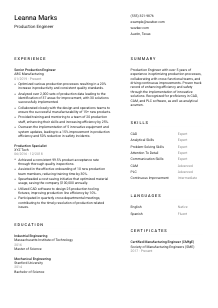
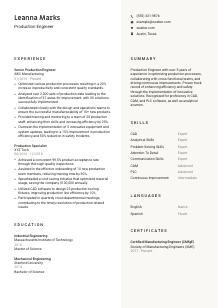
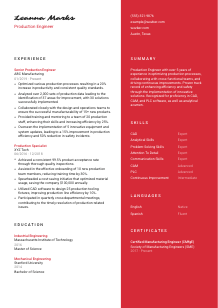
Spearheading manufacturing lines, but your CV feels like it's stuck in the production queue? Build your career narrative with this Production Engineer CV example, created with Wozber free CV builder. Learn how to align your operational acumen with job expectations, pushing your career trajectory on the fast track to success!
Production engineering work gets judged in the language of throughput, quality, safety, and manufacturability. Hiring teams want to see whether you improve line performance, solve recurring production issues, and work effectively with operators, design engineers, and operations leaders when new products or process changes hit the floor. Your CV should make that operating impact visible quickly.
When that story is tailored well, the reader can tell whether your background matches the plant's actual needs instead of lumping you in with broader manufacturing or process engineering profiles. Wozber's free CV builder helps shape that message into an ATS-friendly CV format, so production metrics, software skills, and cross-functional work come through clearly enough for both the ATS and the hiring team to recognize where you can improve output and process stability.
This section is simple, but in manufacturing hiring it still carries practical weight. A Production Engineer CV should present contact and location details cleanly, with no noise, so the employer can move straight to your production background, software knowledge, and plant experience.
Use your full name as the most visible text on the page. Keep it easy to scan and professional. In engineering hiring, clean presentation matters because it sets the tone for how the rest of the CV will read.
Place "Production Engineer" directly under your name when that is the role you are pursuing. This helps recruiters and ATS filters categorize you correctly, especially when your past titles include variations such as Production Specialist, Manufacturing Engineer, or Process Engineer.
List a reliable phone number and a professional email address. Mistakes here create unnecessary friction, and plant hiring often moves quickly once a candidate looks viable on production metrics, software fit, and manufacturing experience.
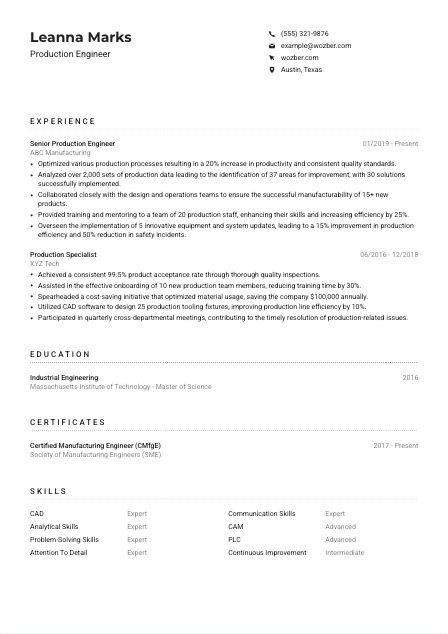
If a posting requires local availability or relocation, include your city and state. In the example job, listing "Austin, Texas" immediately supports a stated requirement and removes a common early screening question. Use this only when location is relevant to the opening you are targeting.
Include LinkedIn or a professional website if it supports your manufacturing background with added depth, such as process improvement projects, equipment implementation work, or engineering credentials. Make sure it matches your CV titles, dates, and achievements.
Do not include age, marital status, gender, or other non-job-related details. Keep the section focused on information that helps the employer contact you and confirm practical eligibility for the role.
Your personal details should remove friction, not add it. A clean header with the right title, dependable contact information, and any relevant location detail lets the hiring team move straight to the production results that matter most.




For a Production Engineer, experience is where your CV either gains traction or blends in. Hiring managers look for evidence that you improved output, supported manufacturability, solved process problems, introduced equipment or systems successfully, and worked with both technical teams and production staff in a real manufacturing environment.
Read the posting closely and pull out the operating priorities behind it. For this role, that includes process optimisation, production data analysis, manufacturability support, staff training, and equipment implementation. Use those themes to decide which achievements deserve space and which older or less relevant bullets can be cut.
List roles from most recent to oldest so the employer sees your current level of responsibility first. In production engineering, progression often shows up through broader line ownership, more complex process decisions, larger training responsibilities, or deeper involvement in capital equipment and new product introduction.
Each bullet should show a specific production problem, action, and result. Focus on improvements to efficiency, scrap, quality, safety, downtime, throughput, or training effectiveness. The sample CV does this well by describing implemented solutions, manufacturability collaboration, and production staff mentoring instead of listing routine duties alone.
Numbers are especially persuasive here because production work is measured constantly. Include gains in productivity, acceptance rate, yield, cycle time, defect reduction, safety incidents, cost savings, number of lines or products supported, or volume of data analysed. Metrics such as a 20% productivity increase, 99.5% product acceptance rate, or $100,000 in annual material savings make the scope of your contribution easier to understand.
Prioritise achievements that reflect the posting's actual engineering needs. If the employer wants someone who can use CAD, CAM, or PLC tools, improve manufacturability, and mentor production staff, make sure those themes appear in your strongest bullets. Move unrelated accomplishments lower or remove them if they do not support the case you are making.
Your experience section should show how you improve production performance in measurable ways. When the bullets connect process changes, technical tools, cross-functional work, and shop-floor results, the employer can picture you contributing in the plant from day one.
Production engineering roles usually ask for a technical degree because the work sits at the intersection of manufacturing systems, equipment, process design, and quality performance. Your education section should confirm that foundation quickly, then get out of the way so the reader can return to your plant experience and results.
Check the posting for the exact education language and make sure your degree is easy to spot. Here, the requirement is a bachelor's degree in Mechanical, Industrial, Manufacturing Engineering, or a related field, so a matching degree should appear plainly without extra wording.
Use a clean structure with school, degree, and field of study. Recruiters do not need a paragraph here. They need quick confirmation that your academic background supports work in production systems, process improvement, and manufacturing operations.
List degrees that connect directly to manufacturing and production work. The example CV helps by showing a Bachelor of Science in Mechanical Engineering and a Master of Science in Industrial Engineering, both of which align naturally with process optimisation and production analysis responsibilities.
If you are early in your career, relevant coursework, capstone projects, or lab work can help fill out your CV, especially if they involve manufacturing systems, tooling, automation, quality engineering, or process design. If you already have several years in production environments, that space is usually better spent on professional accomplishments.
Honors, engineering societies, or standout research can help when they reinforce your technical credibility, especially for newer candidates. Keep them if they add something concrete to your profile. Remove them if they distract from stronger manufacturing experience.
Education should confirm that you have the technical base for production engineering work. Once that foundation is clear, the rest of the CV should carry the heavier proof through manufacturing results, tools, and process improvements.
Certifications are rarely the first thing that wins a Production Engineer role, but they can strengthen your profile when they reflect manufacturing standards, continuous improvement methods, quality systems, or specialised engineering knowledge. Use this section to add relevant professional depth, not filler.
Some production engineering jobs do not require certifications at all, while others value them as proof of manufacturing discipline or continued development. Review the posting carefully, then decide whether certifications will support your case or simply take up space.
Prioritise credentials tied to manufacturing engineering, quality, automation, safety, or process improvement. A certification should connect naturally to the work you are expected to do, whether that is improving throughput, introducing equipment, or controlling process quality.
List the year earned and, if relevant, the active period. That helps the employer understand whether the credential is current and whether you have maintained it over time.
Manufacturing environments change with new equipment, automation tools, quality standards, and safety requirements. Updated credentials can show that your knowledge keeps pace with the floor, especially if you work with process control, lean methods, or advanced manufacturing systems.
A well-chosen certification adds weight when it supports the production story your CV is already telling. Keep the section relevant, current, and tied to the kind of manufacturing problems you solve.
The skills section should read like a practical snapshot of how you operate in a manufacturing setting. Employers want to see the technical tools, analytical strengths, and collaboration skills that support process optimisation, equipment changes, data review, and day-to-day problem solving on the production floor.
Start with the exact capabilities the posting names, then add closely related skills you genuinely use. For this role, CAD, CAM, PLC, analytical thinking, problem solving, attention to detail, and communication are all explicitly relevant, so they belong near the top if they match your background.
Include the tools and abilities you can support in your experience section. Production engineering CVs are stronger when software, process, and people-facing skills line up with actual accomplishments such as tooling design, process analysis, operator training, or equipment implementation.
Lead with the capabilities that matter most for the role you want. In many production engineering jobs, technical systems and manufacturing methods should appear before broad workplace traits. The sample CV does this effectively by leading with CAD and core analytical strengths, then supporting them with CAM, PLC, and continuous improvement.
A useful skills section feels consistent with the rest of the CV. When your listed tools and strengths match your production achievements, the employer sees a candidate who can move from analysis to implementation on the floor.
Language ability matters when production engineers need to explain process changes, train operators, document issues clearly, or work across multilingual teams and suppliers. Include languages when they are required in the posting or when they add clear value to your manufacturing environment.
Start with any language requirement stated directly in the job description. In this case, English mastery is required, so that should appear first and at an accurate proficiency level.
List the language the job needs most before any additional ones. This helps the recruiter confirm a basic qualification quickly, especially when the role involves process documentation, training materials, safety communication, or collaboration across departments.
Additional languages can be useful when you work with diverse plant teams, global suppliers, or multi-site manufacturing operations. They are not mandatory unless the posting says so, but they can strengthen your profile when they have practical workplace value.
Stick with standard terms such as Native, Fluent, Intermediate, or Basic. Clear labels help the employer understand whether you can handle technical documentation, real-time problem solving, or only casual conversation.
Only emphasize languages if they would matter in the work itself. For a Production Engineer, that usually means operator communication, supplier coordination, training, or documentation across teams. If the language has no likely application, keep the section concise.
Language ability belongs on the CV when it supports production communication in a real way. Keep the section factual and relevant to the environment where you will be solving problems and supporting operations.
Your summary should tell the reader, in a few lines, what kind of Production Engineer you are and what results tend to follow your work. Focus on manufacturing experience, process improvement impact, technical tools, and the scale or type of production contribution you bring.
Review the posting and identify the two or three themes that define the role. Here, those include optimising production processes, analysing production data, supporting manufacturability, and working across teams. Build your summary around those priorities instead of trying to cover every detail in your CV.
Start with your title and years of relevant experience. That gives immediate context and helps the hiring manager place you quickly, especially when comparing candidates from adjacent backgrounds in manufacturing, quality, or process engineering.
Choose accomplishments that represent the kind of production value you consistently deliver. The sample summary works because it combines process optimisation, cross-functional collaboration, and efficiency and safety improvements without drifting into generic traits. Keep yours grounded in outcomes, systems, or environments you actually know.
Aim for three to four lines with no wasted wording. Avoid broad claims like "results-driven" unless you immediately support them with real manufacturing context. A clean, specific summary is easier to read in an ATS-compliant CV and gives the hiring team a sharper first picture of your production background.
A strong summary helps the employer understand your production background before they reach the detail below. When it names your experience level, technical focus, and typical manufacturing impact, the rest of the CV lands more clearly.
With each section aligned to the actual production environment, your CV should now present a clear case for how you improve output, quality, safety, and manufacturability. Wozber's free CV builder can help you organise that experience into an ATS-compliant CV that keeps technical skills, metrics, and plant-side achievements easy to scan.
Use an ATS-friendly CV template, review your wording with the ATS CV scanner, and tighten any sections that do not directly support the role. The finished CV should make it easy to judge your manufacturing experience, your command of tools like CAD, CAM, or PLC where relevant, and your ability to turn production data into practical operational gains.