



Use Wozber and land your dream job
Create CV
No registration required
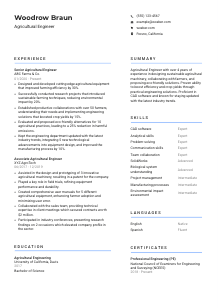
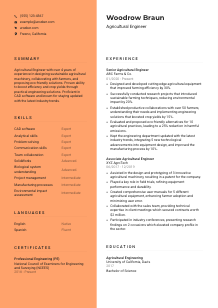
Designing efficient farmland, but your CV seems overgrown? Cultivate ideas from this Agricultural Engineer CV example, created with Wozber free CV builder. Learn how to align your farming innovations with job requirements, and watch your career harvest bountiful opportunities!
Agricultural engineering work gets judged in the field as much as on paper. Hiring teams want to see whether you can turn engineering principles into machinery, structures, and production improvements that actually hold up under farm conditions, regulatory limits, and sustainability goals. Your CV should make that applied side of the work easy to see, from design decisions and field research to farmer collaboration and measurable operating gains.
A tailored CV changes how quickly your background reads against the role. For agricultural engineering, that often means showing the link between CAD-based design, on-site problem solving, and outcomes such as efficiency, yield improvement, durability, or reduced environmental impact. Wozber's free CV builder helps you shape that story into an ATS-compliant CV, so the technical language, project scope, and compliance-minded work behind your experience come through clearly.
Agricultural engineering CVs usually open best with clean, practical details. This section should confirm who you are, how to reach you, and whether any stated hiring requirement, such as location, is already covered before a recruiter gets into your project history.
Use your full name in a larger, easy-to-read format at the top of the page. For engineering roles, that header should feel professional and direct, much like the rest of your CV. Skip nicknames or decorative formatting that distracts from the technical substance you want hiring teams to focus on.
Place "Agricultural Engineer" directly under your name when that is the role you are pursuing. This helps frame the rest of the CV around agricultural systems, machinery design, field testing, and environmental problem solving instead of leaving room for your background to be read as general mechanical or civil engineering.
Include a current phone number and a professional email address that you check regularly. Accuracy matters here. If your work involves coordination with farmers, vendors, project teams, or regulatory contacts, your CV should reflect the same attention to detail in the basics.
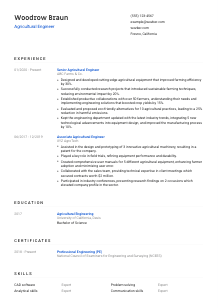
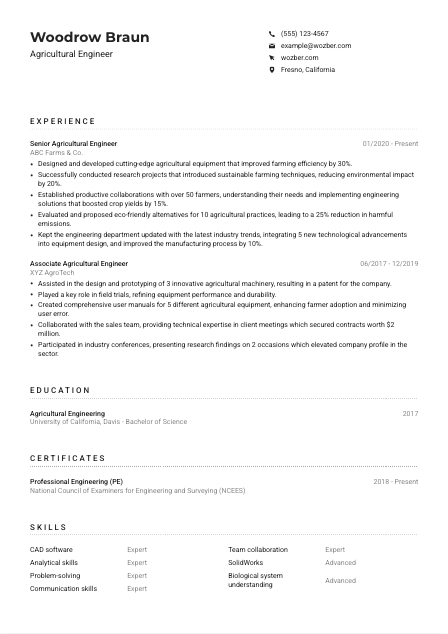
If a posting specifies a city or relocation expectation, reflect that in this section. In the example, listing Fresno, California directly supports the employer's location requirement and removes an avoidable question early in the review. If you are relocating, say so plainly rather than leaving the employer to guess.
Include a website or professional profile only if it supports your application. For agricultural engineers, that could mean a portfolio with equipment design work, CAD-driven projects, research presentations, patents, or field implementation results. A general social profile adds little unless it strengthens your technical credibility.
This section does not need personality-driven filler. It should quickly confirm that you are reachable, professionally presented, and already aligned with any practical requirement the employer has flagged.




Experience is where agricultural engineering CVs separate concept knowledge from applied results. Employers are looking for work that improved farm operations, solved production problems, supported sustainability targets, or translated technical design into equipment and systems people could actually use.
Before rewriting your bullets, identify what the role leans on most. In this case, the employer emphasizes agricultural design, machinery, research, stakeholder collaboration, environmental impact, and regulatory awareness. Those priorities should shape which projects you feature and what language you use in your accomplishment statements.
List positions in reverse chronological order and give more space to roles tied to agricultural machinery, irrigation systems, biological systems, farm structures, field trials, or process improvement. The example does this well by leading with engineering work tied to equipment design, sustainable techniques, and farmer collaboration rather than unrelated tasks.
Use metrics that make sense for agricultural engineering. Efficiency gains, reduced emissions, yield improvements, patent outcomes, trial performance, durability improvements, cost savings, or adoption rates all tell hiring teams how your engineering changed real operations. The sample bullets work because they connect design and research work to results like a 30% efficiency improvement and a 20% reduction in environmental impact.
Prioritise accomplishments that match the target role's technical scope. If you have broad engineering experience, lead with work involving machinery development, prototyping, sustainability, field evaluation, farmer needs, or compliance-related design choices. Support work outside those areas can stay, but it should not crowd out the projects that best match agricultural engineering hiring criteria.
Mirror terms from the posting where they honestly describe your work. Phrases like "design and develop agricultural machinery," "conduct research," "evaluate environmental impact," or "provide practical engineering solutions" help with ATS optimisation and also make your experience read as directly relevant. The key is to tie that language to specific projects and outcomes, not to repeat the job ad word for word.
By the end of this section, a hiring manager should be able to picture the kinds of agricultural problems you have solved, the tools and methods you used, and the operational results your work delivered.
For agricultural engineering roles, education is usually a baseline qualification rather than a differentiator by itself. What matters is presenting the degree clearly and, when useful, adding academic details that support your machinery, systems, environmental, or research background.
If you hold a degree in Agricultural Engineering, Biological Systems Engineering, or a closely related field, state it clearly. In the example, a Bachelor of Science in Agricultural Engineering directly matches the requirement and immediately confirms the candidate meets the academic baseline.
List the degree, field of study, school, and graduation year in a clean format. Engineering recruiters usually want this information quickly so they can move on to your project and work history. Over-formatting does not add value here.
If your degree title is adjacent rather than exact, clarify its relevance through the field name or supporting details. For example, a Biological Systems Engineering degree can still align well when your coursework or project history supports machinery design, agricultural systems, water management, or environmental analysis.
Early-career candidates can benefit from including senior design projects, prototyping work, soil and water systems coursework, precision agriculture research, or machinery-focused capstones. This is especially useful when academic work fills experience gaps or shows technical depth in an area the employer values.
Honors, scholarships, research distinctions, or competition results can help when they point to technical rigor or field-specific initiative. Keep them if they reinforce the kind of engineering discipline the role requires. Leave them out if they distract from stronger professional experience.
This section should quickly confirm that you have the right engineering foundation. If you are earlier in your career, use it to reinforce relevant technical training without turning it into a transcript.
Certifications matter most when they support legal sign-off authority, technical credibility, or current industry practice. In agricultural engineering, that often means highlighting a PE license when requested or when the role involves regulated design, compliance, or client-facing engineering responsibility.
When a posting mentions a Professional Engineering credential, list it prominently. In the example, the PE certification directly addresses a stated preference and strengthens the candidate's standing for design and engineering decision-making work.
Include certifications that relate to engineering practice, equipment design, environmental assessment, safety, or specialised agricultural systems. A shorter list of relevant credentials is stronger than a crowded section filled with certificates that do not change how your candidacy is read.
Add issue dates, active status, or renewal periods when they help show that a credential is current. This is especially useful for licenses and certifications tied to professional practice or regulatory expectations.
Agricultural engineering evolves with automation, sustainability targets, emissions standards, water-use constraints, and new equipment technologies. Updated certifications or continuing education can show that your knowledge keeps pace with changes in field operations and engineering standards.
Use this section to show more than course completion. The right credentials tell employers that you can operate with current standards, technical judgment, and, where relevant, licensed authority.
A skills section for an agricultural engineer should read like a working toolkit, not a generic list. Employers want to see the technical tools, engineering strengths, and field-facing abilities that support design, analysis, testing, collaboration, and sustainable problem solving.
Start with the skills the employer has already emphasized. Here, that includes CAD software, analytical ability, problem-solving, communication, and engineering-related design work. Those terms belong in your skills section when they reflect your actual background, because they match both ATS screening and human review.
Do not stop at category labels. If you list CAD software, specify tools such as SolidWorks or other platforms you actually use. If environmental assessment or manufacturing process knowledge is part of your work, include it. The example is effective because it combines broad engineering strengths with concrete capabilities like SolidWorks and environmental impact assessment.
Order your skills based on relevance to the target position. For agricultural engineering roles, that usually means design software, prototyping, systems analysis, field research, machinery development, sustainability-related evaluation, and stakeholder communication before more general business skills. Keep the section concise enough that the most important capabilities stand out immediately.
A hiring team should be able to glance at this section and understand the technical environment you can step into, the engineering problems you can tackle, and the people you can work with effectively.
Language ability is not always a major deciding factor in engineering hiring, but it can matter in agricultural settings where field coordination, training, supplier communication, and farmer relationships are part of the job. Present languages clearly, with emphasis on any requirement named in the posting.
If the job calls for English fluency or professional competency, put English first and label your level honestly. Since the posting makes English mandatory, this should be easy for the reviewer to find.
Extra languages can add practical value, especially in agricultural regions with multilingual growers, crews, vendors, or community stakeholders. In the example, Spanish is a useful addition because it may support clearer communication in day-to-day field or client interactions, though that will depend on the employer and region.
Stick with standard descriptions such as Native, Fluent, Advanced, Intermediate, or Basic. That keeps expectations realistic and helps employers quickly gauge whether your language ability would be useful in meetings, documentation, training, or on-site communication.
Only include a language if you can describe your level accurately. Basic knowledge can still be worth listing when it helps with relationship-building or field exposure, but exaggerating proficiency can create problems in interviews or on the job.
For agricultural engineers, languages matter when they improve communication around equipment use, project implementation, safety instructions, grower feedback, or cross-functional coordination. Frame them as a real working asset, not as a filler section.
Keep this section brief and truthful. When languages matter in the target environment, they can strengthen your profile by showing smoother communication across field, technical, and stakeholder settings.
The summary is your fastest chance to frame the kind of agricultural engineer you are. It should combine experience level, technical focus, and a few high-value outcomes so the reader understands your profile before getting into the detailed bullet points.
Read the posting and identify the engineering challenges behind it. Here, the employer needs someone who can design machinery, improve farming techniques, work with stakeholders, and address environmental impact. Build your summary around those capabilities rather than around generic traits.
Lead with your title, years of experience, and strongest technical focus. A line like the example's emphasis on sustainable agricultural machinery and practical engineering solutions works because it quickly places the candidate in the right part of the field.
Use phrases from the job description where they match your actual work, but attach them to concrete strengths such as CAD proficiency, field collaboration, process improvement, or environmental evaluation. This keeps the summary aligned without sounding copied.
Aim for three to five lines that cover your experience level, technical strengths, and a result or two that reflects your value. Efficiency gains, sustainability improvements, stronger crop performance, successful field implementation, or machinery innovation are all more persuasive than broad claims about passion or dedication.
When this section is working, the reader already understands your engineering focus, your likely contribution, and why your background matches the role before they reach the first job entry.
An agricultural engineer CV should show applied design ability, practical problem solving, and measurable results in farming environments. If your sections now point clearly to machinery development, research-backed improvements, stakeholder collaboration, and sustainability-minded engineering, you are presenting the right picture.
Use Wozber's AI CV builder, ATS CV scanner, and ATS-friendly CV templates to sharpen the wording, align your experience with the posting, and present it in an ATS-friendly CV format. The finished CV should make it easy to judge one thing quickly: whether you can engineer solutions that work in the field.