



Use Wozber and land your dream job
Create CV
No registration required
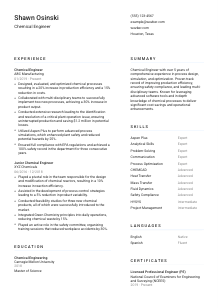
Mixing compounds, but your CV seems volatile? Balance it out with this Chemical Engineer CV example, created with Wozber free CV builder. Learn how to effectively match your chemical wizardry to job specifics, concocting a career formula as powerful as your reactions!
Chemical engineering CVs are strongest when they show how you turn process theory into operating results. Hiring teams want to see what you improved in a plant, pilot, or production environment, whether that meant increasing throughput, reducing waste, troubleshooting process upsets, strengthening safety performance, or using simulation to support better design decisions.
A tailored CV changes how quickly your background reads against the role. When process design, simulation tools, and optimisation work are easy to find, an ATS-compliant CV gives recruiters and engineering managers a faster view of whether you can contribute to process efficiency and safe implementation. Wozber's free CV builder helps organise that alignment cleanly, so your CV makes your technical scope clear from the first scan.
For chemical engineering roles, the header should remove friction immediately. Recruiters need to know who you are, how to reach you, and whether any logistical requirement in the posting is already covered. Keep this section clean, professional, and aligned with the role you are targeting.
Use your full name in a slightly larger font than the rest of the CV. Avoid credentials or extra wording in the same line unless they are essential in your market. For engineering hiring, clarity matters more than style flourishes.
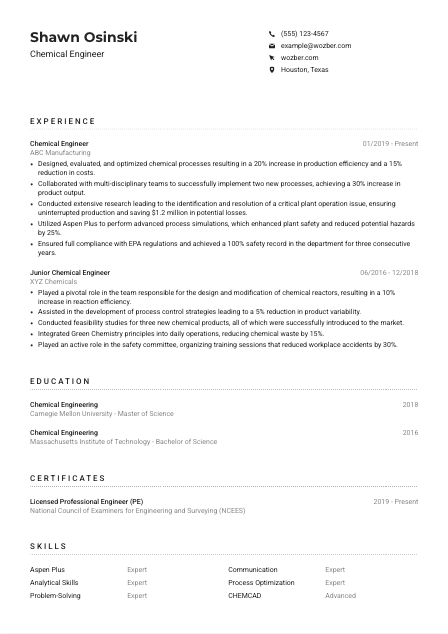
If you are applying for a Chemical Engineer position, say "Chemical Engineer" under your name. This helps recruiters place you quickly and reinforces alignment in ATS searches. If your current title is more specialised, such as Process Engineer, you can still use the target title when it accurately reflects your background.
Add a phone number you answer reliably and an email address that looks professional. A simple format such as firstname.lastname@email.com works well. Skip personal details that do not affect hiring decisions, and make sure every contact point supports a professional engineering profile.
Some chemical engineering jobs are site-based and care about plant access, relocation, or regional presence. In the example posting, Houston, Texas is stated directly, so listing Houston, Texas in the header helps remove a question early. If you are relocating, make that clear in a concise way rather than leaving employers to guess.
A LinkedIn profile, portfolio of technical projects, or professional association page can help if it is current and consistent with your CV. For engineers, this is most useful when it supports your process work, publications, project history, software background, or licensing information.
Your contact section does not need flair. It needs accuracy, professionalism, and any location detail that helps a hiring team move straight to your engineering qualifications.




This is the section where chemical engineering CVs either become credible or stay generic. Employers are looking for applied work: process design, simulation, optimisation, troubleshooting, implementation support, and measurable plant or production outcomes. Your bullets should show what systems you worked on, what you changed, and what improved because of it.
Go beyond the job title and identify the work themes being hired for. Here, the signals are process design, simulation, optimisation, technical support, and regulatory compliance. Those priorities should shape which projects, units, and accomplishments you pull forward from your background.
List your most recent position first, then work backward. Include job title, company, and dates for each role. For chemical engineering CVs, this structure also helps show progression from support work or junior process assignments into larger design, optimisation, or plant-facing responsibilities.
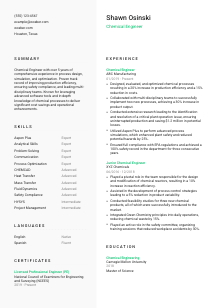
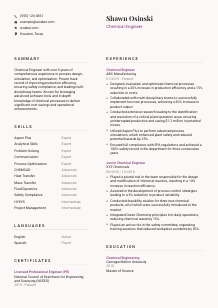
Replace broad statements like "responsible for process improvements" with specifics about the process, tool, or outcome. The sample CV does this well with bullets on Aspen Plus simulations, plant troubleshooting, and new process implementation. That kind of wording tells a hiring manager what you actually handled.
Use numbers where they reflect real engineering performance: efficiency gains, cost reduction, output increase, waste reduction, hazard reduction, downtime avoided, or product variability improved. A bullet such as "increased production efficiency by 20% and reduced costs by 15%" is much stronger than saying you optimised operations.
Prioritise experience involving unit operations, reactor design, simulation, scale-up, process control support, safety review, or cross-functional implementation. If you have unrelated work from earlier in your career, keep it brief or remove it. The space is better used to show the process knowledge and plant judgment the role requires.
The best experience sections connect engineering decisions to operating results. When your bullets show process context, technical tools, and measurable outcomes, employers can picture you contributing on day one.
Chemical engineering hiring usually starts with the academic foundation because the work depends on core technical training. Your education section should confirm that foundation quickly, then add any advanced study, research, or academic work that strengthens your relevance for the position.
If the posting asks for a bachelor's degree in Chemical Engineering or a related field, make that easy to see. List the degree, field, school, and graduation year in a straightforward format. When your degree matches directly, it checks an important box early in the review.
Use the same format for each entry so the section is easy to scan. Chemical engineering CVs do not benefit from decorative presentation here. Hiring teams are looking for the credential, the discipline, and whether your academic path supports the technical work in the role.
If you hold both a bachelor's and a master's degree, include both, with the strongest or most recent presented clearly. In the sample, the bachelor's in Chemical Engineering satisfies the stated requirement, while the master's adds depth. That combination works well when your advanced study supports process, research, or design work.
Recent graduates or engineers with limited industry experience can use this section to show relevant academic depth. Include senior design projects, transport phenomena work, reactor design, process control, or simulation-based coursework if it helps bridge directly into the role.
Honors, scholarships, research assistantships, or technical competitions can be useful if they reinforce your engineering profile. Choose items that point toward analytical rigor, lab work, modeling, or process thinking rather than filling space with general campus activities.
This section should confirm that you have the engineering foundation for the role and, where relevant, show added depth in process analysis, research, or advanced study.
Certifications are not required for every chemical engineering job, but they can strengthen your profile when they reflect licensure, safety expertise, process methods, or continued technical development. List only the credentials that add real value to the work you are targeting.
Some roles require a PE license, safety certification, or industry-specific qualification. This posting does not require one, but that does not mean the section is irrelevant. If you hold a credential tied to engineering practice or regulated work, it can still improve your CV.
Choose certifications that support process engineering, plant operations, safety, compliance, or technical credibility. A Licensed Professional Engineer credential, for example, can strengthen your profile for design-heavy or responsibility-heavy roles, especially when cross-functional implementation and compliance are part of the job.
If the credential is active, renewed, or recently earned, include the date or validity range. That helps employers understand whether your qualification is current, which matters more than simply naming it.
Ongoing coursework, formal certifications, or specialised training in areas like process safety management, Six Sigma, or advanced simulation can show that you keep building your engineering toolkit. Only include items that support the kind of plant, process, or design work you want next.
A focused certification section can strengthen your CV when it points to real engineering responsibility, current knowledge, or added trust in regulated and safety-conscious environments.
Your skills section should read like the toolset of someone who can contribute in a process environment, not like a generic list pulled from several job ads. Balance software, core engineering knowledge, and selected workplace skills that matter in plant, design, or optimisation work.
Start with the capabilities the employer names directly. In this case, that includes process design, simulation, optimisation, Aspen Plus, CHEMCAD, HYSYS, heat transfer, mass transfer, fluid dynamics, analytical thinking, problem-solving, and communication. Use the terms that genuinely match your background so ATS screening works in your favor.
Put the most relevant technical skills near the top, especially software and process knowledge you have used in practice. The sample CV gets this right by foregrounding Aspen Plus, process optimisation, and core engineering subjects before less central skills. That ordering tells a clearer story about day-to-day capability.
A tidy skills section makes a difference when engineering managers are moving quickly. You might group simulation tools, process fundamentals, and professional skills, or rank them by proficiency if your format supports it. Keep the list focused on what you can defend in an interview and apply on the job.
When this section reflects your real engineering toolkit, it strengthens both ATS alignment and human review. Recruiters should be able to spot your simulation background, process knowledge, and problem-solving range in seconds.
Language ability matters in engineering when it affects reporting, teamwork, training, and plant communication. Even when English is the only stated requirement, list language skills carefully and honestly so employers understand how you communicate in technical settings.
If the posting states that clear English communication is required, make English visible in this section. That matters in roles involving technical documentation, cross-functional meetings, operating procedures, and troubleshooting discussions.
Additional languages can be useful in global manufacturing companies, multinational project teams, supplier communication, or diverse plant environments. Include them if they are real strengths, not just limited familiarity.
Use clear labels such as Native, Fluent, Advanced, or Intermediate. Overstating language ability creates risk quickly in engineering roles where safety instructions, incident reports, and technical discussions need precision.
Some chemical engineering positions are highly local, while others involve international plants, vendors, research teams, or documentation across regions. When extra languages are relevant, they can support your case as someone who can work across technical and cultural boundaries.
This section is not about sounding global for its own sake. It should show whether you can communicate clearly where the work happens, whether that is in design reviews, plant support, training sessions, or written technical updates.
Clear language information helps employers judge communication range quickly, especially when English proficiency is required and multilingual coordination could be useful on the job.
Your summary should quickly tell a hiring manager what kind of chemical engineer you are, how much relevant experience you have, and where your strongest value sits. This is the place to connect process knowledge, simulation capability, and operating results in a few tight lines.
Before writing, identify the two or three most important requirements in the posting. For this role, process design, simulation, optimisation, and plant support are central. Your summary should reflect that mix instead of trying to cover every detail from your career.
Start with a direct line that positions you properly, such as your title, years of experience, and core area of practice. The sample summary does this well by leading with more than 5 years of experience in process design, simulation, and optimisation, which immediately matches the role's focus.
Use the next sentence to connect your engineering work to outcomes such as efficiency gains, cost reduction, process safety, troubleshooting, or implementation success. Mention tools like Aspen Plus only when they are part of your actual strengths and relevant to the target role.
Aim for a short paragraph, not a biography. Three to four lines is usually enough to establish your profile. Every phrase should earn its place by clarifying your technical scope, plant impact, or process expertise.
A well-written summary gives hiring teams an immediate sense of your process background, simulation tools, and operational impact. It should set up the rest of the CV as the detailed proof.
When your CV is tailored well, it shows more than interest in chemical engineering. It shows where you have improved processes, how you have used simulation or technical analysis, and what kind of operating results you can deliver safely and consistently.
Use Wozber's free CV builder to organise that story in an ATS-friendly CV format, strengthen phrasing with role-specific terminology, and check alignment with an ATS CV scanner. The finished CV should make it easy to judge your readiness for process design, optimisation, plant support, and safe implementation work.