



Use Wozber and land your dream job
Create CV
No registration required
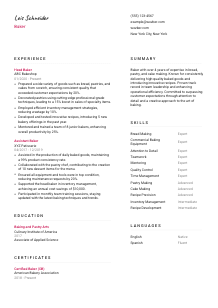
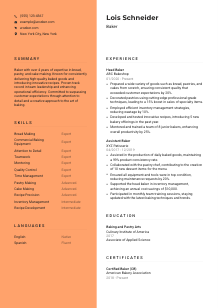
Kneading dough, but your CV doesn't rise to the occasion? Check out this Baker CV example, made with Wozber free CV builder. Learn how to layer your baking expertise with job requirements, so your career bakes to perfection, just like your pastries!
Baking work is judged in the product case long before anyone asks about creativity. Hiring teams want to see whether you can produce bread, pastry, and cake consistently, keep quality high through volume, and work cleanly and precisely with recipes, timing, and commercial equipment. Your CV needs to make that production discipline visible, not just your enthusiasm for baking.
A tailored CV helps separate general food-service experience from true bakery experience. When your wording reflects scratch production, decorating techniques, inventory control, and team coordination, an employer can quickly see whether you match the bench work behind the role. Wozber's free CV builder helps organise that language into an ATS-compliant CV, so the first read makes your baking range and day-to-day reliability easier to spot.
In bakery hiring, the personal details section does one practical job. It tells the employer who you are, what role you do, and whether basic application requirements are already covered before they move on to your production history.
Use your full name in a clear, readable format so it stands out immediately at the top of the page. In a hands-on trade like baking, your name should be easy to find when a hiring manager is reviewing several CVs for production, pastry, or early-morning shift coverage.
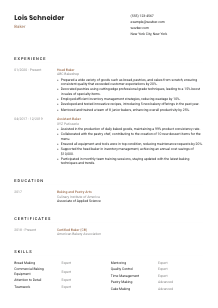
Place "Baker" beneath your name if that is the role you are targeting. This keeps your positioning clear from the start, especially when employers are sorting between bakers, pastry cooks, cake decorators, and broader back-of-house applicants.
List a working phone number and a professional email address. Avoid anything casual or outdated. Bakery hiring often moves quickly when a team needs someone who can step into prep, production, or service support, so make it easy for the employer to contact you without delay.
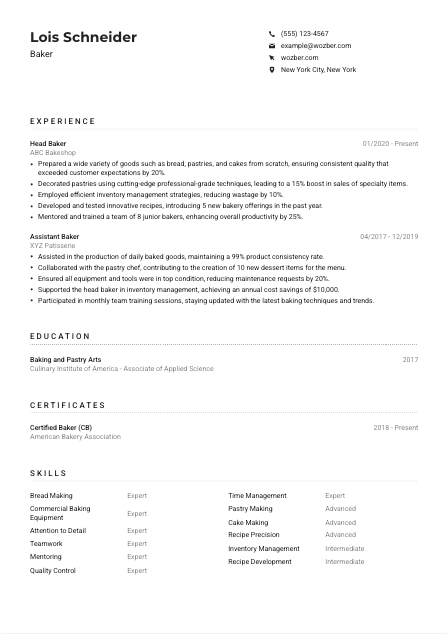
If a posting requires local availability, say so plainly in your city and state. Here, listing "New York City, New York" answers a stated requirement right away and removes uncertainty about commute or relocation before the employer reviews your experience.
A portfolio, website, or professional profile can help if it shows finished cakes, laminated pastries, specialty bread, or other work that supports your application. Only include it if the content is current and polished. For many baker roles, strong experience bullets will matter more than an extra link.
Handle this section with the same precision you bring to scaling ingredients. Clear contact details, a matching title, and any required location information remove friction and let the employer move straight to your baking credentials.




Experience carries the most weight on a baker CV because it shows what you have actually produced, under what standards, and with what results. Employers look for signs that you can handle scratch baking, maintain consistency, work with speed, and support the daily rhythm of a commercial kitchen or bakery.
Start by identifying the kinds of work the employer is hiring for, then mirror that language where it matches your background. In this opening, the priorities include bread, pastry, and cake production from scratch, decorating, inventory management, and collaboration on new offerings. Those are the duties your experience section should bring forward first.
List your jobs from most recent to oldest with the bakery, your title, and dates. That structure helps the reader follow your progression from supporting production to leading it. In the sample CV, the move from Assistant Baker to Head Baker makes growing responsibility easy to track.
Each bullet should show what you made, how you worked, and what changed because of your work. Good baker bullets mention scratch production, finishing techniques, recipe execution, seasonal or specialty items, waste reduction, or new menu development. The sample does this well by pairing tasks with outcomes, such as raising specialty-item sales through stronger pastry decoration.
Quantify results wherever you can. Useful bakery metrics include consistency rates, sales lift on featured items, waste reduction, cost savings on inventory, number of new products launched, team size trained, or productivity gains during prep and service. Figures like 20% higher customer satisfaction, 10% less waste, or five new offerings give substance to everyday kitchen work.
Cut or shorten experience that does not support your fit for the role. If you have mixed food-service experience, prioritise the parts tied to dough production, pastry assembly, cake finishing, equipment use, prep scheduling, or bakery team support. Hiring managers need to see your bench skills and production reliability before anything else.
Your experience section should read like a record of real bakery performance. When the bullets show product range, consistency, operational discipline, and measurable results, employers can picture you contributing on day one.
Formal education is not always the deciding factor in bakery hiring, but relevant training can strengthen your profile, especially when it connects directly to baking technique, pastry fundamentals, food production, or kitchen operations. Keep it clean and closely tied to the role you want.
List the education that best supports your baking background. If you studied baking and pastry arts, culinary arts, or a related field, place that first. In this example, an Associate of Applied Science in Baking and Pastry Arts reinforces the candidate's technical foundation, even though the posting centers more heavily on experience.
Include your degree, field of study, school, and graduation year or date. Simple formatting is enough. Hiring teams do not need a paragraph here. They need to understand quickly whether you have formal training that complements your production experience.
If your coursework aligns closely with the role, keep the wording specific. A baking-focused degree tells the reader you trained in areas such as dough handling, pastry methods, cake work, formula accuracy, and likely sanitation standards, which all connect naturally to commercial bakery expectations.
Include relevant classes, workshops, or specialised training if they strengthen your fit for the target role. This can be useful early in your career or when applying for a bakery that values a specific niche such as artisan bread, plated desserts, or cake decoration. Skip filler coursework that does not sharpen your case.
Honors, competition work, or leadership in a baking program can help if they point to technical ability, discipline, or initiative. Keep these details brief. Once you have several years of bakery experience, education should support the CV rather than compete with your production record.
Education works best here as supporting proof of your training. Keep it relevant, concise, and clearly connected to the kind of baking work you want to be hired to do.
Certifications are useful when they strengthen your professional standing, show continued development, or confirm recognized training in baking. They are rarely the main reason someone gets hired into a baker role, but they can reinforce technical commitment and industry seriousness.
List credentials that connect directly to baking, pastry, food safety, or related production standards. A certification such as Certified Baker can support your application because it aligns with hands-on skill development and professional practice, even when the posting does not require it outright.
For each certification, give the name, issuing organisation, and date earned or active period. Keep the format consistent. The value here is quick recognition, not elaborate explanation.
If a certification is active, renewed, or ongoing, make that visible. Up-to-date credentials suggest that your knowledge has stayed current, whether in technique, safety, or industry standards. That matters in kitchens where consistency and compliance are part of daily operations.
If you continue adding credentials, use them to show direction in your career. For example, extra training in artisan bread, advanced pastry finishing, or food safety can strengthen applications for bakeries with more specialised production standards. Keep the list purposeful rather than long for its own sake.
A well-chosen certification adds another layer of trust to your CV. It works best when it supports the experience you already have and points to continued growth in the trade.
The skills section should mirror how bakery work is actually done. That means balancing technical baking ability with production discipline, equipment familiarity, and the communication needed to work smoothly with a kitchen team, pastry chef, or front-of-house partners.
Read the posting closely and identify the practical skills behind it. Here, that includes bread making, pastry and cake preparation, use of commercial baking equipment, recipe precision, attention to detail, teamwork, and English communication. Those are stronger signals than broad claims about being hardworking or passionate.
List the most relevant capabilities first. For a baker, hard skills usually include dough production, pastry work, cake making, decorating, quality control, recipe execution, inventory management, and equipment use. Then support them with team-facing skills such as communication, time management, mentoring, or cross-department collaboration. The sample CV balances these well by mixing production skills with quality and team support.
Do not turn this section into a full inventory of everything you have ever done in a kitchen. Focus on the skills that match the role and that also show up elsewhere in your experience. A tighter list gives a clearer picture of what you can contribute on the production floor.
The best skill list reads like a summary of the bakery tasks you already handle well. When those skills match the posting and reappear in your experience bullets, your CV feels consistent and credible.
Language ability matters in bakery roles when it affects day-to-day coordination, supplier communication, training, or customer-facing work. Keep this section straightforward and tie it to actual workplace use rather than treating it as a formality.
If the employer asks for a specific language, list it first with an honest proficiency level. This role requires effective communication in English, so English should appear prominently. That immediately answers a hiring requirement tied to teamwork and day-to-day communication.
Put the language most useful for the role at the top, then add others that may help in the workplace. In the sample CV, Native English addresses the requirement directly, while Spanish adds extra value in a diverse kitchen or customer environment.
Extra languages can strengthen your profile if they help with team communication, training, vendor interaction, or service in a multilingual neighborhood. This is especially useful in busy city bakeries where staff and customers may come from varied language backgrounds.
Use clear labels such as Native, Fluent, Intermediate, or Basic. Avoid overstating your level. In a kitchen setting, inaccurate language claims can create problems around instructions, timing, safety, and coordination.
Include this section when it adds something relevant to the role. For baker jobs that involve collaborative prep, ordering, training, or customer interaction, language ability can be genuinely useful. Keep the emphasis on how well you can communicate in real working conditions.
When listed clearly, language skills can strengthen your CV in practical ways. They help show how you will communicate on the floor, with teammates, and in the wider bakery operation.
The summary sets the tone for the whole CV. For a baker, it should quickly establish your production range, your level of experience, and the kind of standards you maintain in a professional kitchen. Keep it short, specific, and grounded in real baking work.
Before writing the summary, decide what the employer most needs to see first. That could be scratch bread production, pastry and cake expertise, decorating skill, volume consistency, or team leadership in a bakery setting. Let the opening lines reflect that focus rather than trying to cover every possible strength.
State your title, years of experience, and the main areas you work in. A line like the sample's focus on 4+ years in bread, pastry, and cake making works because it places the candidate directly in the employer's production needs.
Follow with proof that you deliver more than routine output. Mention strengths such as consistent quality, new recipe development, team leadership, waste reduction, or specialty-item sales growth if those claims are supported in the experience section. This gives the summary weight without turning it into a list.
Aim for a short paragraph that can be scanned in seconds. Avoid vague adjectives and broad career language. A bakery employer should finish the summary with a clear sense of your production capability, technical range, and working style.
A well-written summary gives the employer a quick read on your baking background before they dig into the full CV. With Wozber's AI CV builder, you can tighten that wording, align it with the posting, and present it in an ATS-friendly CV format that keeps your core strengths easy to read.
A baker CV works when it shows what you can produce, how reliably you can produce it, and where you add value beyond the bake itself, whether through decorating, inventory control, recipe development, or team support. Each section should help an employer connect your background to the daily demands of a professional bakery.
Use Wozber to shape that experience into a clear, ATS-friendly CV, then review it with the same care you would give a final batch before service. The finished document should make one thing easy to judge: you can step into a bakery kitchen and deliver consistent results.