



Use Wozber and land your dream job
Create CV
No registration required
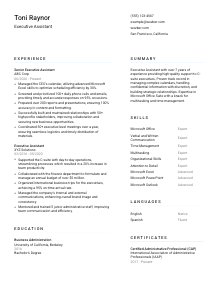
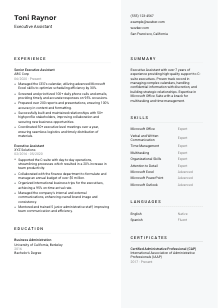
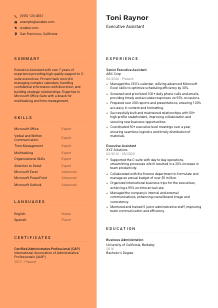
Juggling top-tier tasks, but your CV feels subordinate? Check out this Executive Assistant CV example, created with Wozber free CV builder. Learn how to position your support superpowers in sync with executive expectations, paving your professional path to the corner office!
Executive Assistant work sits close to decision-making. Hiring teams look for someone who can keep an executive's day moving, protect confidential information, and prevent calendar, travel, and communication issues before they reach the leadership level. Your CV needs to show more than administrative support. It should show judgment, pace, and the ability to keep complex priorities organised without constant direction.
When that experience is tailored well, an employer can quickly see whether you have supported senior leaders at the right level of complexity. Wozber's free CV builder helps you shape an ATS-compliant CV around the language employers use for executive support, from calendar management to stakeholder coordination, so your background reads clearly in both ATS screening and human review.
For an Executive Assistant, the top of the CV should reflect the same professionalism expected in executive-facing communication. Keep this section clean, accurate, and aligned with any practical requirements the employer lists.
Use your full name in a readable format, then position yourself immediately as an Executive Assistant. This is a straightforward way to match the target role and signal that your background is built around executive support, not general office administration.
Place "Executive Assistant" beneath your name if that is the role you are applying for. Matching the job title helps ATS systems connect your CV to the posting and helps the reviewer understand your direction at a glance.
List a current phone number and a professional email address. Executive assistants are often trusted with time-sensitive coordination, so even this section should suggest reliability and attention to detail. A casual or outdated email address weakens that impression.
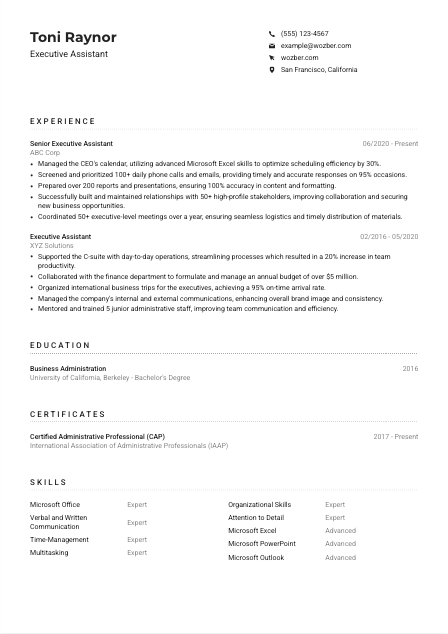
If a role requires someone to be based in a specific city, include that information clearly. In this example, San Francisco, California is a stated requirement, so listing it in the header removes an immediate point of uncertainty about availability and logistics.
A LinkedIn profile or professional website can reinforce your experience, especially if it reflects executive support work, tenure, and progression. Make sure the titles, dates, and achievements match your CV exactly. Consistency matters in roles built on trust.
This section should read the way a well-managed inbox feels to an executive: clear, current, and easy to act on. Get these details right so the hiring team can move straight to your experience.




This section carries the most weight for Executive Assistant hiring. Employers want to see the level of executive support you have handled, the complexity of the work, and the business pace you managed across calendars, meetings, travel, communication, and confidential materials.
Read the posting closely and pull out the recurring work patterns. For Executive Assistant roles, that usually includes calendar ownership, meeting coordination, travel planning, correspondence triage, reporting support, and stakeholder communication. Then make sure your recent roles speak directly to those areas. In the sample CV, calendar management, executive meetings, and confidential reporting all align closely with the target role.
List your most recent position first, then work backward with job title, company, and dates. That structure helps recruiters quickly gauge your seniority and progression, such as moving from Executive Assistant to Senior Executive Assistant while supporting higher-level leaders or broader operational scope.
Executive support is often undervalued on CVs because candidates list tasks instead of results. Replace generic lines like "managed calendar" with the effect of that work. For example, the sample bullet about optimising the CEO's schedule by 30% shows efficiency, prioritization, and command of scheduling tools, all from one line.
Numbers help hiring teams understand volume, pace, and trust level. Useful metrics for this profession include meeting volume, response speed, travel coordination, number of executives supported, stakeholder count, reporting accuracy, or budget exposure. The sample CV does this well with details like 100+ daily calls and emails, 200 reports and presentations, and 50+ executive-level meetings coordinated over a year.
Keep the experience section focused on work that proves executive support judgment. Routine administrative tasks, outdated unrelated roles, or broad office duties without context can dilute your profile. Prioritise bullets that show discretion, coordination, communication, and follow-through under pressure.
Your experience section should make it easy to picture you supporting a senior leader's day. The strongest bullets show what you handled, how much complexity was involved, and what improved because you were running the details well.
Education is rarely the deciding factor for an experienced Executive Assistant, but it still matters when a posting lists a degree preference. Present it clearly so it confirms your background without pulling attention away from the experience section.
If the employer prefers a bachelor's degree, include it clearly near the top of the education section. In this example, a Bachelor's Degree in Business Administration meets that preference and supports a profile built around coordination, communication, and business operations.
List the degree, field of study, school, and graduation year in a clean format. Executive Assistant hiring often moves quickly, and a straightforward layout makes your qualifications easy to confirm in both ATS review and manual screening.
Most mid-career and senior candidates do not need coursework here. If you are earlier in your career, though, business communication, office systems, project coordination, or event planning coursework can help connect your education to executive support work.
If you already have 5+ years supporting executives, keep this section brief. If you are closer to entry level, you can add honors, leadership roles, or academic projects that show organisation, discretion, or polished communication.
Professional credentials such as CAP should appear in the certificates section, not here. Still, the combination matters. A degree plus role-relevant certification can present you as someone with both business foundation and specialised administrative expertise.
This section should confirm the academic baseline the employer asked for and then step aside for your executive support experience. Clear formatting does that job well.
Certifications are not required for every Executive Assistant role, but they can strengthen your profile when they point to advanced administrative judgment, business communication, or office leadership. Use this section to show intentional professional development, not to list every course you have ever taken.
Focus on certifications that relate to administration, operations, communication, or business support. A credential like Certified Administrative Professional (CAP) is relevant because it signals formal knowledge of the standards and responsibilities often expected in executive support roles.
Choose quality over volume. One respected credential tied to executive support is more useful than several unrelated certificates. The goal is to reinforce your ability to operate in high-trust, high-coordination environments.
If a certification is current, renewed, or actively maintained, include the date range. That helps the employer see that your training is recent and still relevant, especially when software, communication standards, or administrative practices evolve.
Executive Assistants often grow into broader responsibilities such as event logistics, budget tracking, board support, or office operations. Updating your certifications over time shows that your capabilities are expanding along with the scope of the roles you pursue.
A well-chosen certificate adds credibility to your CV by backing up the kind of organised, polished, confidential support this work requires. If it is relevant and current, include it.
The skills section should read like the toolkit you use every day to keep leaders organised and communication moving. That means combining software proficiency with the operational habits that make executive support effective under pressure.
Start with the terms the employer already uses. For this role, that includes Microsoft Office Suite, especially Excel, PowerPoint, and Outlook, along with organisation, multitasking, time management, communication, and attention to detail. Mirroring this language helps your CV stay aligned with ATS filters and hiring expectations.
An Executive Assistant needs both platform fluency and strong coordination habits. Pair software skills like Microsoft Excel or Outlook with core strengths such as calendar management, meeting logistics, written communication, and confidentiality. That mix reflects how the work is actually done.
Avoid padding this section with broad or unrelated terms. Choose the skills that support executive scheduling, correspondence handling, travel coordination, presentation prep, and stakeholder interaction. The sample CV stays on track by highlighting Microsoft Office and the core organizational skills directly tied to the job.
Every skill listed should connect to a real part of executive support work. If the employer can map your skills to the executive's day-to-day needs, this section is doing its job.
Language ability matters in Executive Assistant hiring because the role often sits between leaders, teams, clients, and external partners. Clear communication, polished writing, and accurate message handling are part of the job, so present language skills in a practical way.
If the posting asks for professional English, make that easy to find. List English with an honest proficiency level such as Native or Fluent. Since executive assistants often draft correspondence, manage responses, and prepare presentations, this is more than a formality.
Extra languages can strengthen your profile when the company works across regions, serves diverse stakeholders, or needs smooth cross-cultural communication. Spanish, for example, may be useful in some business environments, but only if you can genuinely use it in a professional setting.
Stick to standard terms such as Native, Fluent, Advanced, Intermediate, or Basic. Hiring teams need a realistic sense of your communication range, especially if the role includes writing emails, fielding calls, or supporting visiting stakeholders.
Not every Executive Assistant role requires more than one language, but some do involve international travel coordination, vendor communication, or cross-border scheduling. If your language ability supports those responsibilities, it is worth including.
Only list languages you would feel comfortable using in a business context. For this profession, overstating proficiency can become obvious quickly when communication quality is part of the role itself.
For Executive Assistant roles, language skills matter when they improve communication with leaders and stakeholders. Lead with required proficiency, then include any additional languages that genuinely support the work.
The summary should quickly tell the reader what level of executive support you provide and where your strengths show up in practice. Keep it tight, but make sure it reflects the trust, coordination, and communication standards of the role.
Review the posting and identify the few requirements that define the role. Here, that means experienced executive support, calendar and meeting coordination, strong Microsoft Office skills, discretion, and communication. Your summary should bring those threads together in a few lines, not try to cover your entire career.
Start with a direct introduction such as "Executive Assistant with over 7 years of experience." That immediately establishes seniority and relevance, especially when the employer asks for a minimum of 5 years in executive support.
Choose two or three strengths that reflect how you operate, such as managing complex calendars, preparing confidential reports, coordinating leadership meetings, or maintaining stakeholder relationships. The sample summary works because it points to discretion, executive support scope, and Microsoft Office capability without sounding inflated.
Aim for a short paragraph that can be read in seconds. Avoid vague claims about being hardworking or passionate. Instead, use precise language that matches the role and leaves the detail for the experience section.
A strong summary tells the employer, early on, what kind of executive support you have delivered and at what level. When it is specific, concise, and aligned with the posting, the rest of your CV lands more effectively.
An Executive Assistant CV should make one thing easy to understand: you can keep senior leaders organised, informed, and protected from avoidable friction. When your sections are tailored around executive calendars, communication flow, meeting logistics, discretion, and stakeholder coordination, the hiring team gets a much clearer picture of how you work.
Use that focus as you refine each section in Wozber's free CV builder, and strengthen the final draft with ATS optimisation, an ATS-friendly CV format, and the ATS CV scanner. The result should be a CV that reads cleanly, matches the role's language, and shows you are ready to support executive work at the level the job demands.




