



Use Wozber and land your dream job
Create CV
No registration required
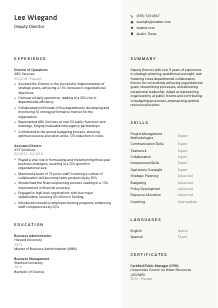
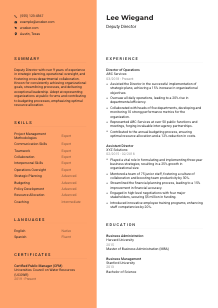
Charting organizational routes, but feel your CV might be off-course? Check out this Deputy Director CV example, created with Wozber free CV builder. It shows how easily you can align your leadership luster with job requirements, steering your career trajectory towards the executive echelons!
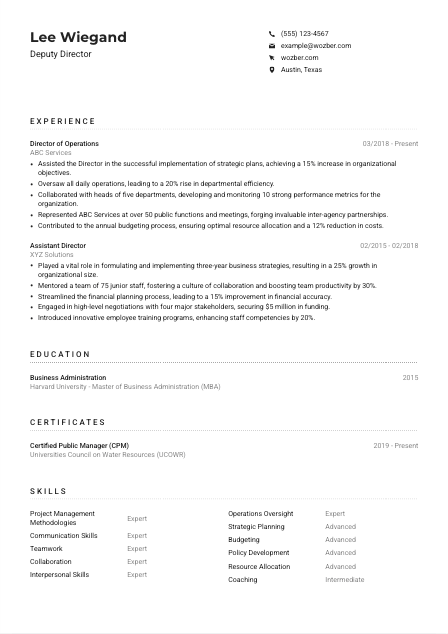
Deputy Director hiring usually turns on one practical question: can you keep strategy moving while operations, budgets, and department leaders all demand attention at once. A CV for this level needs to show more than seniority. It needs to make your management scope, operational judgment, and influence across teams easy to see.
When that story is tailored to the posting, the screening process becomes much clearer, especially in ATS review. Wozber's free CV builder helps organise the language, structure, and role-specific terms that matter here, so an ATS-compliant CV quickly surfaces leadership experience, operational oversight, and public-facing credibility for a Deputy Director opening.
For a Deputy Director, the Personal Details section should read like the top line of an executive briefing: clean, accurate, and immediately relevant. Keep it simple, but make sure it supports the practical requirements of the role, including professional identity and any location requirement stated in the posting.
Use your full name as the most visible text at the top of the page. At this level, your CV should feel orderly from the first line, and a clear heading helps both human reviewers and ATS parsing read it correctly.
Place "Deputy Director" under your name if that is the role you hold or are pursuing. This immediately frames your background in the right leadership lane and helps connect your CV to searches for executive operations, administration, or departmental leadership talent.
List a reliable phone number and a professional email address, then double-check both. Administrative leadership roles often move quickly from application to stakeholder interviews, so small errors here can slow down an otherwise qualified candidate.
If the employer specifies a city or state, mirror that requirement clearly. In the example, listing Austin, Texas supports a stated location expectation and removes an avoidable question during early screening.
Include LinkedIn or a professional website only if it reinforces your CV with consistent leadership history, board or public-facing activity, or major operational achievements. For Deputy Director roles, that extra profile should strengthen your executive credibility, not introduce mismatched titles or outdated metrics.
This section does not need flair. It needs accuracy, professionalism, and immediate alignment with the role's practical requirements.




Experience is where Deputy Director candidates separate themselves. Hiring teams want to see how you supported senior leadership, improved operations, managed cross-department performance, and handled public or financial responsibilities with real results attached.
Read the description closely and identify the operating themes behind it: strategic plan execution, day-to-day oversight, cross-functional coordination, performance management, public representation, and budgeting. Then match each one to work you have already done so your bullets reflect the actual scope of Deputy Director work, not generic leadership claims.
Start with your most recent position and give each entry the essentials: job title, organisation, and dates. Senior leadership CVs benefit from a clean timeline because reviewers are tracking progression, span of responsibility, and whether you have already worked at a level close to director or second-in-command responsibilities.
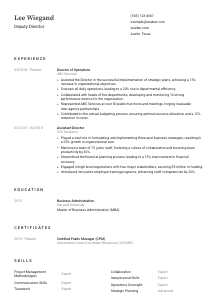
Your bullets should focus on decisions, coordination, and outcomes. Good Deputy Director examples include implementing strategic plans, improving service delivery, aligning department heads around shared metrics, or shaping budget use across a function. In the sample CV, achievements such as a 20% rise in efficiency and cross-department metric development make the leadership scope concrete.
Metrics matter here because they show the scale of your oversight. Use figures tied to budget savings, productivity gains, growth, staffing scope, program reach, stakeholder partnerships, or operational efficiency. Numbers like managing five departments, reducing costs by 12%, or representing the organisation at 50-plus public functions help employers picture the level at which you operate.
Prioritise experience that shows executive support, operational control, staff coaching, resource allocation, and interdepartmental influence. If an accomplishment is impressive but unrelated to leading functions, managing performance, or supporting organizational goals, it can distract from the case you need to make for a Deputy Director seat.
By the end of this section, your work history should show that you can translate strategy into daily execution, guide department performance, and handle the operational responsibilities that usually sit just below the Director level.
Education matters in Deputy Director hiring because it helps confirm the administrative and organizational foundation behind your leadership experience. Present it clearly, with emphasis on degrees that match public administration, business, management, or related operational fields.
Start by checking the posting for minimum and preferred education. Here, a bachelor's degree is required and a master's is preferred, so both should be easy to spot if you have them. That alignment matters early, especially when education is used as an initial screening filter.
List degree, field of study, school, and graduation year. This is enough for most Deputy Director CVs. A simple structure keeps the section ATS-friendly and lets reviewers quickly confirm that your background supports leadership in administration, operations, or public service contexts.
If your degree is in Business, Public Administration, Management, or a related area, spell that out precisely. In the example, an MBA and a bachelor's in Business Management map well to the role's administrative and strategic demands without needing extra explanation.
Most experienced Deputy Director candidates do not need to list classes, but it can help if your coursework directly supports budgeting, organizational leadership, policy, project management, or public sector administration. Use it only when it adds role-specific substance that your degree title alone does not show.
Academic honors, leadership projects, or capstone work can support your profile if they connect to governance, operations, strategy, or public administration. Keep this secondary to the degree itself unless you are early in your leadership career and need extra proof of management-oriented training.
Your education should quickly show that your leadership track is supported by formal training relevant to administration, operations, or organizational management.
Certifications can add weight to a Deputy Director CV when they reinforce how you manage projects, public programs, or organizational performance. They are especially useful when the posting names preferred credentials or when your career path spans both operations and administrative leadership.
If the employer calls out certifications such as CPM or PMP, place those front and centre when you hold them. That kind of direct match helps immediately, particularly for roles that value structured management practice, public administration knowledge, or formal project governance.
Choose credentials that support the work Deputy Directors actually do: program oversight, project delivery, budgeting discipline, process improvement, public sector administration, or team leadership. A short, relevant list is more useful than a long inventory of unrelated courses.
List the certification name, issuing organisation, and date or active period. This matters because employers may want current credentials, especially for project management or public management standards. The sample CV does this well by showing both PMP and CPM with active date ranges.
Deputy Director roles often expand into broader operational, policy, or public-facing responsibility. Certifications in project management, government administration, performance management, finance, or leadership development can strengthen future applications when they align with the kind of department or organisation you want to join.
Use this section to reinforce that your leadership approach is structured, current, and backed by training that fits administrative and operational decision-making.
The skills section should reflect how Deputy Directors work across operations, people, planning, and organizational accountability. Keep it tightly aligned with the posting and focused on capabilities that matter in day-to-day leadership, not broad personality traits on their own.
Look for skills tied to execution, not just labels. In this posting, that includes project management methodologies and tools, communication, interpersonal effectiveness, teamwork, collaboration, budgeting, and operational oversight. These are the capabilities your CV should echo if they reflect your real background.
List skills in the language employers use, but keep them grounded in actual experience. Phrases like strategic planning, performance metrics, resource allocation, policy implementation, coaching, and operations oversight are stronger than vague entries because they connect directly to Deputy Director responsibilities.
Lead with the capabilities most central to the target job. For many Deputy Director openings, that means operational leadership, cross-functional collaboration, project management, budgeting, and communication with internal and external stakeholders. The sample skills list works best where it starts with management and collaboration capabilities tied to the role's daily demands.
Your skills list should read like a concise operating profile of a Deputy Director, showing that you can run initiatives, support leadership decisions, and keep departments working toward shared goals.
Language skills matter in Deputy Director CVs when they affect communication with staff, public stakeholders, partner agencies, or the communities your organisation serves. This section is usually brief, but it should still be tailored to the role's stated requirements.
Start with the posting itself. Here, high English proficiency is explicitly required, so English should appear clearly with an honest proficiency level. When language is listed as a requirement, do not leave reviewers guessing.
Put the language named in the job description at the top of the section. For this role, English belongs first because it supports leadership communication, public representation, and coordination across departments and agencies.
Additional languages can strengthen your profile when the organisation serves diverse communities or works across multiple partners. In the example, Spanish adds useful context because bilingual communication can be valuable in public meetings, staff engagement, or community-facing settings, even when it is not a formal requirement.
Use clear labels such as Native, Fluent, Intermediate, or Basic. Deputy Director roles often involve high-visibility communication, so overstating fluency can become a problem quickly in meetings, presentations, or public-facing work.
Language skills carry more weight when they support the role's actual communication environment. For Deputy Director positions, that usually means staff communication, public forums, inter-agency meetings, and written correspondence rather than language ability presented as a generic bonus.
This section should confirm that you can communicate at the level the role requires and, where relevant, connect effectively with a wider range of staff, partners, or community stakeholders.
Your summary should quickly establish the level at which you lead. For a Deputy Director CV, that means combining years of experience with the kinds of responsibilities you have handled, such as operations, strategic execution, department coordination, budgeting, and public representation.
Before writing, identify the central demands of the position. A Deputy Director summary should reflect support for organizational strategy, oversight of daily operations, collaboration with department leaders, and accountability for performance or resources. That gives your opening the right level of seniority and relevance.
Begin with your years of experience and the areas where you operate most strongly. A line such as "Deputy Director with 9+ years of experience in strategic planning and operational oversight" works because it immediately places you in an executive administration context rather than a general management one.
Choose details that connect directly to the employer's priorities, such as improving departmental efficiency, building performance metrics, representing the organisation publicly, or contributing to budget planning. The sample summary is effective because it ties strategic planning, collaboration, and resource allocation to visible organizational outcomes.
Aim for three to five lines. At this stage, you are not listing every accomplishment. You are giving a compact overview that prepares the reader for the experience section and makes your leadership scope clear before they scan the rest of the CV.
A well-built summary should establish you as a senior operator who can support the Director, coordinate departments, and drive organizational goals with steady administrative leadership.
A Deputy Director CV works best when it presents leadership through specifics: operational improvements, cross-department coordination, budgeting input, public representation, and measurable results. Those details help hiring teams picture how you would function beside a Director and across the wider organisation.
Use Wozber's free CV builder to shape that experience into a clear, ATS-friendly CV template with strong ATS optimisation and role-aligned language. The finished document should make one thing easy to judge: you can lead daily execution while supporting broader organizational strategy.