



Use Wozber and land your dream job
Create CV
No registration required
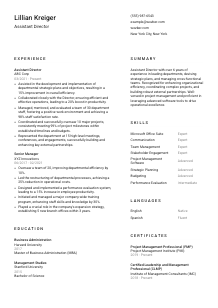
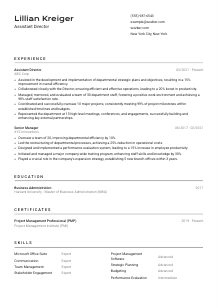
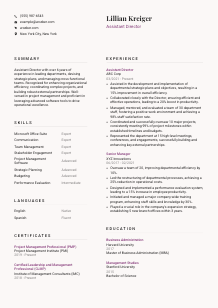
Assisting at a director's level, but your CV lacks direction? Check out this Assistant Director CV example, carefully built with Wozber free CV builder. It shows how to position your leadership acumen and move your career trajectory in line with coveted job prospects!
Assistant Director hiring usually turns on one practical question: can this person keep a department moving when strategy, staff management, and day-to-day operations all intersect at once? Your CV needs to show that you have handled that kind of shared leadership before, whether through operational improvements, team supervision, project delivery, or representing a department in front of senior stakeholders.
The difference a tailored CV makes here is immediate. It helps hiring teams and ATS screening tools quickly separate broad managers from candidates who have actually supported a Director, coordinated cross-functional work, tracked budgets and timelines, and led staff performance. Wozber's free CV builder helps organise those details into an ATS-compliant CV that makes your leadership scope and operational judgment easier to recognize.
For an Assistant Director role, the personal details section should do one job well: remove friction. Hiring teams should be able to confirm your identity, role focus, and contact information in seconds, especially when the posting includes a location requirement or expects polished professional communication.
Use your full name in a larger, clean font so it stands out immediately. At this level, you are presenting yourself as a department leader, so the header should feel polished and straightforward, not decorated or crowded.
Place "Assistant Director" directly under your name if that is the role you are pursuing. Matching the title from the posting helps frame the rest of your CV correctly, especially when your recent positions include related titles such as Senior Manager, Operations Manager, or Program Lead.
List a reliable phone number and a professional email address, then check them carefully. For leadership roles, small errors in contact details can undermine the sense of organisation and attention expected from someone who will oversee staff, projects, and departmental coordination.
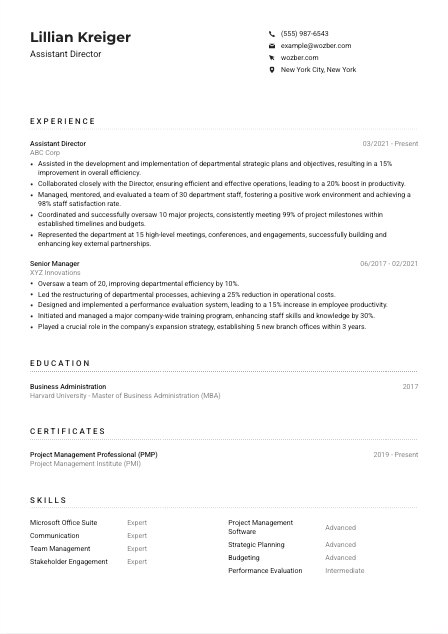
If the posting requires candidates to be based in a specific city, include that city and state in your header. Here, listing "New York City, New York" directly addresses the stated requirement and avoids unnecessary questions about relocation or local availability.
Include LinkedIn or a professional website only if it supports your candidacy. For Assistant Director applicants, that profile should reinforce leadership progression, cross-functional work, project oversight, and any public-facing experience with boards, partners, or external organizations.
This section is brief, but it carries real weight. Clear contact details, the right target title, and any required location information help the reader move quickly to what matters next: your management experience and operational results.




This is the section most likely to decide whether you advance. For Assistant Director positions, employers are looking for more than general management. They want signs that you can support strategic plans, guide teams, coordinate projects, monitor budgets and timelines, and keep operations aligned with senior leadership priorities.
Start by identifying the work themes that appear repeatedly in the posting. In this case, those include strategic planning, operational coordination, staff management, project oversight, and external representation. Your experience bullets should mirror those areas with real examples, not general leadership language.
Use reverse chronological order and give the most space to positions that show management scope, cross-functional coordination, and decision-making responsibility. If your title was not Assistant Director, emphasize the parts of the role that still map to departmental operations, staff supervision, or organizational planning.
Assistant Director CVs read better when each bullet shows what changed because of your work. Metrics like efficiency gains, productivity increases, staff retention or satisfaction, budget control, milestone delivery, and cost reductions all carry weight. The sample CV does this well by tying strategic planning to a 15% efficiency improvement and operational collaboration to a 20% productivity boost.
Scope matters at this level. Include team size, number of projects, budget responsibility, reporting cadence, or the seniority of stakeholders involved. A bullet about overseeing 10 major projects or managing a 30-person department gives a hiring team far more context than a generic statement about leading initiatives.
If you introduced a performance evaluation system, reworked a process, launched training, or built external partnerships, include it. These details show how you operate beyond routine supervision. The strongest examples point to durable improvements, such as lower costs, better team performance, or stronger departmental relationships.
By the end of this section, a hiring manager should be able to tell how you lead, what you improve, and how much responsibility you have handled. That is the standard an Assistant Director CV needs to meet.
Education matters here because the posting sets a baseline degree requirement and prefers advanced study. For Assistant Director roles, your academic section should confirm that foundation quickly, while also supporting the strategic, administrative, or operational side of your background.
If the job asks for a bachelor's degree and prefers a master's, make sure both are clearly listed if you have them. This is one of the easiest screening requirements to satisfy on paper, so do not bury it or leave the section vague.
Start with your most advanced degree first. That helps the reader immediately see qualifications that may strengthen your candidacy for a leadership post. In the example, the MBA appears before the bachelor's degree, which fits the employer's stated preference for graduate education.
Write out the degree, field, school, and graduation year clearly. A degree such as "Master of Business Administration" or "Bachelor of Science in Management Studies" gives more hiring value than abbreviated or partial information because it directly reflects business, organizational, or leadership preparation.
You do not need to turn this into a transcript, but if you have honors, leadership coursework, capstone work, or academic projects tied to operations, management, finance, or organizational development, they can strengthen the section. Use these additions only when they genuinely support your current target role.
If recent coursework strengthens your management profile, mention it in the education or certification area. Assistant Director roles often sit between strategic planning and execution, so training in leadership, budgeting, project delivery, or organizational development can reinforce your trajectory.
This section should confirm that you meet the formal education threshold and, where applicable, show additional depth for leadership work. Once that is clear, let your experience carry the heavier proof.
Certifications matter most when they support the actual work of the role. For an Assistant Director, that usually means showing formal training in project delivery, leadership, operations, or management systems that help you run teams and initiatives more effectively.
When a certification is listed as preferred, move it near the top of this section. A PMP is especially relevant for Assistant Director roles that involve coordinating multiple projects, tracking timelines, and keeping budgets on course.
List certifications that reinforce how you lead and execute, not every course you have ever completed. A short list tied to project management, supervision, or organizational leadership will read much better than a long list of unrelated credentials.
Show when the certification was earned and whether it is current, especially for credentials that require ongoing maintenance. Active dates help employers see that your knowledge is recent and still aligned with current project and management standards.
As your career grows, continue adding certifications that support the type of department leadership you want to do. Depending on the organisation, that could include project management, change management, nonprofit administration, compliance, or advanced leadership training.
The right certificates add another layer of credibility, especially when they map directly to project oversight, team leadership, or operational control. Keep this section focused and current.
The best Assistant Director skills sections do not read like generic management checklists. They show the combination of operational tools, leadership abilities, and communication strengths needed to support a Director, coordinate teams, and keep projects and departmental goals on track.
Start with the specific skills the employer has named, then add closely related ones you genuinely use. In this posting, that includes Microsoft Office Suite, project management software, interpersonal communication, and team management. If those tools or capabilities appear in the job ad, they should appear in your CV in clear language.
Prioritise skills that show how you manage work, not just how you contribute individually. Strategic planning, budgeting, stakeholder engagement, performance evaluation, and project coordination all support the Assistant Director profile because they connect leadership with operational follow-through.
Avoid padding the section with broad or outdated items. Focus on the skills you can back up in your experience bullets. If you list stakeholder engagement, team management, or project software proficiency, the rest of the CV should show where you used them to improve operations, deliver milestones, or guide staff.
Every skill here should connect to work you have actually done. When the skills section lines up with your experience, your Assistant Director profile feels much more convincing to both recruiters and ATS screening.
Language ability matters most when it affects how you lead, report, and represent the department. For Assistant Director roles, that usually starts with strong professional English, especially when the job involves meetings, written communication, staff guidance, and external-facing responsibilities.
If the posting states that English is essential, list it first and state your proficiency clearly. That matters in leadership roles where communication shapes meetings, documentation, presentations, and staff management.
Place the required or primary workplace language at the top, then follow with additional languages. This keeps the section aligned with the employer's needs while still showing broader communication ability.
Extra languages can be valuable when the organisation works with diverse communities, clients, vendors, or partners. They are not always a deciding factor, but they can strengthen your profile when communication and relationship management are part of the job.
Use honest labels such as Native, Fluent, Conversational, or Basic. Assistant Directors are often asked to represent departments in meetings or external settings, so overstating proficiency can create problems quickly.
If your language ability has supported stakeholder relations, community engagement, or multicultural team communication, that can add useful context elsewhere in the CV. Even when only English is required, multilingual ability can still reflect range and adaptability.
This section should quickly confirm that you can communicate at the level the role requires. For Assistant Director positions, clear professional English is foundational, and any additional language skill is a useful bonus when relevant.
Your summary should establish you as someone who can support senior leadership while keeping teams, projects, and departmental operations moving. For Assistant Director roles, the best summaries combine years of leadership experience with a few concrete strengths such as strategic planning, staff oversight, operational improvement, or project delivery.
Before writing, identify the main demands of the position you are targeting. Here, that means assisting with strategic plans, supporting efficient operations, managing staff, and overseeing projects. Your opening lines should reflect that level of responsibility.
Lead with your years of experience and the kind of leadership work you have handled. A line such as "Assistant Director with 6+ years of experience leading departments and cross-functional teams" immediately places you in the right professional tier.
Use one or two measurable or role-specific points that sharpen your profile. The example summary works because it mentions organizational efficiency, complex project coordination, and external partnership building, all of which match the job's responsibilities.
Stay within 3 to 5 lines and avoid repeating bullet points from the experience section. The summary should give the reader a fast, reliable picture of your management style and operating range, then lead naturally into the details below.
A focused summary helps the reader understand your level before they reach your work history. For an Assistant Director application, it should quickly show that you can support strategy, manage people, and keep execution on track.
An effective Assistant Director CV makes three things easy to see: the size of the teams and projects you have managed, the operational results you have delivered, and how closely your background matches the posting's stated requirements. That is what moves you past generic management territory and into serious consideration.
Use Wozber's AI CV builder to tighten your wording, align your experience with the job description, and build an ATS-friendly CV format that reflects real leadership work. When the CV is tailored well, hiring teams can quickly recognize your readiness to support strategy, lead staff, and keep departmental execution on course.