



Use Wozber and land your dream job
Create CV
No registration required
Orchestrating financial strategies, but feeling your CV isn't striking the right investment mix? Check out this Chief Investment Officer CV example, created with Wozber free CV builder. Learn how to align your investment prowess with job criteria, and take your career portfolio to new and prosperous heights!
Chief Investment Officer hiring tends to centre on one question fast: can this person steer capital through changing markets while keeping returns, risk, and organizational goals in balance. CVs for this level need to show judgment, portfolio leadership, and a track record of making allocation decisions that hold up under scrutiny from executives, boards, and external partners.
A tailored CV changes how quickly that picture comes into focus. When your experience mirrors the mandate in the posting, from asset allocation and portfolio oversight to board reporting, both recruiters and investment decision-makers can separate you from adjacent profiles such as senior portfolio managers or finance executives. Wozber's free CV builder helps shape that story into an ATS-compliant CV that makes your investment scope and leadership easier to read at a glance.
At CIO level, the header should read like a clean executive brief. It needs to confirm who you are, how to reach you, and whether you meet any practical filters before anyone gets to your portfolio results or leadership record.
Use your full name as the most prominent text on the page. Keep the formatting straightforward and polished, the same way you would present a quarterly investment review or board memo. Overdesign works against you in senior finance hiring, where clarity and control matter more than style.
Place "Chief Investment Officer" directly under your name when that is the role you are pursuing. This immediately aligns your CV with the search and helps ATS screening connect your background to an executive investment mandate. If your current title differs, you can still target the CIO role in the header while the experience section shows your progression.
List a reliable phone number and a professional email address, ideally in a simple firstname.lastname format. At this level, basic errors in contact information can undercut confidence before your investment record is even reviewed. Include only channels you actively monitor, especially if interview coordination will involve board members, search firms, or senior leadership.
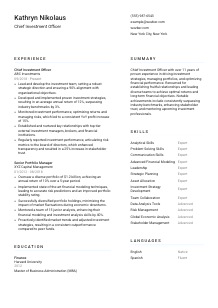
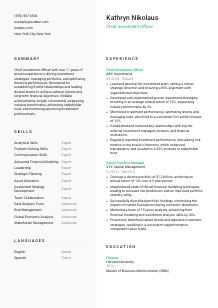
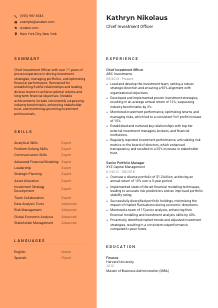
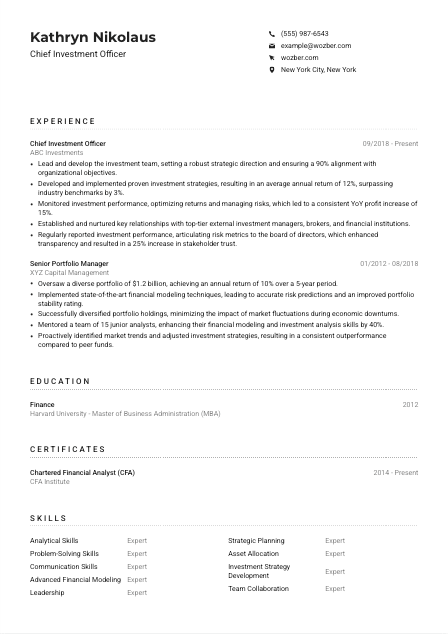
If the job specifies a location requirement, reflect it clearly in your header. In this example, "New York City, New York" answers a stated requirement and removes a practical objection early. For other CIO roles, only include location detail to the extent that it helps confirm availability for the market, office, or jurisdiction involved.
A current LinkedIn profile or professional website can support your candidacy if it reinforces your executive brand. For investment leadership roles, that profile should align with your CV on titles, dates, assets under management, board reporting exposure, and major performance outcomes. If the external profile is sparse or outdated, leave it off until it reflects the level of responsibility you want to present.
This section does not need flair. It needs accuracy, professionalism, and immediate alignment with the CIO search, including any sample-specific requirement such as location.




For a Chief Investment Officer, the experience section carries most of the decision weight. Hiring teams look here for proof of portfolio responsibility, strategic allocation decisions, risk discipline, team leadership, and the ability to explain performance to senior stakeholders in concrete terms.
Start by identifying the operational core of the role. In this posting, the priorities are clear: lead the investment team, set strategy, manage asset allocation and portfolio performance, maintain relationships with external managers and brokers, and report results and risk metrics to senior leadership and the board. Those are the themes your bullets should echo in your own language.
Use reverse chronology and give the most space to positions where you owned investment strategy, portfolio construction, manager oversight, or capital allocation decisions. A hiring committee evaluating a CIO search wants to see increasing decision authority over time. The sample CV does this well by moving from Senior Portfolio Manager to Chief Investment Officer, which makes the promotion in scope easy to follow.
Your bullets should show what changed because of your decisions. Instead of writing that you "managed portfolios," write how you adjusted allocations, improved returns, protected downside, strengthened governance, or aligned investment policy with long-term objectives. The sample's "average annual return of 12%, surpassing industry benchmarks by 3%" works because it ties strategy to a market-relevant outcome.
Numbers matter in investment leadership CVs because they show scope and discipline. Use metrics such as assets under management, annualized return, benchmark outperformance, Sharpe improvement, drawdown reduction, profit growth, or team size where they accurately reflect your work. The example's $1.2 billion portfolio, 15% YoY profit increase, and board trust improvement are strong illustrations of the kind of measurable context that makes executive finance experience credible.
Cut details that do not strengthen your case for a CIO seat. Prioritise achievements tied to asset allocation, portfolio oversight, economic analysis, risk management, stakeholder communication, and leadership of analysts or portfolio managers. Even impressive work should earn its place by showing how you think, decide, and lead in an institutional investment environment.
A CIO experience section should read like a record of capital stewardship. Make it easy to see the scale you handled, the results you produced, and the judgment you brought to strategy, risk, and board-level communication.
Education matters differently at CIO level than it does earlier in an investment career. It is less about academic promise and more about confirming that your foundation in finance, economics, business, and markets matches the level of strategic responsibility attached to the role.
Use the job description to decide what should stand out. Here, a bachelor's degree in Finance, Economics, or a related field is required, and an MBA is preferred. If you have both, list them clearly and place the stronger strategic credential first, especially when it aligns with the mandate of leading investment direction.
List degree, field, institution, and graduation year in a format that can be scanned quickly. For senior finance roles, hiring teams do not need excess description if the credential is already strong. The sample CV handles this efficiently with an MBA in Finance and a bachelor's degree in Economics from well-known institutions.
If you hold an MBA, master's in finance, or another advanced qualification tied to capital markets or enterprise strategy, let that support your executive positioning. This is especially useful when the role involves board communication, long-term investment policy, or cross-functional leadership beyond pure portfolio management.
Most experienced CIO candidates do not need coursework on the CV. Add it only if it strengthens a specific part of your case, such as advanced financial modeling, derivatives, econometrics, or risk management, and only when that expertise is not already obvious from your work history. At this level, concise relevance beats academic completeness.
Distinctions, research, or major projects can be useful if they connect directly to investing, macro analysis, valuation, or leadership. Otherwise, let your professional record carry the section. Senior investment hiring usually gives more weight to capital results and fiduciary judgment than to classroom detail.
Your education section should quickly reinforce that you have the formal grounding for high-level investment decisions. Keep it concise, relevant, and aligned with the role's stated degree expectations.
In investment leadership, certifications can add weight when they sharpen your technical credibility or reinforce long-term commitment to the field. They are especially useful when they support portfolio management depth, fiduciary discipline, or advanced market knowledge.
Start with certifications that a board, CEO, or search committee will immediately recognize. For a CIO CV, credentials such as the CFA often carry the most weight because they connect directly to portfolio analysis, valuation, ethics, and investment decision-making. The posting does not require a certification, but relevant credentials can still strengthen the overall profile.
A short list of respected certifications is stronger than a crowded section. Choose credentials that support the responsibilities in the role, such as portfolio oversight, asset allocation, financial planning, or risk analysis. The sample CV uses CFA and CFP, which together reinforce both investment expertise and disciplined financial decision-making.
Include the year earned or the active date range when it helps clarify current standing. In regulated or high-trust finance environments, current and active credentials can matter, especially if they signal continued professional engagement. Make sure the dates are accurate and easy to interpret.
If your target roles are moving toward more institutional, multi-asset, or board-facing responsibility, continuing education in alternatives, risk, governance, or macro strategy can be useful. Add new credentials only when they reinforce the direction of your leadership story rather than padding the section.
The right credentials add another layer of confidence to your CV. They should support the investment judgment, technical depth, and professional standards expected from a Chief Investment Officer.
A Chief Investment Officer skills section should not read like a generic leadership inventory. It should surface the technical and strategic capabilities behind portfolio decisions, risk oversight, team direction, and communication with senior stakeholders.
Read the job description with an investor's eye for patterns. This one points to portfolio management, asset allocation, financial modeling, data analysis, leadership, communication, and risk-aware strategy development. Those are the capabilities to prioritise because they sit at the centre of the role's daily and strategic demands.
Include both the analytical tools and the leadership strengths that define successful CIO performance. For many candidates, that means skills such as investment strategy development, portfolio construction, risk management, financial modeling, global market analysis, stakeholder management, and team leadership. The sample CV gets this balance right by pairing advanced financial modeling with strategic planning and leadership.
Do not treat this section as a complete catalogue of everything you can do. Choose the skills that best match the role you want now, especially those that support board reporting, external manager oversight, and long-term portfolio performance. A focused skills list also improves ATS optimisation because the most relevant terms are easier to identify and connect to your experience.
Every skill listed here should support a credible CIO profile. Prioritise capabilities tied to returns, risk, portfolio oversight, and executive communication over broad business language.
Language ability matters most when it supports the actual market and stakeholder context of the role. For a Chief Investment Officer, that often means clear board communication in English first, with additional languages adding value in cross-border manager relationships, regional market work, or multinational teams.
If the job description names a required language, list it first with an accurate proficiency level. In this case, English is mandatory, so it should appear at the top of the section. That removes uncertainty around a basic requirement and keeps the CV aligned with the posting.
After the required language, include additional languages that could support your investment work, such as relationship management with international partners or exposure to regional markets. The sample CV lists Spanish after English, which adds breadth without distracting from the stated requirement.
Choose standard terms such as "Native," "Fluent," or "Professional Working Proficiency." Ambiguous wording makes it harder for hiring teams to understand whether you can negotiate, present, or review market material in that language. Executive roles benefit from precision here just as much as they do in performance reporting.
Extra languages are most persuasive when they relate to how you work. If your background includes global manager selection, regional due diligence, or international capital markets exposure, those languages can support that story. If not, keep the section simple and factual.
Multilingual ability is useful, but it should not crowd out stronger CIO qualifications. Include only languages you can genuinely use in professional settings, especially in conversations involving market updates, performance reviews, or relationship management.
For CIO roles, language information should be brief, accurate, and tied to real communication needs. Lead with the required language, then add others that strengthen your international reach.
The summary at the top of a Chief Investment Officer CV needs to do one job well: establish your level of investment leadership in a few lines. It should position you as someone who can direct strategy, oversee portfolios, manage risk, and communicate with senior decision-makers before the reader reaches the detailed experience section.
Start with the priorities in the job description and translate them into a concise executive profile. For this role, that means emphasizing years in investment management, portfolio and asset allocation depth, strategic leadership, and the ability to deliver long-term financial outcomes. Skip broad claims that could apply to any senior executive.
Your first line should identify you as an investment leader with relevant tenure and area of command. A phrase like "Chief Investment Officer with 10+ years in investment management and portfolio strategy" gives immediate context and aligns with the posting's experience threshold.
Use one or two high-value outcomes that show the scale and effect of your work. The sample summary does this by referencing benchmark outperformance, stakeholder trust, and team leadership. That combination works because it covers investment results, executive communication, and talent development without becoming a list.
Aim for a concise paragraph that could hold up in front of a CEO, board member, or retained search consultant. Three to five lines is usually enough. Every sentence should earn its place by clarifying your investment philosophy in action, the results you achieved, or the scope you led.
When written well, the summary tells the reader they are looking at a credible CIO candidate before they review a single bullet point. Make it specific, measurable, and grounded in real investment leadership.
A Chief Investment Officer CV should present more than seniority. It should show how you allocate capital, manage downside risk, lead investment professionals, and report performance in language that boards and executive teams trust.
Use Wozber's free CV builder to organise that story in an ATS-friendly CV format, then refine it with targeted wording, role-specific terminology, and ATS optimisation so your strategic track record is easy to recognize. The finished CV should make one conclusion straightforward: you are prepared to lead an investment program with discipline, range, and executive credibility.




