



Use Wozber and land your dream job
Create CV
No registration required
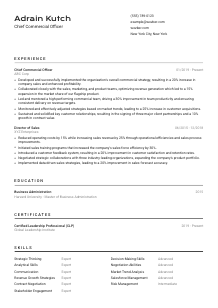
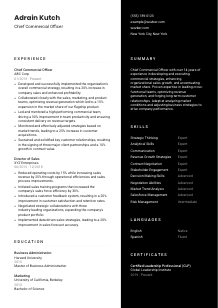
Plotting profit strategies but your CV lacks market appeal? Check out this Chief Commercial Officer CV example, created with Wozber free CV builder. Learn how to align your commercial acumen with job specifics, positioning your career trajectory on the same path as your sales chart!
A Chief Commercial Officer is expected to connect strategy with revenue results. Hiring teams want to see how you have shaped commercial direction, aligned sales and marketing with product decisions, protected margins, and expanded customer relationships at scale. A CV for this level needs to show business growth through decisions you led, not just functions you oversaw.
When that story is tailored to the role, the first read becomes much clearer. Wozber's free CV builder helps you line up your language with the job description and produce an ATS-compliant CV that surfaces commercial strategy, revenue ownership, and cross-functional leadership early, so your application reads like an executive prepared to drive sales goals and profitability.
For a Chief Commercial Officer, the header should read like the top line of an executive profile. Keep it clean, credible, and aligned with the market you want to lead in.
Your name should be the most visible element, followed immediately by the title you are targeting or already hold. For a senior commercial role, that title matters because it frames the level of ownership you bring, from revenue strategy to major partnerships.
If your background supports it, place "Chief Commercial Officer" under your name so the role match is immediate. This is especially useful when your recent titles vary across companies, such as VP Commercial, Head of Revenue, or Director of Sales, but your scope already includes pricing, growth strategy, and commercial leadership.
List a reliable phone number, a professional email address, and, if relevant, a LinkedIn profile or personal site that reflects your board-facing experience, major deal work, or market expansion results. Any digital profile should mirror the leadership narrative on the CV, including revenue growth, negotiation wins, and cross-functional collaboration.
Location is usually a practical detail, but some executive searches treat it as an early screen. In the example job description, New York City, New York is a stated requirement, so listing that location directly removes an avoidable question about availability.
Do not add age, marital status, headshots, or other personal information unrelated to commercial leadership. Use this space for details that help a company contact you and quickly understand your executive positioning.
This section should confirm who you are, what level you operate at, and whether you meet practical requirements such as location. Keep it concise so the focus moves quickly to your growth record and leadership scope.




This is the section most likely to decide whether you move forward. For a Chief Commercial Officer, experience needs to show commercial strategy, revenue accountability, market expansion, team leadership, and influence across sales, marketing, product, and major client relationships.
Start by marking the business outcomes the employer cares about most. In this case, the emphasis is on revenue growth, market share expansion, commercial strategy, cross-functional alignment, and negotiation with key customers and partners. Your bullets should map to those priorities instead of describing general executive duties.
List roles in reverse chronological order and make the scope of each role easy to understand. A move from Director of Sales into Chief Commercial Officer, as shown in the example, works well because it signals increasing ownership over forecasting, team performance, strategic partnerships, and company-wide growth decisions.
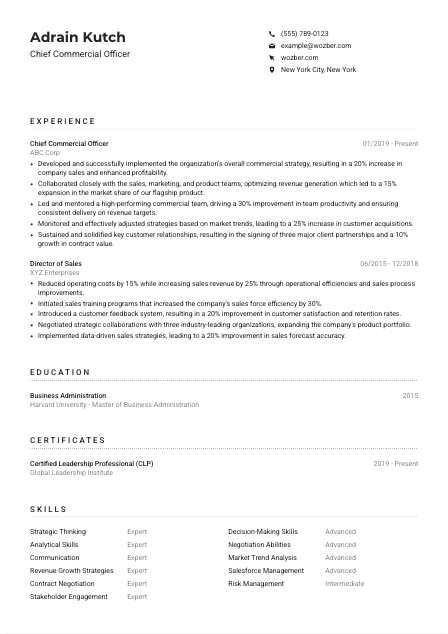
Each bullet should show a commercial decision and the business result that followed. Good examples include launching a growth strategy, improving pricing or go-to-market execution, expanding market share, or strengthening a major account portfolio. The sample CV does this well with results such as a 20% increase in company sales and a 15% expansion in market share.
Numbers matter at this level because they anchor executive claims in business performance. Use metrics that fit commercial leadership, such as revenue growth, contract value, acquisition gains, forecast accuracy, margin improvement, retention, productivity, or share of wallet. Results like three major client partnerships or a 25% increase in customer acquisitions are much stronger than broad claims about success.
Earlier achievements are useful only if they reinforce your readiness for senior commercial leadership. Keep bullets that show revenue ownership, strategic planning, market analysis, team development, and negotiation leverage. Trim operational details that belong more naturally on a mid-level sales CV unless they clearly connect to broader commercial outcomes.
A Chief Commercial Officer CV should leave little doubt about the scale you have led and the growth you have delivered. If each role shows business decisions, cross-functional influence, and measurable revenue impact, the experience section is doing its job.
At this level, education is not the main selling point, but it still helps establish fit. Employers often want confirmation that your academic background supports commercial strategy, market understanding, and executive decision-making.
If the posting asks for a bachelor's degree in Business, Marketing, or a related field, make sure that match is obvious. Here, the sample candidate aligns well with a Bachelor of Science in Marketing and strengthens the profile further with an MBA, which the role lists as preferred.
List school, degree, field, and graduation year in a clean structure. For senior commercial roles, the main value is clarity. A hiring team should be able to scan this section quickly and confirm the academic baseline without searching for details.
Place the highest or most relevant degree first when it strengthens your executive positioning. An MBA, master's in business, or similar advanced credential can reinforce strategic and financial credibility for a role tied to profitability, market growth, and company-wide planning.
You do not need to list coursework unless it adds something meaningful, such as pricing strategy, international business, product marketing, or negotiation. For experienced commercial leaders, academic extras should support the role rather than crowd the section.
Executive education, leadership programs, or strategy-focused workshops can be useful if they are relevant to growth leadership, market expansion, or team management. Keep them only if they add weight beyond your formal degrees and current experience.
This section should confirm that your academic foundation supports the commercial scope of the job. Once that is clear, let your growth record and executive results carry the stronger argument.
Certifications are secondary for most Chief Commercial Officer roles, but the right one can reinforce your leadership range, industry knowledge, or strategic development. Use this section to add depth, not volume.
If the role does not require a specific credential, focus on certifications that strengthen your profile in leadership, negotiation, strategy, revenue operations, or industry specialization. The example's Certified Leadership Professional credential fits because it complements team leadership and executive management responsibilities.
A short list of meaningful certifications is more persuasive than a crowded section. Choose credentials that speak to managing commercial teams, leading transformation, handling complex accounts, or driving strategic growth.
Dates can show that your learning is current, especially in areas that evolve with market conditions, customer expectations, and commercial models. They also help a hiring team distinguish an active credential from one earned long ago and never revisited.
As your career moves into broader commercial leadership, your certifications should reflect that shift. Keep the section current with learning that supports enterprise growth, strategic partnerships, pricing, leadership, or global market expansion.
A relevant certification can sharpen your profile, especially when it aligns with leadership or commercial strategy. Just keep the emphasis where it belongs, on business results and the scale of responsibility you have held.
A Chief Commercial Officer is hired for judgment, revenue leadership, and the ability to align teams around commercial outcomes. Your skills section should reflect that level of responsibility with a mix of strategic, analytical, operational, and relationship-driven capabilities.
Start with the language used in the job description. Here, the priorities include strategic thinking, analytical ability, decision-making, communication, negotiation, and commercial leadership. Those are not filler terms for this role. They shape how companies evaluate growth leaders responsible for sales goals and profitability.
Add skills that reflect how you lead the business, not just how you support it. Strong examples include revenue growth strategies, market trend analysis, contract negotiation, stakeholder engagement, sales leadership, pricing strategy, forecasting, and cross-functional collaboration. The sample CV's mix of strategic thinking, revenue growth strategies, and contract negotiation is on the right track.
Group or order skills so both hiring teams and screening systems can read them easily. Wozber helps you build an ATS-friendly CV format that keeps these terms visible and readable, which is useful when executive CVs are screened for commercial keywords tied to leadership scope and growth outcomes.
This section should reinforce the impression created by your experience bullets. If your skills read like the capabilities of someone who sets commercial direction, leads teams, and closes high-value opportunities, they are working.
Language ability matters differently depending on the company's footprint. For some Chief Commercial Officer roles, strong English is essential for board communication, client negotiation, and cross-functional leadership. In global or regional businesses, additional languages can strengthen your value.
If the job specifically asks for clear English communication, make that visible. This posting does exactly that, so listing English prominently is a practical way to confirm you can handle executive presentations, negotiations, and customer-facing communication.
Order languages by business relevance, not personal preference. For many U.S.-based commercial leadership roles, English should come first, followed by any additional language that supports customer relationships, regional expansion, or cross-border partnerships.
Additional languages can help if the company sells across regions or manages multinational accounts. In the example, Spanish adds useful commercial range, particularly for partnership development or market expansion, but it should be presented as an advantage rather than a universal requirement for every CCO role.
Use clear levels such as Native, Fluent, Advanced, or Conversational. At the executive level, overstatement creates risk because language ability often surfaces quickly in client meetings, board discussions, or partner negotiations.
Only highlight language skills that support the role's likely scope. For a commercially focused executive, that usually means market communication, stakeholder management, negotiations, and regional leadership rather than language ability in the abstract.
When language skills support customer growth, partner management, or regional expansion, they deserve space on the CV. Keep the section honest and commercially relevant.
The summary sits at the top of the CV and shapes how the rest of your background is read. For a Chief Commercial Officer, it should quickly establish your level, your commercial scope, and the business results you are known for delivering.
Read the posting for the recurring themes. In this case, those include overall commercial strategy, revenue growth, profitability, market share, cross-functional collaboration, and major client relationships. Your summary should reflect that mix of strategic ownership and commercial execution.
Your first line should identify you as the level of leader the company is trying to hire. A summary like the example's "Chief Commercial Officer with over 14 years of experience" works because it immediately places the candidate in an executive commercial context.
Use wording from the posting where it matches your real background, such as developing commercial strategies, optimising revenue generation, leading cross-functional teams, or expanding market share. This improves alignment without making the summary sound copied.
Three to five sentences is usually enough. Focus on scale, leadership scope, and a few defining strengths, such as revenue growth, market expansion, team leadership, and relationship management. Save detailed metrics for the experience section, where they can carry more weight.
A well-written summary should tell the reader, within a few lines, what kind of growth leader you are and what business results tend to follow your leadership. That context makes every section below easier to read.
A Chief Commercial Officer CV should show where you have owned growth, how you have aligned teams around revenue goals, and what business results followed. When your summary, experience, skills, and education all point in the same direction, the document reads like an executive brief rather than a collection of jobs.
Use Wozber's AI CV builder to sharpen the language, strengthen ATS optimisation, and organise the final version in an ATS-friendly CV template that keeps your leadership scope, commercial strategy, and measurable results easy to find. The finished CV should make one conclusion simple: you are ready to lead revenue and market expansion at the executive level.