



Use Wozber and land your dream job
Create CV
No registration required
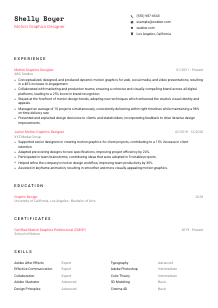
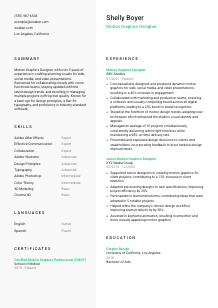
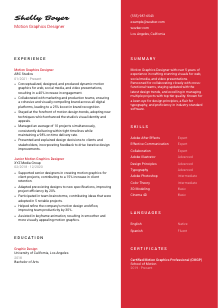
Animating visuals, but your CV feels stationary? Check out this Motion Graphics Designer CV example, created with Wozber free CV builder. Learn how to effortlessly sync your dynamic design skills with job specifics, turning your career trajectory into a beautifully animated journey!
Motion graphics hiring moves fast, but the work itself is rarely quick. Teams want designers who can turn a concept into polished animation across web, social, and presentation formats while keeping typography, pacing, and brand consistency under control. Your CV needs to show that you do more than animate. It should make your visual judgment, software fluency, and ability to deliver on deadline easy to see.
A targeted CV changes how your background is read, especially when recruiters or creative teams are sorting candidates with similar design titles. Wozber's free CV builder helps shape an ATS-compliant CV around the language of the role, so your experience with motion design, cross-functional collaboration, and project delivery is surfaced clearly instead of getting buried in generic creative wording. That makes it easier to recognize where your work already matches the production needs of the team.
The top of the CV should answer the practical questions first. For a Motion Graphics Designer, that means confirming who you are, what role you do, and whether you're reachable and based where the employer needs you to be.
Use your name as the clearest identifier on the page. Keep it larger than the body text, easy to scan, and styled simply. This is a design role, but the header should show restraint and hierarchy, not decorative effects that compete with the content.
Place the target role directly under your name when it matches your background. Using "Motion Graphics Designer" tells the reader and the ATS immediately where you fit. If your current title is close but not identical, align it where truthful so your application is categorized with the right creative candidates.
Add a phone number and email address you check regularly. Use a professional email format and avoid anything casual or outdated. Creative teams move quickly when booking interviews or portfolio reviews, so your contact information should never slow that down.
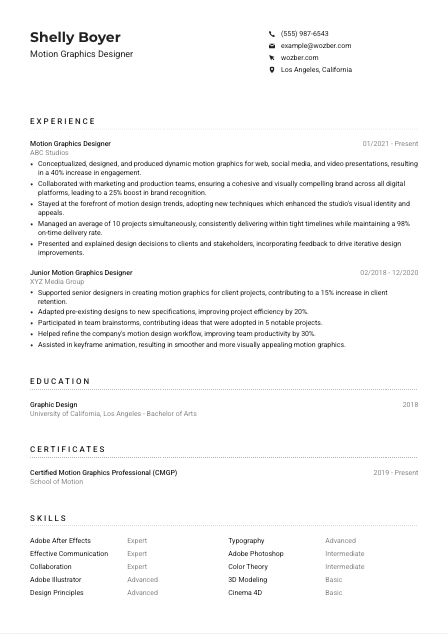
Some motion design roles can be remote, hybrid, or studio-based, so location matters only when the employer states it. Here, Los Angeles, California is part of the requirement, so listing city and state directly in the header removes an immediate question. The sample CV handles this well by showing Los Angeles, California up front.
For motion graphics roles, a portfolio link often carries as much weight as the CV itself. Include a website, reel, or polished LinkedIn profile if it leads to relevant work samples. Make sure the projects there reflect the same strengths you mention in the CV, whether that is social animation, branded video assets, explainer content, or presentation graphics.
This section is brief, but it should settle the basics immediately. When your title, location, and portfolio are easy to find, the reader can move straight to your motion work and production experience.




Motion graphics CVs are strongest when they show how design work performed in real settings. Hiring teams look for evidence of concept development, animation execution, collaboration with marketers or producers, and reliable delivery across multiple deadlines.
Read the job description like a creative brief. Mark the recurring needs: motion graphics for digital platforms, proficiency with core Adobe tools, collaboration across teams, trend awareness, and the ability to manage several projects at once. Those points should guide which accomplishments you surface and what language you use.
List each position in reverse chronological order with job title, company, and dates. That structure helps reviewers track your progression from junior support work to ownership of full motion deliverables. For creative careers, this timeline also shows whether your experience has deepened in animation, branding, campaign work, or client-facing presentation design.
Each bullet should connect your design work to a result. Mention what you created, where it appeared, who you worked with, and what changed because of it. The sample CV does this effectively with bullets about motion graphics for web, social media, and video presentations, then ties that work to engagement, brand recognition, and iterative improvement.
Metrics make creative work more concrete when they reflect how the work was actually measured. Useful examples include engagement lift, project volume, turnaround speed, retention, on-time delivery, or workflow efficiency. A line such as managing 10 projects at a 98% on-time delivery rate tells a hiring manager far more than saying you "thrived in a fast-paced environment."
Prioritise experience that reinforces animation, visual storytelling, design systems, client or stakeholder feedback, and software-driven production. If an older role is less relevant, trim it to the pieces that still support the job target. The goal is a portfolio-backed career story centered on motion graphics, not a full archive of every creative task you have ever done.
Your experience section should read like a record of shipped creative work. When the bullets show platform type, collaboration, tools, and outcomes, the hiring team can picture you contributing to live campaigns and content schedules.
Education matters most here as a qualification check and a context clue. A degree in graphic design, motion design, or a related field tells employers you were trained in visual fundamentals that still shape motion work, including composition, typography, and colour use.
If the posting asks for a bachelor's degree in Graphic Design, Motion Design, or a related field, make that easy to find. List the degree and field clearly rather than hiding the discipline in abbreviations. In the example, "Bachelor of Arts" and "Graphic Design" immediately align with the requirement.
Keep the structure simple: degree, field of study, school, and graduation year or date. Creative CVs still need scannable formatting, and this section is often checked quickly before the reviewer returns to your portfolio and experience.
When your major directly supports the role, you usually do not need extra explanation. A Graphic Design or Motion Design degree already reinforces your grounding in visual systems, layout, and design theory. Put that information in plain view instead of overdescribing it.
This is most useful for early-career candidates or career changers. Include standout coursework, thesis projects, or capstone work if it involved animation, title design, branding systems, storyboarding, or video production. Keep it selective and tied to the kind of motion work you want to do now.
Honors, awards, design competitions, or leadership in creative clubs can help when they show recognition for visual craft or collaborative production. Skip minor academic details if you already have several years of relevant studio or agency experience.
This section should confirm the formal background the role asks for and support your design foundation. Once that is clear, let your portfolio and work history carry the heavier part of the argument.
Certifications are rarely the deciding factor for a Motion Graphics Designer, but they can strengthen your profile when they point to current software ability, structured training, or continued investment in motion craft.
Start with the job description. If no certification is required, use this section selectively rather than filling it for its own sake. For this role, the employer does not request a certificate, so the section works best as supporting proof of professional development rather than a core qualification.
Choose credentials tied to motion design tools, animation workflows, or closely related creative disciplines. A certificate in After Effects, 3D motion, compositing, or advanced design systems will add more value than a generic online course title. The example's "Certified Motion Graphics Professional" supports the role because it relates directly to the field.
Software workflows evolve quickly, especially in motion, compositing, and hybrid 2D or 3D pipelines. Listing the completion date or active period gives context on how recent the training is and whether it reflects your current toolkit.
If your work is moving toward newer workflows, update your certifications to match. Training in areas like advanced After Effects expressions, Cinema 4D integration, or motion systems for social content can reinforce the direction of your recent work and the kinds of roles you are targeting.
Use this section to show that your skills are current and intentional. In motion design, fresh training matters most when it reinforces the software, techniques, and creative direction already visible elsewhere in the CV.
A Motion Graphics Designer skills section should reflect how the work gets made. That means a balance of software proficiency, design fundamentals, and collaboration skills that matter in reviews, revisions, and production handoffs.
Start with the stated requirements, then add closely related capabilities you genuinely use. For this posting, that includes Adobe After Effects, Illustrator, Photoshop, typography, colour theory, communication, and collaboration. Those are not random keywords. They map directly to how motion work is designed, reviewed, and delivered.
Lead with the tools and strengths most relevant to the target role. If you animate primarily in After Effects and build supporting assets in Illustrator and Photoshop, place those first. Then add adjacent strengths such as storyboarding, layout, brand systems, or 3D support when they are part of your actual production process.
Avoid turning the section into a software inventory. Choose skills that a creative lead or recruiter would expect to see tied to your recent work. The sample CV keeps the focus on core Adobe tools, design principles, and team communication, then adds a lighter signal for 3D with Cinema 4D and modeling. That is a useful balance when 3D is supportive rather than central.
When this section mirrors your real workflow, it strengthens everything else on the page. Reviewers should be able to connect the tools and design strengths here to the projects and results in your experience section.
Language skills matter on a creative team when they affect client communication, stakeholder presentations, written feedback, or day-to-day collaboration. Include them when they are relevant to the role or clearly stated in the posting.
If English competency is listed as a requirement, show it clearly. Place English first and mark your proficiency accurately as Native, Fluent, or another honest level that reflects how you work in meetings, critiques, and written communication.
Lead with the language the employer needs for presentations, feedback rounds, and cross-functional coordination. In this case, English should be first because it directly matches the posting and supports the communication expectations of the role.
Additional languages can be useful when teams work with international clients, multilingual audiences, or globally distributed collaborators. They are secondary to design ability, but they can broaden the ways you contribute. Spanish in the example is a useful extra skill, especially in markets with diverse client or audience needs.
Use clear labels and avoid overstating your ability. If you can handle presentations, feedback sessions, and written communication in a language, say so through an accurate proficiency level. That makes the section more credible and more useful to the employer.
For most motion graphics positions, languages support the application rather than define it. Include them when they strengthen collaboration or client-facing work, but keep the emphasis on portfolio quality, production experience, and software fluency.
This section works best when it clarifies communication range without overshadowing your design qualifications. Keep it honest, relevant, and tied to how you work with teams, clients, or audiences.
The summary is where you frame your value in a few lines before the reader reaches the rest of the CV. For motion design, that means quickly showing your experience level, platform focus, technical toolkit, and the kind of creative contribution you make on a team.
Before writing the summary, identify the two or three priorities at the centre of the role. Here, those include motion graphics production across digital platforms, solid Adobe tool proficiency, collaboration with cross-functional teams, and dependable delivery under deadlines. Those themes should shape the summary language.
Start with a direct line that states who you are professionally and how long you have worked in motion graphics or animation. Add one piece of scope, such as the platforms you design for or the type of content you produce. The example summary does this well by naming 5+ years of experience and referencing web, social media, and video presentations.
Follow with a few tailored strengths that connect to the posting. Mention the tools, design judgment, collaboration style, or delivery strengths most relevant to the role. Good summary details for motion design include animation execution, brand consistency, typography, feedback-driven iteration, and managing multiple projects without sacrificing quality.
Aim for 3 to 5 lines with tight, relevant language. Skip broad claims about being passionate or creative unless you immediately anchor them in work that proves it. This section should read like a compact creative profile, not a generic introduction.
A well-written summary makes the rest of the CV easier to interpret. In a few lines, it should establish your motion design focus, your level of experience, and the kind of production value you bring to a fast-moving creative team.
A tailored Motion Graphics Designer CV should make three things clear quickly: the kind of content you animate, the tools and design fundamentals you rely on, and the results your work has produced. When your experience, skills, and summary all point in the same direction, the hiring team gets a much sharper picture of how you would perform in production.
Use Wozber to turn that into an ATS-friendly CV format with stronger keyword alignment, cleaner structure, and faster revision. Wozber's AI CV builder and ATS CV scanner can help surface missing requirements, sharpen role-specific phrasing, and keep your application focused on the motion work that matters most. Then your CV can do what it should do in this field: show that you are ready to design, iterate, and deliver.




