



Use Wozber and land your dream job
Create CV
No registration required
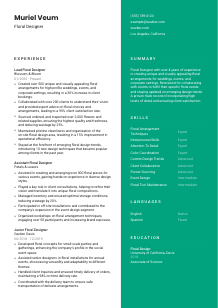
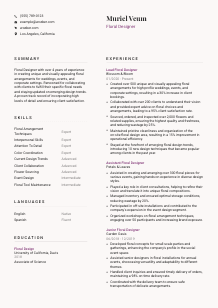
Blooming with creativity, but your CV still seems like a bouquet missing its centerpiece? Arrange your credentials with this Floral Designer CV example, created with Wozber free CV builder. Learn how to showcase your floral skills to match job requirements, making your career path as vibrant and beautiful as your arrangements.

Floral design is judged in the details. Hiring teams look for someone who can translate a client brief into arrangements that feel intentional, hold up through transport and installation, and stay visually consistent across weddings, corporate events, retail orders, or seasonal work. Your CV needs to show both design sensibility and the practical discipline behind it, from flower care and sourcing to client consultation and setup execution.
A tailored CV helps your strongest work surface fast, especially when an ATS first scans for terms like floral arrangement techniques, client collaboration, colour coordination, and event work. Wozber's free CV builder makes it easier to align your wording with the posting and keep an ATS-friendly CV format, so the hiring team can quickly see whether your experience fits the kind of floral production, client-facing work, and design quality they need.
This section does straightforward work, but it still affects how easily an employer can place you in the role. For floral design positions, that often means making your professional identity, contact information, and any location requirement immediately clear without crowding the top of the page.
Set your name in a clean, readable font that stands slightly above the rest of the header. Floral design is a visual field, but your CV header should feel polished and restrained, more like good event signage than decorative branding.
Place "Floral Designer" directly under your name when that is the role you are applying for. This removes ambiguity right away and helps align your CV with both the posting language and ATS matching.
Include a phone number you answer reliably and a professional email address, ideally in a simple format such as firstname.lastname@email.com. If you also have a portfolio site or professional Instagram that shows wedding work, installations, or arrangement style, include it only if the presentation is client-ready.
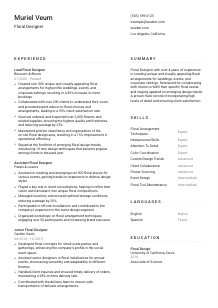
If a role specifies a local requirement, reflect that in your header. In the example here, listing "Los Angeles, California" immediately addresses the employer's location filter and avoids questions about relocation before anyone reads your design experience.
Do not add age, marital status, photo, or other personal details unless they are standard and necessary in your market. Floral employers need to know how you design, source, consult, and execute, not unrelated personal background.
Your header should answer the basics at a glance: who you are, how to reach you, what role you do, and whether you meet any stated location requirement. That keeps the focus where it belongs, on your floral work.




For a Floral Designer, experience is where hiring teams look for proof that you can deliver arrangements people actually buy. They want to see the scale of your work, the types of occasions you have handled, how you work with clients, and whether you can manage quality from sourcing through setup.
Read the description closely and mark the responsibilities that define daily performance. Here, the role centers on custom arrangements for weddings, events, and corporate settings, client consultation, flower sourcing and inspection, workspace upkeep, and awareness of current design trends. Those are the themes your experience bullets should reflect.
Use reverse chronological order so employers can see your current level of responsibility first. For each job, include your title, employer, and dates. In floral design, progression from junior or assistant work into lead design, client-facing ownership, or event execution tells a useful story about trust and range.
Instead of writing only that you "created arrangements" or "worked with clients," show scope and result. The sample CV does this well with details such as creating more than 500 arrangements, consulting with more than 200 clients, and supporting weddings, events, and corporate work. Even if your numbers are smaller, name the occasion types, design volume, or service impact.
Use numbers where they naturally fit the profession: booking growth, client satisfaction, reduced flower waste, on-time delivery, event volume, workshop attendance, or inventory efficiency. A line like "reduced wastage by 25% through tighter sourcing and storage practices" says much more than a generic claim about being detail-oriented.
Keep the section focused on design execution, consultations, installations, sourcing, inventory handling, upkeep of tools and displays, and other responsibilities that connect to floral production. If an older role is only partly relevant, keep the bullets that show transferable work such as client service, visual merchandising, or event support and trim the rest.
By the end of this section, a hiring manager should be able to picture the kinds of arrangements you have produced, the clients you have served, and the level of responsibility you can take on in the design area or at an event site.
Education usually plays a supporting role in floral design hiring, but it still helps when it shows formal training in design principles, plant handling, colour theory, event styling, or related creative work. Present it clearly and let it reinforce the hands-on experience above it.
Some floral roles focus almost entirely on portfolio, shop experience, and event execution. Others value formal study in floral design, horticulture, art, or event design. If the posting does not require a degree, keep this section concise and relevant rather than trying to make it carry the application.
List your degree, field of study, school, and graduation year. That is enough for most Floral Designer CVs. The sample uses this format well with an Associate of Science in Floral Design, which quickly tells the reader the training is directly tied to the craft.
If you studied floral design, horticulture, botany, visual merchandising, or another closely related field, make that easy to spot. A field name that connects to arrangement technique, flower care, or design composition adds useful context, especially earlier in your career.
Relevant coursework can help if you are newer to the field or if your degree title is broad. Classes in floral arrangement, colour theory, plant identification, event decor, or retail design can strengthen the section. Skip the course list if your work history already covers those strengths clearly.
Honors, design showcases, student projects, or club leadership can belong here when they connect to floral work or event styling. For an early-career candidate, a capstone project on wedding florals or a design competition may be worth mentioning. For a more experienced florist, keep the focus tighter.
Your education section should support your credibility without overstating it. If your training is directly tied to floral design, make that visible. If your experience carries more weight, let education stay concise and professional.
Certifications can matter more in floral design than in many other creative fields because they show structured training, current standards, and commitment to the craft. They are especially useful when a posting mentions a state-specific certification or license, or when you want to underline advanced professional development.
Start with the posting. If a certificate, license, or state requirement is mentioned, make sure the matching credential is easy to find. In this example, the job notes state-specific certification if applicable, so a credential such as Certified Floral Designer can strengthen your case.
List floral-industry certificates before unrelated training. A recognized credential like "Certified Floral Designer (CFD)" immediately supports your technical credibility in arrangement work, design principles, and professional standards.
Name the issuing organisation and include the year earned or active date range. This helps employers understand whether the credential is current and from a respected source. The sample CV handles this clearly by pairing the CFD credential with the American Institute of Floral Designers.
Refresh this section as your training evolves. Add new floral certifications, workshops, or licensing updates that reflect current practice, and remove items that no longer add value. In a field shaped by trends, seasonality, and event expectations, recent development matters.
Use certifications to reinforce expertise that the rest of the CV already suggests. They work best when they support your design experience, confirm required credentials, or show that your skills are current.
The skills section should read like the working toolkit behind your arrangements. Employers hiring Floral Designers are usually scanning for technical design ability, client-facing judgment, and the practical shop or event skills that keep quality high from prep table to final placement.
Build this section from the posting and your real experience. Here, that includes floral arrangement techniques, colour coordination, interpersonal skills, client collaboration, flower sourcing, and awareness of current design trends. Those terms match how the work is described and help with ATS alignment.
Order the list so the most important abilities appear first. For this kind of opening, design technique, attention to detail, colour work, and client collaboration should appear before secondary skills. The sample CV does this effectively by leading with core floral competencies rather than generic soft skills.
Do not turn this section into a catch-all. Choose skills that connect directly to arrangement quality, event execution, sourcing, care, consultation, and shop organisation. A shorter list with precise floral language is stronger than a long list filled with broad traits.
Your skills should back up the work shown in your experience section. When the terms match the posting and reflect real floral practice, employers can quickly see the technical and client-facing strengths you bring into the design room.
Language skills matter in floral design when the work involves consultations, vendor coordination, delivery communication, or a diverse client base. Keep this section practical and tied to how communication happens on the job.
If the role specifies a working language, include it clearly. This posting requires the ability to operate in an English-speaking environment, so "English" should appear prominently with an honest proficiency level.
List the languages most useful for consultations, event coordination, and day-to-day teamwork first. In customer-facing floral roles, clear communication can directly affect order accuracy, design expectations, and service quality.
Extra languages can strengthen your profile if they help you serve a broader client base or work smoothly with vendors and event teams. In the example, Spanish is a practical addition in a large, diverse market, though it is an advantage rather than a universal requirement.
Use clear labels such as "Native," "Fluent," "Intermediate," or "Basic." Avoid exaggeration. If you can handle client consultations, vendor calls, or written order notes in a language, your stated level should reflect that honestly.
For a boutique shop with mostly local walk-in business, one required language may be enough. For wedding studios, hospitality settings, or markets with multilingual clients, additional language ability can be a real differentiator. Include it when it supports the kind of floral work you want to do.
Keep this section grounded in communication that matters on the job. When listed clearly, languages can show that you are ready to handle consultations, team coordination, and client service without friction.
Your summary should quickly place you in the floral market you want to work in. It needs to capture your level of experience, the kinds of arrangements or events you handle, and the strengths that show up repeatedly in your work, without slipping into generic creative language.
Before writing, identify the two or three ideas the employer cares about most. In this case, those include custom floral arrangements for events, strong client collaboration, trend awareness, and careful sourcing and presentation. Your summary should reflect those priorities in natural language.
Start with your title and a credible snapshot of your experience level. A line like "Floral Designer with 4+ years of experience creating arrangements for weddings, events, and corporate settings" works because it establishes both role and scope immediately.
Use one or two follow-up sentences to show what you are known for. That might be client consultation, colour coordination, event installation, fresh product sourcing, or maintaining high satisfaction rates. The sample summary works because it ties visual design skill to client needs and current trends rather than relying on vague creativity claims.
Aim for three to five lines. Avoid listing every skill or repeating bullets from your experience section. A hiring manager should be able to read the summary quickly and understand your floral specialty, your working style, and the kind of value you bring before moving into the rest of the CV.
A good summary makes your direction clear right away. It should tell the reader what kind of Floral Designer you are, what settings you have worked in, and why your background matches the opening they need to fill.
A Floral Designer CV works best when it shows the balance behind the craft: visual judgment, client communication, careful sourcing, and reliable execution for live events and daily orders. If those strengths are clear across your header, experience, skills, and summary, the hiring team can quickly see where you fit.
Use Wozber's free CV builder to organise that experience into an ATS-compliant CV, then refine it with ATS CV scanner feedback and targeted wording. The finished CV should make one thing easy to judge: whether you can design, coordinate, and deliver floral work that clients will remember.