



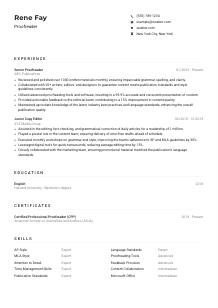
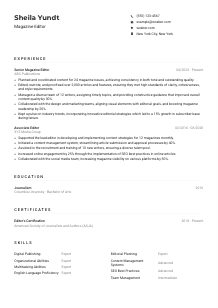
Use Wozber and land your dream job
Create CV
No registration required
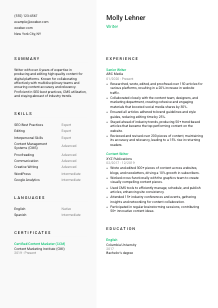
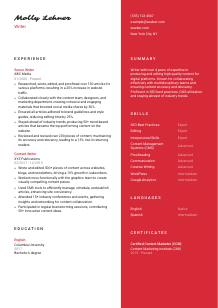
Weaving words, but your CV reads flat? Check out this Writer CV example, created with Wozber free CV builder. Learn how to shape your literary prowess to match job narratives, turning your career story into a bestseller!
Writing jobs are won on range, control, and consistency. Hiring teams want to see whether you can move between research, drafting, editing, proofreading, and publishing without losing brand voice, accuracy, or deadline discipline. A writer CV needs to show published output, collaboration with editors or designers, and the business effect of your content, whether that means traffic, engagement, conversions, or subscriber growth.
When those details are tailored to the posting, your CV is easier to sort in both human review and ATS screening. Wozber's free CV builder helps you align section wording with the role's language, keep an ATS-friendly CV format, and make it immediately clear that your experience covers digital content workflows, editorial standards, and the channels the team needs you to write for.
This section is simple, but it still carries hiring value. For a writer, clean contact details and a relevant professional title set the tone right away. If the job includes a location requirement or portfolio expectation, handle both here so the rest of the CV can stay focused on your editorial work.
Put your name at the top in a larger, readable font. Writers are expected to care about presentation, so avoid decorative styling, nicknames, or anything that makes your header look cluttered. Keep it polished and publication-ready.
Place "Writer" under your name when that is the role you are pursuing. If your current title is more specific, such as Content Writer or Senior Writer, you can still use the target title when it accurately reflects your background. That immediate label helps position you for editorial, digital content, and cross-channel writing roles before the reader reaches your experience section.
List a current phone number and a professional email address, then proofread them as carefully as you would a final draft. Writers are often screened for attention to detail from the first line onward. A typo in your email or a broken website link can undercut claims about editing and proofreading strength.
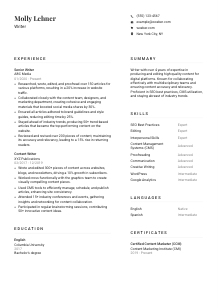
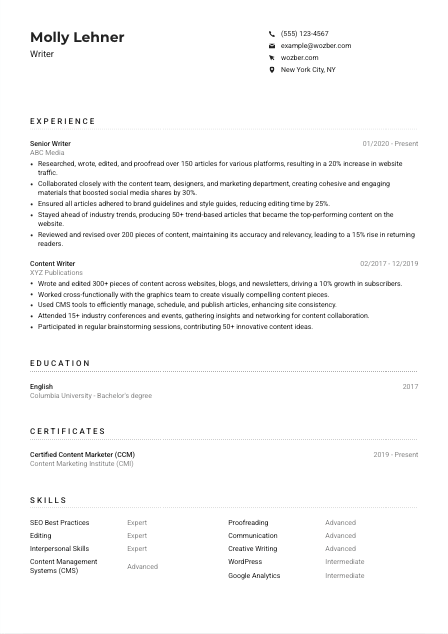
If the employer requires a specific location, add your city and state. In the example, "New York City, NY" answers that requirement directly and removes a practical question before it slows the application down. Only include full address details if specifically requested.
A website, portfolio, or published work link gives hiring teams a fast way to review your voice, range, and subject matter. This matters even more for digital writing roles where blog posts, landing pages, newsletters, or social content often carry as much weight as the CV itself. Make sure the samples reflect the kind of work you want next.
Your header should answer the basics in seconds: who you are, what role you do, how to reach you, and whether you meet any practical requirement such as location or portfolio access.




For writers, experience is where the hiring decision usually sharpens. Employers look past job titles and scan for output volume, channel mix, editorial ownership, SEO awareness, revision work, and collaboration with designers, marketers, or content leads. Your bullets should show what you wrote, how you worked, and what changed because of it.
Choose roles and bullet points that match the posting's core tasks. If the employer needs someone who can research, write, edit, proofread, and maintain content across websites, blogs, and social channels, lead with experience that shows those exact workflows. Older or less relevant writing work can stay shorter unless it adds a useful specialty such as industry knowledge or a strong audience focus.
For every position, include company name, job title, and employment dates. That basic structure matters because writing careers often span agencies, media companies, in-house teams, and freelance projects. Clear chronology helps the reader follow your progression from content production to stronger editorial ownership or broader channel responsibility.
Writers are often hired for output and impact, so show both. Instead of listing "wrote blog posts," specify scope and result, such as publishing 150 articles, increasing website traffic by 20%, or lifting social shares by 30%. The example CV does this well by tying writing and collaboration work to traffic, returning readers, and editing efficiency.
Good writer bullets do more than list topics. Mention where the content lived, how it was managed, and how often it was reviewed. Website articles, blogs, newsletters, social posts, CMS publishing, brand guideline adherence, and ongoing content updates all matter here. A line about reviewing 200 pieces to keep them accurate and relevant says a lot about editorial reliability.
Use space on the page for work that strengthens your case for digital, editorial, or brand content writing. If a bullet does not show writing quality, channel experience, collaboration, or measurable business effect, revise it or remove it. Relevance is especially important when the posting emphasizes SEO, CMS use, proofreading, and teamwork across departments.
Your experience section should show that you can produce clean copy at scale, adapt to different platforms, work with creative and marketing partners, and improve content performance through revision and editorial judgment.
Education is rarely the deciding factor for a writer with a solid portfolio, but it still matters when a posting asks for a specific degree background. Use this section to confirm the academic foundation behind your writing, editing, research, or communications skills without taking focus away from your published work and results.
If the job asks for a bachelor's degree in English, Journalism, Communications, or a related field, state your degree in a direct, standard format. In the example, a Bachelor's degree in English lines up neatly with the posting. That kind of match is worth making easy to spot.
Keep the entry concise and complete. Listing the institution, degree, field of study, and graduation date gives the reader enough context without crowding the page. Writers do not need elaborate formatting here. Clean structure is enough.
If you are early in your career, relevant coursework in journalism, digital media, editing, rhetoric, or communications can help. The same goes for student publications, editorial boards, or long-form writing projects. For experienced writers, these details are optional unless they directly support the kind of content job you are targeting.
Include honors, awards, or extracurriculars only if they add clear editorial value. A campus literary journal, newspaper leadership role, or writing award can support your profile. Generic clubs or unrelated activities usually do not earn space once your professional experience is established.
Writing roles on digital platforms change with SEO practices, content strategy, audience behaviour, and publishing tools. If you have taken recent courses in content marketing, search optimisation, analytics, or CMS platforms, they can strengthen this section, especially when your degree is older or from an adjacent field.
Keep this section straightforward. It should quickly confirm that you meet the academic requirement and, when useful, show training that supports your editorial and digital content work.
Certifications are optional for many writing jobs, but the right one can reinforce digital publishing knowledge, content strategy skills, or platform fluency. They work best when they connect to the actual demands of the role rather than filling space.
Look for certificates that relate to SEO, content marketing, analytics, digital publishing, brand writing, or editorial processes. A certification such as Certified Content Marketer supports a writer profile because it shows you understand both copy quality and content performance, not just drafting.
A certificate can help surface capabilities that are only lightly represented elsewhere on the CV. If your experience bullets focus on writing volume, a credential in SEO or content strategy can round out your profile. If your background is more editorial, a CMS or analytics-related course can signal digital platform readiness.
Always list the certificate name, issuing organisation, and date earned or validity period. That timeline matters because platform tools and search practices change. A recent credential often carries more practical weight than an older one with no clear link to current workflows.
Do not load this section with every workshop you have attended. Keep the certifications that strengthen your case for the specific writing role in front of you. One relevant credential is more convincing than a long list of loosely connected training items.
If you include certifications, make sure they sharpen your profile in a useful way, whether that is SEO fluency, content marketing knowledge, or stronger command of digital publishing tools.
A writer's skills section should read like the toolkit behind the content. Hiring teams look for a mix of editorial craft, digital platform knowledge, and collaboration skills. Mirror the language of the job description, but only with skills you can back up in your experience or portfolio.
Start with the requirements and responsibilities. For this role, that includes SEO best practices, CMS proficiency, proofreading, editing, communication, and interpersonal skills. Those terms deserve priority because they connect directly to the day-to-day work of producing and refining content across digital channels.
List the editorial abilities that shape quality, such as writing, editing, proofreading, brand voice, and research, alongside digital skills such as CMS use, WordPress, SEO, Google Analytics, or content scheduling tools when relevant. That mix shows you can create strong copy and operate within modern publishing workflows.
Lead with the abilities the employer is most likely to scan for first. In the example, SEO, editing, CMS knowledge, proofreading, and communication belong near the top because they map closely to the posting. Secondary skills such as creative writing or analytics can follow once the core requirements are covered.
The best skills section for a writer is specific, job-aligned, and easy to support elsewhere on the page. If a skill matters to the role, make sure your experience shows how you used it.
Most writing jobs are centered on one primary language, and accuracy matters. This section is useful when the employer explicitly asks for English proficiency or when additional languages could support audience reach, research, localization, or cross-market communication.
If the role calls for strong English communication, list English first and state your level clearly. In the example, "English - Native" answers that requirement in a direct way. For writers, this section should reinforce command of language, not leave room for interpretation.
Additional languages can help in content research, multicultural audience work, interviews, or region-specific campaigns. They are especially useful when the company serves diverse readerships or publishes across markets. If another language does not strengthen your candidacy, it does not need to be listed.
Choose standard terms such as Native, Fluent, Advanced, Intermediate, or Basic. Writers are expected to communicate precisely, so avoid vague descriptors. Clear proficiency levels help the employer understand whether you can write, edit, research, or simply converse in that language.
For some writer positions, multilingual ability is a bonus rather than a requirement. In those cases, include it as supporting value, not as a substitute for strong English writing credentials. The main hiring question is still whether you can produce polished copy in the language the role uses every day.
When relevant, multilingual ability can signal cultural awareness, audience sensitivity, and broader source access. Those strengths can matter in content strategy, brand storytelling, and research-heavy writing, especially when topics or readerships cross regions or communities.
For a writer, language skills should clarify communication strength and audience range. Keep the section direct, accurate, and connected to the kind of content work you want to do.
The summary is a short editorial pitch at the top of the page. It should tell the reader what kind of writer you are, how much experience you bring, and which strengths matter most for the role. Keep it brief, but make sure it covers the writing environment you know best and the outcomes you deliver.
Open with your title and years of experience in a way that sets context fast. "Writer with over 4 years of experience" works because it quickly establishes seniority and role focus. If you specialise in digital content, brand writing, editorial work, or B2B content, include that angle when it helps narrow your profile.
Use the next sentence to highlight the skills that matter most for the role, such as SEO, CMS use, editing, proofreading, cross-functional collaboration, or multi-platform content production. The example summary does this effectively by naming digital platforms, teamwork, SEO, and content accuracy.
Aim for a few lines, not a full paragraph block. Writers are expected to edit tightly, so every phrase should carry information. Drop filler adjectives and focus on concrete strengths, tools, content types, and outcomes.
End with a clear statement about the contribution you make. That might be producing high-performing digital content, maintaining brand consistency, improving engagement, or keeping published material accurate and current. The closing line should connect your craft to the team's content goals.
After reading these lines, a hiring manager should know whether you are a digital content writer, editorial specialist, SEO-focused writer, or broad multi-channel contributor, and why your background fits the opening.
A writer CV works best when it reads with the same control as the content you create. Keep the language clean, match the posting's priorities, and show measurable results from the channels and workflows you know well. Your strongest version will connect writing craft with platform knowledge, collaboration, and content performance.
Wozber can help you tighten that process from start to finish. Use Wozber's free CV builder to shape an ATS-compliant CV, refine wording with AI-assisted tailoring, and check alignment with an ATS CV scanner so your experience maps clearly to the role's requirements. The final draft should make one thing easy to judge: you can produce reliable, effective content in the environments where this team publishes.