



Use Wozber and land your dream job
Create CV
No registration required
Polishing prose, but your CV feels rough around the edges? Check out this Editor CV example, created with Wozber free CV builder. Learn how to match your editorial finesse to job demands, crafting a career narrative that flows as smoothly as your best manuscripts!
Editors are trusted with work that carries a publication's voice, credibility, and production rhythm. Hiring teams look quickly for proof that you can tighten copy, protect style standards, work productively with writers, and keep content moving cleanly from draft to final version. Your CV should make that editorial judgment visible from the first section.
When an editor CV mirrors the language of the posting, screening gets much easier, especially in an ATS-compliant CV. Wozber's free CV builder helps you line up your experience with the right terms, from copyediting workflows to writer collaboration and production coordination, so the CV reads clearly to both software and the people deciding who can step into the editing process with confidence.
For editor roles, the contact section is simple but strategic. It should confirm who you are, how to reach you, and whether you meet any practical requirements stated in the posting, without distracting from your editorial credentials.
Use your full name as the most visible text on the page. Editors are expected to care about presentation, hierarchy, and readability, so even this first line should look deliberate and polished. Choose a straightforward font and avoid decorative styling that would feel out of place in a publishing or media context.
If the target job is for an "Editor," use that title directly beneath your name unless your current level needs a closer variation such as "Senior Editor" or "Editor-in-Chief." Matching the posting helps position you correctly in ATS searches and immediately tells the reader which lane of editorial work you are pursuing.
List a current phone number and a professional email address you actually monitor. For editorial hires, small errors can carry more weight than they do in many other fields, so double-check every character. If you include a portfolio site or LinkedIn profile, make sure the writing samples, publication credits, and job titles there match your CV.
Some editor openings have clear location expectations tied to newsroom schedules, office collaboration, or production workflows. Here, the role specifically asks for New York, New York, so showing that in your personal details removes an immediate question. Treat location as tailoring to the posting, not as something every editor CV must emphasize.
A personal website, portfolio, or LinkedIn profile can strengthen your application if it shows edited pieces, publication work, content strategy, or leadership in editorial teams. Keep it relevant. A link should give hiring managers a sharper view of your editorial judgment, not send them to unrelated content.
Your personal details should confirm the basics without friction: your role identity, your contact information, and any practical requirement such as location. That lets the reader move straight to the work that proves your editorial range.




This section does the heaviest lifting for an editor CV. Hiring teams want to see the kind of content you handled, how you improved it, how you worked with writers, and whether you could keep quality high while meeting deadlines and publication schedules.
Before rewriting your bullets, note the operating themes in the job description. For this role, those include professional editing experience, command of grammar and tone, use of tools like Track Changes or Suggest Edits, writer communication, and coordination with design or production. Those points should guide which accomplishments you lead with and which wording you mirror.
List your most recent editing role first with title, employer, and dates. That structure helps hiring managers quickly track your progression from hands-on editing to senior review, writer management, or editorial leadership. For experienced editors, recent work usually carries the strongest signal because it reflects current style standards, workflows, and tool use.
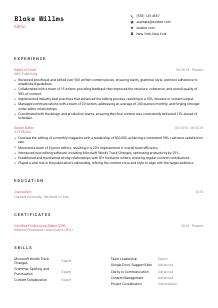
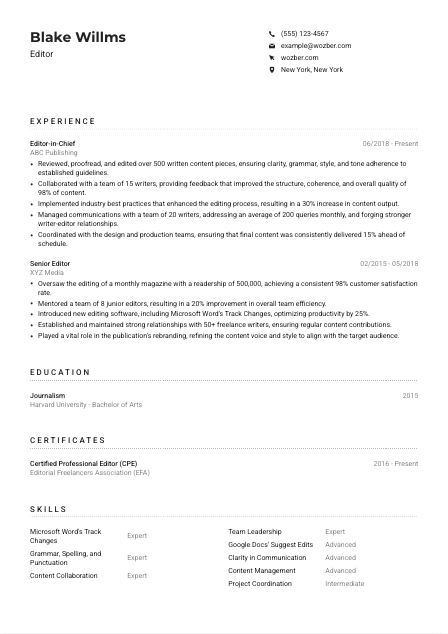
Bullet points should show what changed because of your editing. Instead of writing only that you "edited content," specify the volume, the type of material, or the improvement delivered. The sample CV does this well with lines such as editing more than 500 content pieces and improving the structure and coherence of work produced by a team of writers. That tells the reader about scope, quality control, and collaboration in one pass.
Numbers help when they reflect how editing is actually measured: content volume, on-time delivery, output increases, readership, satisfaction rates, turnaround improvements, or writer response volume. Metrics like a 30% increase in content output or delivery 15% ahead of schedule make your contribution concrete without sounding forced. Use figures that connect directly to editorial quality, efficiency, or production reliability.
Keep the focus on work that resembles the role you want. Publishing, media, content teams, and newsroom-style environments usually matter more here than unrelated writing or administrative experience. If you have older roles that are less relevant, shorten them and give more space to jobs where you reviewed copy, guided writers, enforced style, or worked across editorial and production teams.
Your experience section should show that you can improve copy, communicate edits clearly, and keep content moving through the publication process. If those points are obvious in a few fast scans, the CV is doing its job.
Education matters most here as a qualification check and a credibility marker. For editor roles, the key question is whether your academic background supports strong language command, reporting discipline, or communication training relevant to publishing and media work.
When a job calls for a bachelor's degree in Journalism, English, Communications, or a related field, make that information easy to find. If your degree matches directly, as it does in the sample with a Bachelor of Arts in Journalism, that alignment is worth making explicit near the top of the section.
List the degree, field of study, school, and graduation year in a clean format. Editors are used to reading structured information quickly, so this section should feel orderly and easy to scan. Unless you are early in your career, there is usually no need to add extra explanation around a straightforward degree entry.
If your degree is closely tied to editorial work, do not bury the field of study. Journalism, English, and Communications all carry obvious relevance because they point to training in writing, language, analysis, and audience-aware communication. Put that connection to work for you.
Relevant courses can help if you are a newer editor or your degree title is broader than the posting's preferred fields. Classes in copyediting, news writing, publishing, rhetoric, media studies, or communications can show useful preparation. For experienced editors, though, strong professional experience will usually matter more than a long course list.
Honors, editorial roles on student publications, or research projects tied to writing and media are worth including when they support your current positioning. If you led a campus publication, edited a journal, or graduated with distinction in a writing-heavy program, those details can reinforce editorial discipline and responsibility.
For most editor applications, education should confirm that you meet the degree requirement and have a strong language or communications foundation. Let it support the CV, not compete with the experience section.
Certificates are rarely the first filter for editor roles, but they can strengthen your profile when they show continued development in editing standards, publishing practice, or relevant tools. Use them to reinforce specialization, not to pad the CV.
List certificates that speak to the actual work of editing, such as copyediting, proofreading, editorial standards, publishing workflows, or recognized professional associations. If the job description does not require certifications, relevance matters more than quantity.
A certification should sharpen your positioning. In the sample, "Certified Professional Editor (CPE)" works well because it directly supports the candidate's editorial identity and complements years of publishing experience. One strong, role-linked credential is more useful than several general learning badges.
Dates help readers understand recency and whether a credential is active. That can matter in fields where style guidance, digital publishing practices, and editing tools continue to evolve. If the certification is current or ongoing, say so clearly.
Editors are expected to stay current with changing style guidance, digital workflows, accessibility standards, and audience expectations. Recent coursework or active certification study can support that point, especially if your recent job titles do not fully show your growth. Keep the emphasis practical and tied to your editorial work.
A focused certificates section can add depth to your editorial profile, especially when it supports your niche or shows continued growth. Keep every entry connected to the kind of content and workflow the target role involves.
A useful skills section for an editor does more than list broad strengths. It should reflect the tools, language control, collaboration habits, and production awareness that show up in day-to-day editing work and in the job posting itself.
Start with the terms the employer already uses. Here, that includes grammar, spelling, punctuation, editing software, collaboration with writers, communication, and consistency of written content. Those phrases are strong anchors for both ATS optimisation and human review because they mirror the role's actual demands.
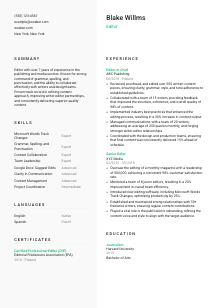
Feature the abilities you can support elsewhere in the CV. If you mention Microsoft Word's Track Changes, Google Docs' Suggest Edits, content collaboration, or project coordination, make sure your experience bullets show you using those skills in real editorial settings. The sample CV handles this well by pairing tool knowledge with process improvements and writer management.
Editors often have a wide range of capabilities, from line editing to content planning, but the CV should lead with the skills most relevant to the target role. Put core editorial strengths first, then add supporting tools or coordination skills. A short, well-ordered list is more effective than a crowded section full of vague traits.
Your skills should show that you can handle the mechanics of editing, communicate with writers, and work inside a real content workflow. If the list reads like the toolkit of a working editor, it is on target.
Language sections matter differently for editors than they do for many other professions. Even when the role is English-first, the way you present language proficiency can reinforce command of language, audience range, and communication flexibility.
This posting explicitly asks for a strong command of English, so English should lead your language section. If you are a native speaker or operate at a professional near-native level, say so clearly. For editors, language credibility is not a side note. It is part of the core qualification.
Additional languages can be valuable in multilingual editorial environments, audience development, international publishing, or writer communication across markets. In the sample, Spanish adds breadth without distracting from the English-first focus. Include extra languages when they say something meaningful about the work you can support.
Use clear labels such as Native, Fluent, Advanced, or Intermediate. Editors are expected to write precisely, so avoid inflated descriptions. A realistic rating protects your credibility and helps employers understand where a second language might be useful in editing, review, or communication workflows.
Some editor jobs need only excellent English-language command, while others benefit from multilingual ability for source review, international editions, or diverse contributor networks. Read the posting closely and decide whether your language range is a secondary advantage or a central qualification.
A language entry should support a real professional advantage, such as editing for multilingual audiences, working with international contributors, or understanding source material more directly. If it does not strengthen your editorial profile, leave it out. If it does, keep it concise and credible.
For most editor CVs, English proficiency is the main point to establish clearly. Any additional language should support the kind of content, audience, or contributor base you can work with.
The summary sets the editorial frame for the rest of the CV. It should quickly establish your level, your environment, and the kind of editing work you do well, using language that matches the role rather than broad personal branding.
Read the posting and identify the few themes that matter most. For this role, that means editing experience, command of English mechanics, collaboration with writers, and coordination across teams. Those points should shape your opening lines rather than generic claims about being passionate or detail-oriented.
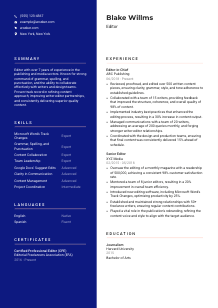
Start with a direct statement of who you are professionally. The sample summary does this effectively with "Editor with over 7 years of experience in the publishing and media sectors." That kind of opening immediately establishes seniority and domain context, which are both useful screening cues.
After the opener, mention the strengths that matter in day-to-day editorial work. Strong grammar and punctuation, refining structure and tone, collaborating with writers, and coordinating with design or production teams are all better choices than vague descriptors. Keep the focus on how you operate as an editor.
A summary should sharpen the reader's expectations, not repeat the whole experience section. Aim for a compact paragraph that introduces your editorial scope and strongest qualifications, then lets the bullet points carry the proof. Concise writing is part of the impression you are creating here.
A well-written summary tells the reader what kind of editor you are, where you have worked, and what strengths you bring to the publication process. That is enough to frame the rest of the CV with confidence.
An editor CV should read the way edited copy reads: clear, controlled, and purposeful. Every section should support the same message that your background fits the publication's workflow, whether that means copy quality, writer collaboration, production timing, or command of editorial tools.
Use Wozber to tighten that alignment with an ATS-friendly CV format, job-specific phrasing, and an ATS CV scanner that helps surface missing requirements before you apply. When the wording, structure, and evidence line up, your CV makes it easy to judge whether you can improve content and keep it moving to publication.




