



Use Wozber and land your dream job
Create CV
No registration required
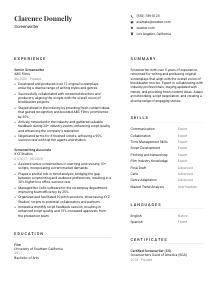
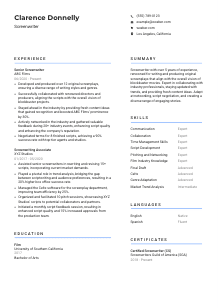
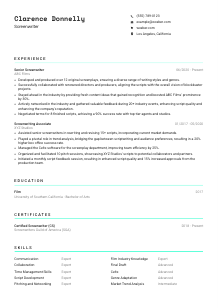
Scripting stories, but your CV lacks the right dialogue? Browse this Screenwriter CV example, created with Wozber free CV builder. Learn how to weave your narrative talents into a compelling career arc, making your writer's journey as engaging as the films you create!
Screenwriting CVs are often weakened by language that sounds artistic but says very little about the work itself. Hiring teams want to see how you develop original scripts, revise under notes, shape material for production realities, and contribute inside a collaborative process with directors, producers, and story teams. Your CV should make that writing practice visible, not hide it behind vague claims about creativity or passion.
A tailored CV changes what gets noticed first. When the wording reflects the project's needs, whether that means feature development, genre versatility, rewrite work, pitching, or fluency with screenwriting software, the reader can quickly place your experience in the right lane. Wozber's free CV builder helps you shape that alignment in an ATS-friendly CV format, so your credits, tools, and story-development strengths are easier to connect to the role at hand.
This section is short, but it still does real work for a screenwriter. It establishes your professional identity, gives producers or recruiters a direct way to reach you, and can immediately confirm practical details that matter for a fast-moving hiring process, especially when a posting includes a location requirement or expects portfolio access.
Use your full name as the most visible line on the page. Keep the formatting clean and professional so it reads more like a byline than a design element. In creative fields, over-stylized headers can distract from the actual writing credentials you want someone to notice first.
Place "Screenwriter" directly under your name if that is the role you are pursuing. If your background spans adjacent work such as journalism, copywriting, or story editing, the title helps remove ambiguity and anchors the CV in screenplay development rather than general writing.
Include a reliable phone number and a professional email address. Double-check both. If a producer, coordinator, or agency contact wants to follow up after reading a sample or pitch note, any error here creates friction you do not need.
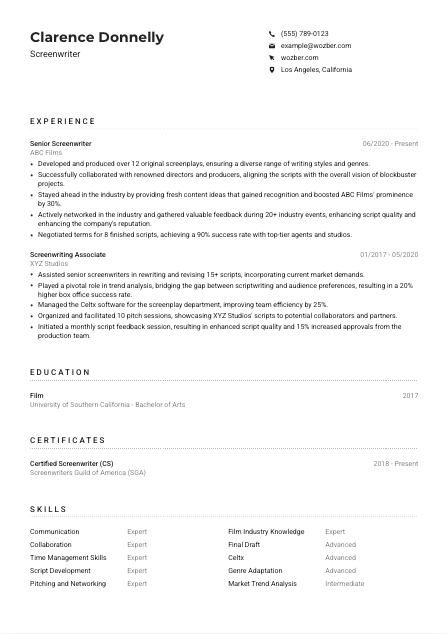
If a job specifies a city or market, mirror that in your contact details. In the example here, listing "Los Angeles, California" directly supports the stated requirement. Treat this as targeted tailoring, not a rule for every screenwriting CV.
A personal website, portfolio page, or professional profile can give context beyond a one-page CV. For screenwriters, this is especially useful when it leads to loglines, writing samples, contest placements, produced credits, or project summaries. Make sure the link works and reflects the kind of material you want to be hired for.
Your contact section should confirm that you are a working writer who is easy to reach, appropriately positioned, and prepared to share material. Keep it clean, accurate, and aligned with any practical requirement named in the posting.




For a screenwriter, experience is where the CV either becomes credible or stays generic. Hiring teams look for proof that you can generate material, revise under direction, work across stakeholders, and move scripts from idea to draft to pitch or sale. This section should read like a record of completed writing work, not a list of broad creative traits.
Before drafting bullets, identify the actual work the employer names. Here, that includes developing original screenplays, revising scripts, collaborating with directors and producers, tracking market trends, attending pitch sessions, and negotiating sales or options. Those responsibilities should guide what you emphasize in your own experience section.
List your positions in reverse chronological order with title, company, and dates. That structure helps a reader see whether you have moved from assistant or associate-level support into full script ownership, rewrite authority, or senior creative collaboration. The example shows that progression clearly from Screenwriting Associate to Senior Screenwriter.
Each bullet should show what you wrote, revised, pitched, or influenced. Strong lines mention screenplay volume, genre range, collaboration with decision-makers, or improvement to a script development process. "Developed and produced over 12 original screenplays" works because it combines output, originality, and range in one line.
Numbers help when they reflect how writing work is actually measured. That might include scripts completed, pitch sessions led, approval rates, production wins, option agreements, event participation, or business results tied to content performance. In the example, negotiating terms for 8 finished scripts with a 90% success rate gives the reader a concrete sense of commercial traction.
Every bullet should strengthen your case for screenplay development, revision, collaboration, or market awareness. If you have adjacent experience in content, journalism, editing, or communications, keep the points that translate into story structure, audience insight, deadline management, or professional writing under feedback. Leave out tasks that do not help a producer or studio imagine you in the role.
Your experience section should show that you have done the actual job of a screenwriter: writing, rewriting, collaborating, pitching, and moving stories toward production or sale. When those points are concrete, the hiring team can judge your range and working style quickly.
Education matters most when it supports the writing path you are presenting. For screenwriters, that usually means showing formal grounding in film, English, dramatic writing, storytelling, or another field that connects naturally to script development, narrative analysis, or screen media.
Start by checking how the posting describes the academic baseline. In this case, a bachelor's degree in Film, English, or a related field is requested. If you meet that requirement, make it easy to spot with clear degree and field labeling.
List your degree, field of study, school, and graduation year. That is usually enough. Recruiters and coordinators should be able to scan this section in seconds without hunting for basics.
When your degree directly relates to screenwriting, do not bury it. A Bachelor of Arts in Film, like the one shown in the example, immediately supports familiarity with cinematic storytelling, screenplay structure, and production context.
If you are early in your career or your strongest preparation came through academic work, you can include select coursework, thesis projects, or workshops in screenwriting, adaptation, dialogue, film analysis, or story development. Skip generic course lists that do not deepen the screenwriting profile.
Festival selections, script labs, writing awards, film club leadership, or capstone projects can strengthen this section when they connect directly to story craft or production collaboration. This is especially useful if your professional credits are still growing.
Keep this section concise, but make sure it supports the narrative of how you developed as a writer. When the degree, field, and relevant training line up cleanly with screen work, the section does its job.
Certifications are rarely the centerpiece of a screenwriter CV, but they can still help when they point to specialised training, recognized programs, or continued development in writing craft, story analysis, or entertainment business practice. Use this section to add substance, not filler.
Focus on certificates, fellowships, guild programs, workshops, or structured training that deepen your screenwriting profile. A credential should connect to screenplay development, revision, pitching, genre writing, or the business side of selling work.
If you have several credentials, list the ones most relevant to the job you want now. For example, a screenwriting certification or respected workshop matters more here than a broad creative writing course with no film connection.
Add the year earned or the active date range when relevant. Recent training can show that you are still developing your craft and staying current with industry expectations, software workflows, or market-facing writing practices.
Screenwriting careers often evolve through labs, mentorships, festival programs, and guild-affiliated education as much as through formal degrees. If you continue sharpening your writing or pitching skills, let that show here in a compact, relevant way.
A concise certificates section can strengthen your profile when it reflects real screenwriting development. Choose credentials that add context to your writing practice or industry engagement, then move on.
A screenwriter's skills section should balance craft and workflow. Hiring teams want to see narrative strengths, collaboration habits, and tool familiarity that match how scripts are actually developed, revised, and shared in production environments. A generic list of soft skills is not enough on its own.
Start with the language in the job description, then read for the underlying workflow. Here, the employer names communication, collaboration, time management, and software familiarity, while the responsibilities imply script development, rewriting, pitching, industry awareness, and market analysis.
Select the mix of hard and professional skills that best matches the work you want. For this example, tools like Final Draft or Celtx matter because they were named directly, while skills such as genre adaptation, script development, and pitching support the broader writing profile.
Do not turn this section into a catalogue of every writing-related term you know. Prioritise the skills most likely to matter for the role and present them clearly for both human readers and ATS optimisation. If you are using Wozber's AI CV builder or ATS CV scanner, you can quickly compare your wording with the posting and tighten the list around the most relevant terms.
The best screenwriting skills sections make it obvious how you work: what you write, how you collaborate, and which software or story-development strengths you bring into the room. That clarity matters more than a long list.
Language ability can be valuable in screenwriting when it expands the kinds of stories you can write, the dialogue you can handle authentically, or the audiences and collaborators you can work with. It is usually a supporting section, but for some projects it can become a real advantage.
Many screenwriting jobs do not require additional languages, so keep this section proportionate. If the project involves multilingual dialogue, international co-production, or culturally specific storytelling, language skills become much more relevant.
Lead with the language you use most confidently in professional or creative work. If your writing, pitching, or collaboration happens primarily in English, make that immediately clear. Additional languages should follow in order of practical value or fluency.
Include other languages only if you can describe your level accurately. Even reading or conversational ability can be useful, but overstating proficiency will create problems quickly if a project requires nuanced dialogue work or live discussion.
Terms such as "Native," "Fluent," "Professional," or "Conversational" are clear and easy to scan. The example's "English - Native" and "Spanish - Fluent" format works because it is simple and immediately understandable.
For the right project, language skills can support more authentic dialogue, stronger cultural texture, or smoother collaboration with international creatives. Mention them when they add substance to your writing profile, not just to fill space.
If your language ability strengthens the kinds of stories you can tell or the teams you can work with, include it clearly. If not, keep the section modest and accurate.
The summary sits at the top of the CV, so it needs to place you quickly. For a screenwriter, that usually means clarifying your years of experience, the kind of script work you handle, the environments you have worked in, and one or two strengths that matter for the specific opening. Keep it specific enough to sound grounded in real credits and real collaboration.
Pull the few requirements that matter most for first-pass review. In this case, that means professional screenwriting experience, original screenplay development, collaboration with directors or producers, awareness of market trends, and comfort with revision and pitching.
Start with a direct line that identifies you as a screenwriter and establishes your experience level. "Screenwriter with over 5 years of experience" works because it gives the reader immediate context without wasting space on generalities.
After the opening, mention the parts of your background that best match the job. That could include genre range, produced scripts, rewrite experience, collaboration on development projects, pitch-session success, or negotiation of script sales. The example summary works well because it ties together original screenplays, collaboration, trend awareness, and negotiation in a compact way.
Aim for 3 to 5 lines that sound like a professional introduction, not a personal statement. Focus on the writing work you actually do and the results or context that make it credible. A hiring team should finish the summary already understanding what kind of screenwriter you are likely to be.
A sharp summary gives immediate context for everything that follows. When it clearly states your experience, writing focus, and collaborative range, the rest of the CV reads with much better momentum. Wozber's ATS-compliant CV templates and ATS CV scanner can help you tune that top section so the language matches the role and the writing experience comes through cleanly.
A screenwriter CV works best when it reads like a professional track record, not a personal manifesto. Show what you have written, how you revise, who you collaborate with, and where your work has gained traction, whether that is through completed scripts, pitch activity, options, produced work, or measurable development outcomes.
Before sending it out, compare your wording to the target posting one more time. Wozber's free CV builder makes it easier to tailor each section, strengthen ATS optimisation, and present your work in an ATS-friendly CV template that keeps the focus on your writing credits, tools, and project relevance. The finished CV should make one thing clear fast: you can deliver scripts that move from page to production conversation.