



Use Wozber and land your dream job
Create CV
No registration required
Capturing magical moments, but your CV doesn't spark any interest? Focus in on this Wedding Photographer CV example, created with Wozber free CV builder. Learn how to frame your photography prowess to blend seamlessly with job requirements, so your career album always tells a success story!
Wedding photography sits at the intersection of technical control and live event judgment. Hiring managers want to see that you can work fast in changing light, direct groups without disrupting the day, and still deliver polished candid and posed images that clients will keep for years. Your CV needs to make that operating range visible before anyone opens your portfolio.
A tailored CV helps separate event shooters from photographers who understand weddings specifically, where client communication, lighting adaptability, and post-production all have to hold up under pressure. Wozber's free CV builder helps shape that story into an ATS-compliant CV by aligning your wording with the job description, so the hiring team can quickly see whether you have the experience to run a wedding day shoot with confidence.
For a wedding photographer, the header should feel professional and easy to act on. This section tells an employer how to reach you, whether you match any location requirement, and where to review your work. Keep it clean, current, and directly relevant to client-facing photography work.
Use your full name prominently and keep the styling simple. Wedding photography is a referral-heavy field, so your name should read like a professional brand rather than a design element. Choose a format that stays clear in an ATS-friendly CV format and still feels polished when a studio owner or creative director scans it.
Place "Wedding Photographer" directly below your name when that is the role you want. Matching the job title helps position you correctly, especially when employers are sorting applicants across portrait, commercial, and event photography backgrounds. It also mirrors the language used in the posting, which supports ATS optimisation.
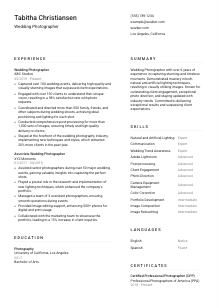
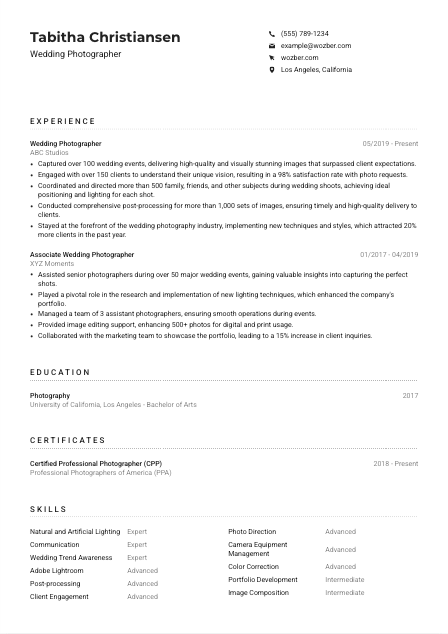
Include your phone number, professional email, and location. If the posting asks for a specific base, reflect it clearly. In the example, listing Los Angeles, California immediately supports the employer's stated location requirement. This is also the place to make sure your email address feels client-ready, since wedding work depends heavily on trust and responsiveness.
A website link is essential for photographers. Point employers to a current portfolio that shows full wedding coverage, not just a few standout portraits. Include galleries with candid moments, family formals, ceremony lighting, reception flash work, and consistent editing style. If your LinkedIn is active and relevant, you can include it too, but your portfolio should do the heavy lifting.
Skip age, marital status, headshots, and other personal information that does not strengthen your candidacy. Wedding photography hiring centers on experience, portfolio quality, communication, and reliability on event day. Keep this section tight so the reader moves quickly to the work that proves those points.
Your header should make three things immediately clear: who you are, how to contact you, and whether you meet any practical requirement such as location or portfolio access. That keeps the focus where it belongs, on your ability to photograph weddings well.




This is the section where wedding photography becomes concrete. Employers are looking for more than time served. They want signs that you have covered real events, handled changing lighting conditions, worked smoothly with couples and families, and delivered finished galleries on schedule. Your bullets should reflect the pace, judgment, and client care the job actually requires.
Read the posting for the parts that define daily performance. For this role, that includes natural and artificial lighting, candid and posed coverage, client communication, direction of groups, and post-processing. Those are not just keywords to echo. They are the core functions your experience section should demonstrate through specific wedding-day work and delivery outcomes.
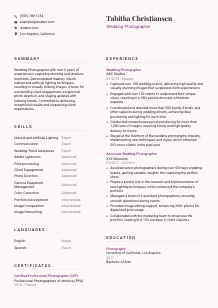
Start with your most recent photography role and include job title, studio or company name, and dates. If you moved from associate work into lead coverage, make that progression easy to see. In the example, the shift from Associate Wedding Photographer to Wedding Photographer helps show increasing responsibility for directing subjects, managing shoots, and owning final client delivery.
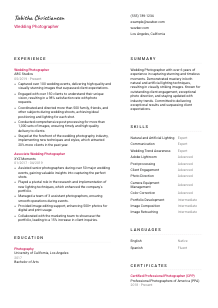
Each bullet should show what you handled and what happened because of it. Instead of saying you "photographed weddings," show volume, client response, lighting skill, delivery pace, or portfolio growth. The sample CV does this well with details like 100+ wedding events, a 98% satisfaction rate, and more than 1,000 edited image sets. Those numbers make the scale of the work easy to understand.
If you have broader photography experience, lead with the parts that matter in weddings. That usually means timeline coordination, family formals, candid coverage, flash and low-light reception work, client consultations, second-shooter management, album or gallery delivery, and retouching. Cut or shrink unrelated photography tasks unless they strengthen your case for handling live events and client expectations.
Keep bullets concise, front-load the action, and avoid long narrative blocks. Studios and hiring managers often review CVs quickly while comparing portfolios, availability, and event experience. Clean structure helps them find the essentials fast: how many weddings you covered, what level of responsibility you held, and whether your results show both technical control and client trust.
Your experience section should show that you can lead or support a wedding shoot from first consultation to final gallery delivery. When the bullets cover lighting, direction, client satisfaction, and finished output with real scope, the CV starts to read like someone who can step into an event day and perform.
Formal education is rarely the deciding factor in wedding photography, but it can still add useful context. A degree in photography, visual arts, media, or a related field can reinforce your technical foundation in composition, lighting, and editing. If your schooling is relevant, present it clearly and let it support, rather than overshadow, your event experience and portfolio.
Some wedding photography roles ask for a specific degree, while others care far more about portfolio quality and event experience. In this posting, education is not a stated requirement, so treat this section as supporting context. Keep the emphasis on training that strengthens your practical work behind the camera and in post-production.
List your degree, field of study, school name, and graduation year. That is enough for most photography applications. The example handles this cleanly with a Bachelor of Arts in Photography from UCLA. Clear formatting matters here just as much as elsewhere, especially if your CV is being screened through an ATS before it reaches a hiring manager.
If you are early in your career, coursework in lighting, portraiture, digital imaging, colour theory, or photo editing can strengthen this section. If you already have years of wedding work, keep those details brief unless they directly support a target role, such as advanced studio lighting or documentary photography techniques.
Exhibitions, student publications, visual storytelling projects, or photography club leadership can add value when they show initiative or technical growth. Use them selectively. The strongest additions are the ones that connect to real photographic judgment, client collaboration, or editing discipline rather than general campus involvement.
You do not need to turn this section into a transcript. Select the educational details that support your current wedding photography profile, whether that is visual training, editing knowledge, or early professional development. The point is to add context to your craft, not distract from the experience that gets you hired.
Education should quietly reinforce your technical and creative foundation. When it is concise and relevant, it supports the larger picture of a photographer who can handle both the artistic and practical demands of wedding work.
Certifications are optional in many wedding photography roles, but the right one can strengthen your CV. They work best when they support how you shoot, edit, or run client work, especially in a field where trust, consistency, and technical control matter as much as artistic style.
Choose credentials that reinforce wedding-relevant strengths such as professional standards, lighting, post-processing, or camera technique. A certificate like "Certified Professional Photographer (CPP)" fits naturally because it supports technical credibility in a client-facing photography business, even when the posting does not require certification by name.
Include the certificate name, issuing organisation, and date earned or renewal period. Keep the format simple so employers can read it at a glance. If the credential is active, say so. That small detail tells the reader you keep your qualifications current rather than listing old coursework as if it were still in use.
Wedding photography changes with style trends, editing expectations, and lighting approaches. Recent training in flash techniques, off-camera lighting, Lightroom workflows, retouching, or client workflow management can help show that your methods are current. That matters when employers want someone who can deliver work that feels contemporary, not dated.
List certifications that add professional weight, then stop. A short, credible section is stronger than a long list of loosely related courses. Update it as you renew credentials or complete training that clearly improves the way you shoot, edit, or serve wedding clients.
This section should reinforce trust in your technical standards and ongoing development. If a credential makes an employer more confident in your lighting, editing, or professional discipline, it belongs here.
The skills section should reflect how wedding photography actually works. That means balancing technical ability with client-facing execution. Lighting, editing, direction, and communication all matter because the job moves from quiet candid moments to fast group coordination to polished post-production, often in a single day.
Start with the employer's wording, then match it to your actual strengths. In this job description, that includes natural and artificial lighting, post-processing, communication, rapport with clients, and directing subjects. Those terms belong on the CV when you genuinely use them, because they describe the work and help your CV align with ATS screening.
Wedding photographers are hired for both image quality and the way they handle people. Include technical skills such as Adobe Lightroom, retouching, colour correction, flash lighting, composition, or camera equipment management alongside client engagement, photo direction, and communication. The example CV does this well by pairing editing and lighting skills with client-facing strengths.
Do not turn this into a master inventory of every photography term you know. Prioritise the capabilities that affect hiring decisions for wedding work. A clean list is easier to scan and more convincing than an overloaded one. If you use proficiency levels, keep them honest and reserve top ratings for skills you use confidently in live event conditions.
Your skills section should quickly show that you can create strong images, manage people well, and finish the work professionally. When those capabilities are easy to spot, the rest of the CV has stronger context.
Wedding photography is highly personal work. You are often guiding couples, coordinating family members, and handling requests in emotionally charged moments. If a posting names a language requirement, meet it clearly. Additional languages can also help if they genuinely expand the range of clients you can serve.
If the employer asks for English, list it clearly with an accurate proficiency level. This posting specifically requires conversational English, so that should appear on the CV without being buried. In client-facing photography roles, language ability affects consultations, timeline discussions, posing direction, and expectation management throughout the event.
Describe each language with standard terms such as Native, Fluent, Intermediate, or Basic. That gives employers a realistic sense of how well you can communicate with couples, guests, coordinators, and vendors. Avoid vague labels that sound impressive but do not tell the reader whether you can actually work in that language on a wedding day.
If you speak another language well, include it. In markets with diverse client bases, that can be a practical advantage during consultations and event coverage. The sample CV lists Spanish as Fluent, which works because it adds service range without distracting from the core requirement in English.
Do not overstate language proficiency in a role built on live communication. Wedding days leave very little room for confusion when you are organising group portraits or responding to client requests. A truthful rating protects both your credibility and the client experience.
Language skills are not decorative here. They affect rapport, direction, and calm communication during a fast-moving event. If your additional language ability helps you connect with more couples or work more smoothly with families and vendors, it is worth showing.
List languages with the same honesty and clarity you would use with a client. For wedding photography, strong communication can be as important as camera technique in keeping the day running smoothly.
Your summary should give an immediate sense of what kind of wedding photographer you are. In a few lines, show your experience level, your technical range, and the client-facing strengths that matter for live events. This is where you frame your value before the reader moves into the details of your portfolio and work history.
Start with the skills and responsibilities the employer cares about most. For this posting, that means wedding experience, lighting proficiency, artistic and technical quality, post-processing ability, and communication. Pull those ideas into your summary in natural language so the opening lines already match the kind of photographer they need.
Lead with your title and years of relevant experience. Be specific. "Wedding Photographer with 6+ years of experience" immediately tells the reader that you clear a key threshold for a role asking for at least 3 years. That first line should also place you firmly in wedding work rather than photography in general.
Choose strengths that reflect both craft and execution. Strong options here include working with natural and artificial light, capturing both candid and posed moments, maintaining high client satisfaction, or delivering polished post-production. The sample summary is on the right track because it combines lighting expertise, client engagement, and current trend awareness in a compact space.
Aim for three to five lines with no filler. Skip broad claims like "passionate professional" unless they are backed by something tangible. A hiring manager should finish the summary knowing your level, your style of contribution, and why your background fits a wedding photography workflow that runs from planning to final image delivery.
A well-written summary should quickly position you as someone who can shoot the event, work well with people, and deliver finished images at a professional standard. If those three points land early, the rest of your CV has a clear direction.
Once each section reflects the real demands of wedding work, your CV starts doing more than listing jobs. It shows that you can manage live events, adapt to changing light, direct people calmly, and deliver edited galleries clients will value. That is the combination employers need to recognize quickly.
Wozber can help you turn that experience into a sharper application with its free CV builder, ATS-friendly CV templates, and ATS CV scanner for stronger ATS optimisation. Use that structure to align your wording with the role, then make sure the final CV clearly shows the scale, style, and reliability of your wedding photography practice.




